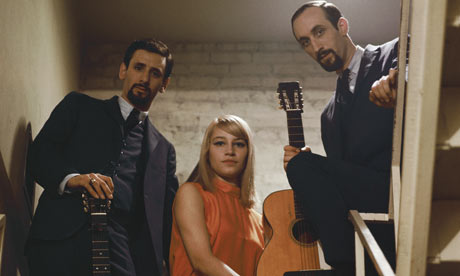
Two weeks ago, we looked at a song about a poor girl murdered by her lover; last week, we met two young women unfazed by men. This week, the logical progression proceeds to a lady who just will not be trifled with..."he was her man, but he done her wrong."
Both of my grandmothers played piano and sang, reflecting what was considered a proper social education for girls born as they were in 1892 and 1900. While most of their repertoires consisted of often long-forgotten popular songs from their childhoods, both occasionally drifted into performing what might be called a kind of derivative folk music, often Irish airs with rewritten American lyrics. Occasionally these ladies were capable of some surprises. My maternal grandma - a rather prim and conservative woman - would occasionally slip into a bit of honky-tonk or ragtime, and it was from her that I first remember hearing "Frankie and Johnny," a honky-tonk/ragtime classic if the genres ever produced one.
Most of the major folklorists like John A. Lomax and Carl Sandburg believe that F&J is very old for an American folk tune, probably pre-dating the Civil War, though others maintain that the spate of published versions in the first decade of the 20th century points to a later origin. It seems like a good bet, though, that the 1831 murder of Charlie Silver by his wife Frankie Stewart Silver (with an axe - ouch! - and in North Carolina again!) might well be the song's inspiration, since in the folkways of the region Mrs. Silver did in her husband in a jealous rage. In actual fact, Mrs. Silver (all of 17 at the time of the killing) pleaded self-defense in the face of an imminent threat from her drunken husband. While the jury initially refused to believe her, eventually seven of the members signed a petition to commute her death sentence on the grounds that she had in fact been abused. It didn't work, and Frankie Silver was hanged for the crime. A good brief summary of the case appears HERE.
An early version from 1927 of what has become the standard songbook version of the song is done here by Frank Crumit:
Now Crumit's lyrics are for the most part the old honky-tonk song, but fans of the "You're Gonna Miss Me/Leaving Home" version will recognize that Crumit interpolated some of those lines into the middle of his arrangement.
A chronological digression here. Around 1962, the great Bob Gibson rearranged F&J on his Where I'm Bound album that I profiled a few weeks back. Now the Bob Gibson Legacy site has uploaded a fine performance video of Bob doing the number HERE, but it can't be put on this page - so here is a trio called Dirty Dishes doing Gibson's arrangement:
In 1908, Frank Leighton and Boyd Bunch copyrighted a F&J version whose lyrics (some in Crumit's record) are very close to what banjo legend Charlie Poole and the North Carolina Ramblers came up with, again in the 20s:
I ran across of video of Fiddlin' John Carson doing this version at about the same time but lost it. If I find it again, I'll re-post it.
In turn, John Cohen, Mike Seeger, and Tom Paley of the New Lost City Ramblers adapted (and copyrighted) Poole's lyrics with a respectful vocal and instrumentally skillful version in about 1959:
Mike Seeger of the group next introduces (1980s vintage, I'd say) The Stillhouse Reelers doing a rendition that they adapted directly from Charlie Poole* with one difference that I believe to be significant and will deal with below - they do it a lot faster:
It was the NLCR version of the song that was the clear and direct inspiration for the Kingston Trio's re-named "You're Gonna Miss Me." We know this because Dave Guard copyrighted the song, including the names of Cohen, Seeger, and Paley. There is a YouTube video of a fragment of the KT rendition (again, non-embeddable) HERE; the full studio version sounds like this:
The KT gives the number its trademark full-speed, hell-bent-for-leather treatment (with an able assist from producer Voyle Gilmore, who brings up the musicians' instruments at the precise moment of their vocal solos before nicely re-blending on the choruses). Perhaps it was this that excited some of the distaste that NLCR John Cohen expressed for the group. In fact, Cohen once remarked (on the Woodsongs radio program, I believe) something to the effect that the only tradition that the KT seemed to have any respect for was that of a frat party. That leaves open the question, for me at least, of why a similar adaptation of the song by The Stillhouse Reelers above does not come in for similar censure - or why all these versions are using unattributed material that clearly came from Poole (who in turn seems to have heard and used the Leighton version). It's not really important because all of these versions are enjoyable. Just wondering.
Friday, December 10, 2010
Thursday, December 2, 2010
Of Bad Girls And Banjos: "Little Maggie"
The songs seem to be part of a family of "banjo blues" that are derived in part from genuine African-American blues in the wonderful melange of styles and sources that American folk music is. But the accompaniment structure - just two chords, typically a G to an F and then back again - is Euro all the way, closely resembling the rather mournful sounding mixolydian mode. That means essentially just that the songs use fewer notes than tunes written in our "normal" twelve note scale. And that's really easy to hear - both songs are even more repetitive than most other folk songs, eight bars repeated over and over, verse and chorus both.
Wherever it was that Corey and Maggie went their separate ways as songs, their recording histories continue to parallel each other. As noted in my "Corey" article linked above, that song was first waxed by Clarence Gill and later Buel Kazee in 1927 - the same year that Grayson and Whitter (of "Tom Dooley"fame) on October 1 laid down the initial "Little Maggie" recording, to be followed in 1937 by Wade Mainer, still with us at the age of 103. In the late 1940s, the Stanley Brothers covered the song, for the first time in the new bluegrass genre of which Ralph Stanley was one of the originators (more on this below).
Grayson and Whitter were a fiddle-guitar group, but "Maggie" has always been a favorite of banjo players because the very simplicity of its chord structure allows for a some genuine tour-de-force instrumental innovation. Classic Kentucky mountain banjoist Lee Sexton here plays the tune in a kind of pre-bluegrass picking mode:
Sexton seems to be playing here in some kind of modal tuning - again, a variation from what we normally hear. It's a kind of minor sound, and that changes the melody as well as the accompaniment.
Ralph Stanley plays the song in a straightforward bluegrass style - here he is interviewed by the late Mike Seeger of the New Lost City Ramblers:
Stanley's arrangement has become the template from which most subsequent recordings have been derived. I find it interesting in this video that Stanley is quietly trying to establish an independent origin for his banjo style, since by 1946 Earl Scruggs had established himself as the putative godfather of three-fingered banjo picking while he was a member of Bill Monroe's Bluegrass Boys. But the "forward roll" that Stanley demonstrates in the video is in fact markedly different from the standard Scruggs style of picking.
Now Dave Guard of the Kingston Trio was certainly no Stanley or Scruggs during the first week of February in 1958 when the KT recorded its first album and decided to close it with "Little Maggie" (last song on the B side for those who remember LPs) - and he knew it. Guard had been bitten by the banjo bug in 1956 while a graduate student at Stanford after he attended a concert by Pete Seeger (at which a fifteen-year-old Joan Baez was also in attendance). Prior to that, Guard was a guitarist all the way, quietly evolving his own style after having been taught the rudiments of the instrument by his high school pal and eventual KT partner Bob Shane. According to third Trio member Nick Reynolds, Shane and Guard searched the music stores of San Francisco in vain looking for a 5 string banjo - all they could find were 4 string tenor banjos used more commonly in Dixieland jazz and Big Bands rather than in folk-styled music. In stepped Reynolds' father, a captain in the U.S. Navy and a lover of all kinds of music, including old time mountain songs, and he gave Guard his own 1920s-era S.S. Stewart standard neck 5 string. Guard reportedly bought Seeger's How To Play The Five String Banjo and taught himself Seeger's primary style - the more traditional "frailing" or "clawhammer" approach to the instrument in which the strings are brushed in rhythmic combinations of different fingers rather than plucked as they are in bluegrass style. Here's what Davey came up with:
It's not a bad effort at all for a guy who's been playing the instrument for less than two years (if you can get past the gentle mockery of the "hilbilly" origins of the song that the group also employed that same year in their "Shady Grove" recording and blessedly omitted in subsequent arrangements of Appalachian tunes). The positively plunky sound of Guard's/Capt. Reynolds' banjo almost certainly comes from its having a calfskin head, a delightfully traditional sound when the air is dry but murder when it's humid, because the pressure from the strings forces the pliant calfskin to sink and consequently dulls the vibration and sound of the strings. I'm guessing there was rain in Los Angeles on that February day when the KT recorded this one at Capitol Records.
Ricky Skaggs has been outspoken in his dislike of the "commercial" turn that country music has taken, and he has built the second half of his career around both preservation and innovation of older mountain and country styles of music. Here he is performing "Maggie" in 1999 with Kentucky Thunder:
According to the album credits, the blazing banjo solo is by Marc Pruett - and the instrumentation overall is a good indication of why many country and bluegrass artists expressed such disdain for the (by comparison) primitive playing of most of the pop folk groups.
Contemporary bluegrass favorites The Grascals give us something in the same mode, though with a bit more emphasis on the instrumentals, if not at quite as breakneck a pace:
Maggie and Corey are clearly pursuing different paths. Corey is, after all, a moonshining entrepreneur, decidedly unromantic and apparently interested in men only for their money:
Don't care if you are living, don't care if you are dead
If you want a taste of my product, then I'm gonna take your bread.
We can assume the product is moonshine only, though you never know. But Maggie is clearly a good time girl, fun to be around but deadly to lose your heart over. In this regard, she has a lot in common with Woody Guthrie's nameless beloved in "Hard, Ain't It Hard, who continually
...sits down upon another's knee,
And tells him what she never will tell me.
Another cousin, perhaps? Little Maggie is, after all, continually "fooling another man" as well. In any event, all three ladies are clearly and in their separate ways thumbing their noses at convention and turning the tables on the menfolk. They all seem also to have a talent for self-preservation, and it's positively refreshing to have some folk songs where young ladies who refuse to conform to boys' rules don't end up shot through the heart lying dead on the ground. Maybe there is justice in the world after all.
Thursday, November 25, 2010
Murder Most Foul - "Poor Ellen Smith"
But this most foul, strange, and unnatural."
- Shakespeare, Hamlet
I would guess that many folk aficionados like myself have wondered at some point or other what sort of dark spirit was hovering over the hills and hollers of North Carolina in the 19th century that prompted so many notorious murders, marring the serenity of that otherwise lovely state. Tom Dula killed Laura Foster (maybe) in Wilkes County; Frankie Silver did in her husband in Morganton, Burke County; Omie Wise was hacked up by a jilted suitor near Asheboro; the nameless girl in "The Lone Green Valley" similarly met her end in a dark Carolina forest - and Ellen Smith was indeed shot through the heart and found lying dead on the ground in Winston-Salem. Each case spawned one or more memorable ballads that have enriched the American folk tradition. Still - I'd have to think twice before letting a daughter of mine go to school in Durham or Chapel Hill...maybe there's something in the water.
If anyone needs to be told - that last sentence is a joke. But as terrible as any murder may be - those killings in North Carolina that morphed into songs all have some especially tawdry or gruesome or pathetic element to them, none more so than the sad tale of the very real Miss Smith. Ellen Smith was 17 years old and seems to have been a maid at the Zinzendorf Hotel in Winston-Salem. Described in some records as "a mulatto," she was by most accounts something of a dark beauty - and likely developmentally challenged, as they say today. She fell afoul of a fast-talking ne'er-do-well ladies man named Peter DeGraff, who was likely also a hotel employee. Smith and DeGraff apparently had a baby together, though it died before it was a year old, and Ellen was again pregnant when DeGraff apparently sent her a note (since lost) in July of 1892 to meet him in the woods behind the Zinzendorf. Smith went, probably expecting a marriage proposal. What she got was the bullet through the heart described in her song - and at close range, too, as the powder burns on her apron attested.
DeGraff was the only real suspect, as their affair was widely known, but for some reason lost in the mists of time the county sheriff refused to arrest DeGraff, who remained free until a newly-elected top cop cuffed the suspect in April of the following year. DeGraff pleaded innocent and maintained that he returned to the scene of the crime on the day of his arrest to try to summon the late Miss Smith's spirit. That didn't go over very well with the jury, which took twelve hours to convict him. Appeals subsequent to the trial proved fruitless, and DeGraff kept his date with the hangman on February 8, 1894.
The incident led to the composition of two very different songs, one rather dour and narrated by the character of DeGraff, much like the verses of "Tom Dooley"; the other is an oddly uptempo number more typical of country fiddle dance tunes. It is the latter whose lyrics are the more familiar, though as we will see, our recording artists often spliced a new version from the two. The full lyrics to both are HERE.
We know of the song today largely through the efforts of folklorist, performer, and YMCA executive director Frank Warner, who also rescued "Tom Dooley" from regional obscurity and helped make it a national phenomenon. In the best John J. Lomax-Carl Sandburg-Pete Seeger tradition, Warner traveled around the Appalachians with his tape recorder and, yes, his automatic copyrighting machine. It was Warner who heard the gifted Frank Proffitt strum the version of the Dooley song that Proffitt had learned from his grandmother, a woman who knew the Melton and Foster families who were involved in the murder case, and it was Warner's re-arrangement that became the basis for the Kingston Trio's version. But Warner also recorded a number of Proffitt's neighbors, one of whom named Homer Cornett sang this for Warner:
Warner's collection of field recordings, including this one, has recently been released on Appleseed Records. The rustic authenticity of Cornett's singing is something I find oddly appealing - wouldn't want a steady diet of it, though.
A truly surprising number of other artists have covered the song. The Kossoy Sisters, darlings of late 1950s Greenwich Village and a duo whom I've used in other posts, recorded the song in the mid-50s with legend Erik Darling adding a fine clawhammer banjo part to their guitar accompaniment:
The Kossoys are both still with us and occasionally reunite for a few shows.
Speaking of clawhammer, here is a talented amateur known only on YouTube as "LongbowbanjoAL" with some fine picking:
You could practically predict that the Kingston Trio would take a swing with their trademark uptempo, high-energy approach - and they do here:
Odd it is how gleeful the guys sound on the chorus. As always, the Trio is preserving a sort of PG image with lyric changes: in the original, it is Ellen's clothes that are mangled and all cast around, but the obvious sexual implication of that is undone when the Kingstons cheerfully substitute the gruesome "body" for the garments. But in a retreat from the ghastly, someone in the group figured that "X marks the spot" was more acceptable than the original "blood marks the spot" - though what with Ellen's body now mangled and all...And of course, here our speaker is not only innocent but is also about to be released from prison in the last verse, a more palatable conclusion than a body swinging at the end of a rope. Not as always, Trio banjoist John Stewart has also made a substitution on this song and the whole New Frontier album: he is playing a Gibson RB-100 long neck banjo rather than his usual Vega Pete Seeger model. The boxy, plunky sound of the Gibson passes muster (barely) on some other songs on the record like "Long Black Veil" (another murder ballad but not indigenous to North Carolina) but the ringing sustain of the VPS is clearly what is called for here - and is sadly missed
A few weeks back, resident folklorist Jeremy Raven pinch hit for me one week and introduced the thought that Wilma Lee Cooper was the bluegrass equivalent of the KT's Nick Reynolds - the same enthusiastic approach to vocals and even more the almost unbelievably high energy sustained rhythm strumming. Take a look:
Jeremy really nailed that one right on the head - a great performance, positively Reynoldsesque.
And speaking of the late, great Nick - consider this version from contemporary bluegrass up-and-coming stars Crooked Still, whom I've also employed in these posts before:
I hope everyone noticed as the camera pans left that the rhythm guitarist is playing - a tenor guitar, just like Reynolds. I also always like to hear songs usually done by men performed by women.
I suppose that one reason that gruesome murders seem to spawn folk songs (going back centuries at least as far as "Lord Randall" and likely farther) is that singing the ballads stimulates a catharsis of sorts - a purgation of shock and horror rather than pity and terror. Or maybe the fates of both victim and killer are intended to serve as warnings - to the wayward girls who are usually the victims and to the dark and violent men who usually do the deeds. Then again, there is something about creative representations of all sorts that propels the real awfulness of violence into the higher realm of art. Good thing that it does, or none of us would ever watch a western or a war movie - or listen to "Tom Dooley" or "John Hardy" or "Poor Ellen Smith."
Friday, November 19, 2010
"The Thread That Runs Through It All" - The Music Of Bob Gibson
This is a picture of one of the greatest folk albums that you may have never heard by an artist that you may have forgotten. Before the other Bobs (Shane of the Kingston Trio, Flick of The Brothers Four, and Dylan of Greenwich Village and points west), there was Bob Gibson, who sang, picked, and strummed his take on folk music into the consciousness of more young musicians than any other soloist of his era except for Pete Seeger himself. On our KPFK radio folk show last Saturday, my friend and co-host Art Podell (formerly of Art&Paul and the New Christy Minstrels) remarked that Gibson's work was the thread that ran all through the entire folk movement, and this is easy to demonstrate. Take a look:
This is an assemblage of musicians in Nashville in 1994 who gathered for a fundraiser for Gibson's medical expenses in what would prove to be his final illness (he died two years later). They called it a "class reunion" because all of them owed at least some of their musical development to Bob. Yes, that's Tom Paxton, Peter Yarrow, John Hartford, and Emmylou Harris in the back row, Oscar Brand and Ed McCurdy flanking Gibson center with Glenn Yarbrough on the right, Shel Silverstein and Josh White, Jr. in the front. You could easily add John Denver, Gordon Lightfoot, and Leo Kottke to the group because all have acknowledged patterning their 12-string guitar styles after Gibson. To say that it is an impressive group is to beat understatement to death.
I wrote a bit about Bob Gibson last April in an article about his song "To Morrow", and the details about his career and his arrangement of that number are there to see. I want this week's post to be about his music because it is not heard nearly widely enough any more. Gibson's daughters (one of whom is prominent folk performer Meridian Green, who toured with her father and Tom Paxton in the 1980s) have a wonderful site in his memory called Bob Gibson Legacy, and it is more comprehensive than I could ever hope to be. They have uploaded some fine performance videos on YouTube here, but they have disabled "embedding" so I cannot post them to appear on this page. Too bad, because they include some of his best songs.
But we have some quality Gibson material to post nonetheless, as well as some fine versions of several of his compositions by other groups. I want to start with the title song from the album above - though since this article was written, that video has lost its embeddable status, so here is the link to YT - well worth a click:
Bob Gibson - "Where I'm Bound"
He could absolutely play the hell out of a 12-string. On Where I'm Bound he has a "12 String Guitar Rag" that'll flatten you - and if you want to hear the roots of what Lightfoot, Denver, and Kottke have done with the instrument, that number is a must-listen. The entire album can be downloaded for about $8 on Amazon, and as soon as I finish this post, it will become the first entire .mp3 album I will have purchased on the web.
One of Gibson's best-known and most-often covered compositions is the modern spiritual "Well, Well, Well," which he composed and performed with Bob (Hamilton) Camp for the first time at the 1960 Newport Folk Festival:
The uploader implies that this is the recording from the duo's legendary At The Gate Of Horn album, but let me assure you - this is the Newport recording, with Dick Rosmini (another fabulous 12 and 6 string guitarist) and bassist Herb Brown backing them up.
One of the best-loved cuts from the Horn album was Gibson's "Civil War Trilogy," the middle song of which ("Yes,I See") was the title song of Gibson's previous album.
As I noted in the article on "To Morrow," Gibson launched the career of the then-eighteen year old Joan Baez by bringing her to Chicago to open for him at the Gate of Horn (of which Gibson was part owner) and then with a dramatic showman's flair bringing her up from the audience to sing with him at the first Newport Folk Festival in 1959. This song was the first time that most of America would learn of Baez's incredible voice:
I posted this version of "Good News" when I wrote the article on the song - but you just can't write a post about Bob Gibson without a banjo song with BG's Seeger-influenced audience involvement approach:
.
Gibson could also write wonderfully tender songs as well, and our first venture into a Gibson number performed by other artists is this version of his "Blues Around My Head" by the Chad Mitchell Trio from their live At The Bitter End album:
That outstanding album also included another Gibson composition, likely his other most often covered song, "You Can Tell The World." The CMT did a bang-up job on the song - but so did Australia's Seekers, a group strongly influenced by Gibson. They also performed nearly his exact arrangement of "This Little Light of Mine," which you can check out in my article on it here. But for now - The Seekers with "World" -
Simon and Garfunkel from their first album with their version:
And again, from our friends from the University of Tennessee, the Cumberland Trio, veterans of Hootenanny and a successful showbiz run for several years, here from their 2004 reunion concert:
It would fall somewhere between truism and cliche to say at this point that fame is fleeting and that all things must pass. But I find that of all the artists of the 50s and 60s whose music has been overshadowed by what passes as pop culture today, it is the neglect of Bob Gibson that is personally especially painful for me. I spent an incalculable number of hours as a boy reveling in the virtuosity, the scope, and the sheer ebullient love of life of this man's music. I saw him in person a few times as well, later in the 70s while he was battling his various addictions. When he got up to perform, though - all the trouble fell away, and he became the one and only Bob Gibson, master folk performer, who deserves much better of a world he helped to enrich with his talent.
This is an assemblage of musicians in Nashville in 1994 who gathered for a fundraiser for Gibson's medical expenses in what would prove to be his final illness (he died two years later). They called it a "class reunion" because all of them owed at least some of their musical development to Bob. Yes, that's Tom Paxton, Peter Yarrow, John Hartford, and Emmylou Harris in the back row, Oscar Brand and Ed McCurdy flanking Gibson center with Glenn Yarbrough on the right, Shel Silverstein and Josh White, Jr. in the front. You could easily add John Denver, Gordon Lightfoot, and Leo Kottke to the group because all have acknowledged patterning their 12-string guitar styles after Gibson. To say that it is an impressive group is to beat understatement to death.
I wrote a bit about Bob Gibson last April in an article about his song "To Morrow", and the details about his career and his arrangement of that number are there to see. I want this week's post to be about his music because it is not heard nearly widely enough any more. Gibson's daughters (one of whom is prominent folk performer Meridian Green, who toured with her father and Tom Paxton in the 1980s) have a wonderful site in his memory called Bob Gibson Legacy, and it is more comprehensive than I could ever hope to be. They have uploaded some fine performance videos on YouTube here, but they have disabled "embedding" so I cannot post them to appear on this page. Too bad, because they include some of his best songs.
But we have some quality Gibson material to post nonetheless, as well as some fine versions of several of his compositions by other groups. I want to start with the title song from the album above - though since this article was written, that video has lost its embeddable status, so here is the link to YT - well worth a click:
Bob Gibson - "Where I'm Bound"
He could absolutely play the hell out of a 12-string. On Where I'm Bound he has a "12 String Guitar Rag" that'll flatten you - and if you want to hear the roots of what Lightfoot, Denver, and Kottke have done with the instrument, that number is a must-listen. The entire album can be downloaded for about $8 on Amazon, and as soon as I finish this post, it will become the first entire .mp3 album I will have purchased on the web.
One of Gibson's best-known and most-often covered compositions is the modern spiritual "Well, Well, Well," which he composed and performed with Bob (Hamilton) Camp for the first time at the 1960 Newport Folk Festival:
The uploader implies that this is the recording from the duo's legendary At The Gate Of Horn album, but let me assure you - this is the Newport recording, with Dick Rosmini (another fabulous 12 and 6 string guitarist) and bassist Herb Brown backing them up.
One of the best-loved cuts from the Horn album was Gibson's "Civil War Trilogy," the middle song of which ("Yes,I See") was the title song of Gibson's previous album.
As I noted in the article on "To Morrow," Gibson launched the career of the then-eighteen year old Joan Baez by bringing her to Chicago to open for him at the Gate of Horn (of which Gibson was part owner) and then with a dramatic showman's flair bringing her up from the audience to sing with him at the first Newport Folk Festival in 1959. This song was the first time that most of America would learn of Baez's incredible voice:
I posted this version of "Good News" when I wrote the article on the song - but you just can't write a post about Bob Gibson without a banjo song with BG's Seeger-influenced audience involvement approach:
.
Gibson could also write wonderfully tender songs as well, and our first venture into a Gibson number performed by other artists is this version of his "Blues Around My Head" by the Chad Mitchell Trio from their live At The Bitter End album:
That outstanding album also included another Gibson composition, likely his other most often covered song, "You Can Tell The World." The CMT did a bang-up job on the song - but so did Australia's Seekers, a group strongly influenced by Gibson. They also performed nearly his exact arrangement of "This Little Light of Mine," which you can check out in my article on it here. But for now - The Seekers with "World" -
Simon and Garfunkel from their first album with their version:
And again, from our friends from the University of Tennessee, the Cumberland Trio, veterans of Hootenanny and a successful showbiz run for several years, here from their 2004 reunion concert:
It would fall somewhere between truism and cliche to say at this point that fame is fleeting and that all things must pass. But I find that of all the artists of the 50s and 60s whose music has been overshadowed by what passes as pop culture today, it is the neglect of Bob Gibson that is personally especially painful for me. I spent an incalculable number of hours as a boy reveling in the virtuosity, the scope, and the sheer ebullient love of life of this man's music. I saw him in person a few times as well, later in the 70s while he was battling his various addictions. When he got up to perform, though - all the trouble fell away, and he became the one and only Bob Gibson, master folk performer, who deserves much better of a world he helped to enrich with his talent.
Friday, November 12, 2010
1963
I've been working on preparing an upcoming public radio program for this Saturday (11/13/10), the second show that will feature again Joe Frazier of the Chad Mitchell Trio, Art Podell of the New Christy Minstrels , myself (variously described in the promos as "folk blogger," "folk musicologist," "member of the Chilly Winds," "folk historian," and other less complimentary sobriquets) - with the welcome addition this time of none other than George Grove of the Kingston Trio.
The show will air from 6am-8am PST on Saturday, 11/13. For Southern California listeners - it's at 90.7 FM - with a live feed on the internet at blessedly later times in other zones here:
KPFK-FM Live Feed Link
Since I got to help organize the show (the actual producer and on-air host most weeks is Mary Katherine Aldin, who produced thirty CD/albums from the Vanguard tapes of the Newport Folk Festival in the 50s-60s, including 1993's The Kingston Trio: Live At Newport) - I nominated as the theme the music of 1963, a pivotal year in the careers of Joe and Art, for folk music and the nation in general as well.
Each of the four of us will take about a half hour to present a selection of the music that Joe and Art were involved in making that year and that George and I were listening to. It occurred to me that without stepping on the toes of the show itself and publishing our song list, I could present here this week a sort of parallel set of songs and videos, most of which are not actually to be featured in the show, but that make a fine set of songs to listen to anyway.
I will say that not surprisingly Joe, Art, and George have each cited the cataclysm of November 22, 1963 as central to their memories of that year - and for who of us alive at the time would that not be so? Some of the songs they have selected for the NPR show are related to that event, and like many others I have always believed that the Kennedy assassination was the death of a kind of American optimism and innocence from which we have never completely recovered, the day "when they blew the dreams away," as John Stewart wrote.
But lest we forget - the year opened in a kind of exhausted relief that we hadn't blown the whole damn world away two months earlier in October of 1962 over Cuba. It seemed to climax two months before JFK's death in one of the greatest and most positive moments in American history, a moment whose soundtrack, as people like to say now, was folk music. So return with us now to the hope and despair of that pivotal year...
...which opened with a legitimate folk singles hit by the Kingston Trio:
The chorus as written by the great Hoyt Axton, of course, went "I don't give a damn about a greenback dollar" - a line deemed objectionable by the wise old suits at Capitol records, who insisted that the "damn" be replaced by the guitar strum that you hear here. The cut on the KT album New Frontier included the real lyric; the video above is an upload of the 45rpm single version.
In early '63, folk music seemed to be everywhere, performed by some really talented people. Near the top of that list was The Limeliters featuring (l-r in the video) Alex Hassilev, Dr. Lou Gottlieb, and Glenn Yarbrough. Like the Kingstons, they had a wonderful way with smoothly commercialized versions of traditional songs, as here, as well as a slightly caustic wit that made them distinct from the other folk acts:
This show was broadcast on VARA TV in the Netherlands, reflecting the international popularity of the U.S. folk revival.
Folk music also had its short-lived moment in the primetime limelight of American television with the April 6, 1963 debut of ABC's often schlocky Hootennany broadcast. Though there were some really great performances in the season and a half of that show (many of which, including the ones below, appeared on the recently-released DVD collection), the suits at ABC decided to observe the blacklist of Pete Seeger and refused to put the godfather of American folk music on the only network show ever broadcast that was putatively devoted to the genre. This led to a boycott of Hootenanny by the three biggest names in folk show business at the time - the Kingston Trio, Joan Baez, and Peter, Paul and Mary - as well as a goodly number of other folk performers as well.
It is worth noting, though, that while Seeger appreciated the support generated by the boycotting groups, he in fact urged folk performers to go on the show, believing as he said that any exposure of folk music to the mass American audience was a good thing. That explains why good friends of his like Theo Bikel and admirers like Judy Collins and the Chad Mitchell Trio felt comfortable to appear on the show even while they objected to the blacklisting.
One of the groups that appeared on Hootenanny that was even more aggressively non-political than the general approach of the KT was the New Christy Minstrels, who had a huge singles hit with this song:
I'd have to describe this as "bubble-gum folk," really catchy and well-performed - but if you chew on it too long.... The song has always been a pleasure for me akin to reading a good potboiler novel - totally engrossing for as long as it lasts.
The supremely talented Journeymen of future Papa John Phillips, Scott McKenzie, and Dick Weissman also appeared several times - here performing a song by Weissman later covered by the Kingstons. The lead vocal is the sweet tenor of the lamentably departed McKenzie:
One of my all-time favorite solo performers, Bob Gibson, also appeared on several shows. This is Bob at his infectious best. The live performance videos of Gibson can't be embedded, but they are emminently worth seeing and a worth a click. Here is one of Bob's best, the title song from a 1963 album:
Bob Gibson: "Where I'm Bound"
The Tarriers were also on that show, and yes, that's the great Eric Weissberg (later of "Dueling Banjos" fame) sitting behind Gibson and noodling along on the mandolin.
Any discussion of folk music in 1963, though, has to climax with the phenomenal success of Peter, Paul and Mary, who that year surpassed the Kingston Trio as the leading sellers of folk albums in the U.S. While the Kingstons had remarkable overall longevity (their debut album spent an astounding 195 weeks on the Top 200 charts) - PP&M's debut album spent 84 weeks in the Top Ten and was joined for a period of time there by their next two albums, Movin' and In The Wind, both of which were released (early and late) in 1963.
Beyond album sales, however, PP&M brought a kind of artistic legitimacy to folk music by appearing (reportedly at the request of Martin Luther King himself) at the August 1963 civil rights March on Washington. Appearing shortly after King's "Dream" speech, they opened with the Pete Seeger-Lee Hays classic "Hammer Song" and followed it with Bob Dylan's "Blowin' In The Wind - the order of the songs as played that day is reversed in this video:
They also performed a lovely version of "Blowin' In The Wind," but the only video on YouTube of that performance is absolutely ruined by commentary inserted over and interrupting what should have been an archival recording of one of the most sublime moments in the history of American music.
PP&M were also the prime attraction at the Newport Folk Festival that same summer - and they opened their set on the final night of the festival with an even more stirring rendition of "Hammer":
It is also thanks largely to those massive PP&M record sales that America came to know this song and its skinny, nasally, 22-year-old composer:
Our radio show on Saturday will go deeper into the year and present some of the music that bore a distinct connection to the Kennedy assassination. But even a casual folk fan looking at the performances above cannot help but remember what a marvelous and terrible year that was....
Subscribe to:
Posts (Atom)