It was the best of times, it was the worst of times, it was the age of wisdom, it was the age of foolishness, it was the epoch of belief, it was the epoch of incredulity, it was the season of Light, it was the season of Darkness, it was the spring of hope, it was the winter of despair...
- Charles Dickens, A Tale Of Two Cities, 1859
Probably no one ever expressed more succinctly the permanent and apparently unchanging nature of the human condition as did Dickens here in this justifiably famous opening to a marvelous and romantic novel (that, parenthetically, most of us were forced to read when we were much too young to appreciate or understand it). Consider: Dickens was writing in the middle of the 19th century about events late in the 18th, but here in the early reaches of the 21st the sentiment still rings true. We are as beset by war and economic woes and uncertainty and political madness in 2012 as we have been at any and every other time in our lives - and as in fact people have always been, everywhere.
Yet that sense that the world and its troubles always remains the same - plus ça change, plus c'est la même chose, as the French say - is deceptive, perhaps even illusory. Things do change, and sometimes for the better. Consider again: while the state of race relations in the U.S. today may be abysmal, with frequent reminders of such in the media (for example, the recent stories of racist notes on meal recepits at fast food restaurants), would any of those of us old enough to remember the 1950s and 60s not agree that we live in a much better, more just, more equitable country now than we did fifty or sixty years ago? Have there not been very real and very significant gains made toward establishing the justice and insuring the domestic tranquility that have been our objectives since the beginning of the nation?
Likewise, a girl born in the United States today, or in fact at nearly any time over the last forty or so years, has a universe of greater choices available to her than virtually any of her female forbears did, even here in the land of the free. Traditional avenues of motherhood and domestic life are still open to her, but her direction, her sense of herself, her range of possibilities are not as completely circumscribed by those older roles as they once were. Prior to the mid-20th century, marriage was the only game in town for women - it was marriage, even a bad one, or poverty. In the U.S. and everywhere else, a woman could neither own real property nor inherit it, and the only guarantor of a good life for her children was the support of a financially stable man.
Women of my mother's or even my sisters' generations who wanted a career for themselves in addition to or in place of family life were often swimming against a current of resistance, sometimes obvious, perhaps more often passive or disguised, as in the proverbial glass ceiling. The young women of today, though, and here I am including the ladies grown into maturity during the thirty years I taught in all-girls schools, believe and live as though full equality with men in opportunity and achievement is their birthright, as of course we now recognize it to be.
All of this is what makes this week's song, known by many names but most commonly as "The Old Maid's Song" or "Take Her Out Of Pity," both clearly archaic in its situation yet still profoundly moving in its sentiments. It is, as with several other songs profiled here recently, very old - the first printed version called "The Poor Auld Maid" appeared in 1636, and like most really old songs, there are many variant versions. In some, it is the lady herself who is speaking, so the chorus (nearly always a variation on "Come a landsman, a pinsman..."*) climaxes with "take me out of pity"; more often, though, it is a melancholy and concerned brother who seeks for his sister a better fate than the poverty and scorn of old maid-hood. The song works better this way, I think, since the third verse extolling her virtues seems less like the bragging it would be were she singing it than it does like the high and sincere estimation of a loving sibling.
Some early versions have the girl eventually marrying a chimney sweep; others, like the related Scots reel "The Old Maid In The Garrett" with a verse virtually identical to our song's chorus, make bitter fun of the lonely and not-so-young lady. The likely author of the root song, 17th century London balladeer Martin Parker, called it "The Wooing Maid," had her singing it, and included eighteen verses. By the time the song crosses the Atlantic, though, it seems to have reduced itself to the three verses presented in the versions below as it burrowed its way into the folk culture of the southern mountains.
It seems as if the American folk revival singers who did the number heard it first in a recording by Peggy Seeger from 1955, a sample of which can be heard on Amazon HERE. The first version I heard was by the Kingston Trio in 1961. There were two video uploads of the song on YouTube (including one from me), but Capitol/EMI has been cracking down recently (a post on that upcoming) and these videos are now blocked in the U.S.
However - my own folk group the Chilly Winds based our version instrumentally and vocally on the KT's, so this is a fair approximation of what I heard fifty years ago:
We moved the instrumental to the middle of the song and ended with the intro redux instead of on the V7th chord, but otherwise that's pretty much what the Trio did.
Flash! - 5/27/13: Capitol has been good enough to lift the replay ban on many Kingston Trio tracks - so here is the 1961 recording by that group.
Interesting to compare to The Chilly Winds - a few differences in the approach.
Another major pop folk group gave the song the other spin - here it is sung as "The Old Maid's Lament" by The Womenfolk:
The grainy video is annoying, but it is interesting to hear it sung in Martin Parker's originally-conceived feminine voice.
Clive Palmer is an English folkie, co-founder of The Incredible String Band, and just as his contemporary UK rock musicians like Eric Clapton made themselves masters of American rhythm and blues, Palmer became a 5-string banjo virtuoso:
Wonderful mountain frailing here, and Palmer's spare, unadorned accompaniment has an expressively authentic feel to it.
Ireland's Wolfe Tones, perhaps my favorite Celtic group after the Clancys and the Dubliners for their unabashedly radical Irish republican songs, give it an almost predictable gusto:
This is from a 1966 album; I was reminded of nothing other than the Clancys' delightful version of "Nancy Whiskey" in rhythm and harmonies.
The song has some legs, as we see now - because the next two versions are international. First, a semi-pro band from Madrid called Wenaives:
They sing better in English than I do in Spanish, for sure - it just strikes me as a curious song to cover for an Iberian band. Perhaps it is the simple C-Am-F-G7 chord pattern that is so characteristic of American '50s pop ballads.
That might equally be the case for this homage to the Kingstons' version (note the instrumental part) from Christine and Flora in China:
I always enjoy videos of people making folk music at home, and I think that the ladies do a fine job, again given the difficulty of singing in a language not their own.
It would be lovely if this song were merely a plaintive relic of a time long gone, and thank all the powers that be that it is so in the America of today. The sad fact is, though, that across the globe the desperate plaint of this song remains a stark reality for hundreds of millions of women, even in this century.
*No sources are quite sure what a "pinsman" is - some versions of the song say "tinsman" or "tinsmith," which are self-evident, and others suggest that the correct word is "pensman," or scribe or secretary.
Showing posts with label CloseUp. Show all posts
Thursday, January 12, 2012
Wednesday, January 5, 2011
Edric Connor And "The Virgin Mary Had A Baby Boy"
When I was deciding which song to profile for my Christmas post two weeks ago, my final decision came down to either "The Last Month Of The Year" or "The Virgin Mary Had A Baby Boy." I chose the former because I thought that the blues/gospel approach of that song was an arrestingly different take on Nativity music than we are normally used to. For all that, though, I could have chosen "Virgin Mary" because it is equally unique as what its collector Edric Connor termed "the only West Indian negro carol I found" in his 1945 collection The Edric Connor Collection of West Indian Folk Songs and Tunes.
With a few different breaks, Trinidad-born Edric Connor (1913-1968) might well have been what Harry Belafonte became. Connor was both a collector (as above) and a performer in Jamaica and for the greater part of his life in Britain. A decade before Belafonte's landmark Calypso album (the first LP to be certified as having sold a million units), Connor was popularizing the genre with a series of recordings including a December 1955 album (praised in a brief review in Billboard HERE) with the same title as Harry B's but pre-dating it by half a year - and underselling it by several hundred thousand copies. Connor was also the first artist to record in 1952 the song that Bob Gibson heard in 1954 and that both he and the Tarriers recorded later in the decade, the song that became the signature hit for Harry Belafonte and that is still heard ad infinitum in ball parks across the land today - "Day-O." Here is Connor performing the song that he collected on the docks in Jamaica:
Fans of contemporary African music cannot help but notice the similarity of Connor's back-up chorus here to Ladysmith Black Mambazo's harmonies. And Kingston Trio fans clearly owe a kind of distant debt to Connor as well, since it was the calypso craze initiated by Belafonte's popularity (and Harry B. acknowledged some influence from Connor) that initially brought the group together.
"The Virgin Mary" might well have languished in Connor's fairly obscure 1945 book had it not been picked up by a group called The DePaur Chorus, who released an album called Calypso Christmas in 1956:
Following the DePaur group, both Belafonte and the second troupe of the Weavers with Erik Darling waxed the number in 1958. Harry B. gave the song his familiar "gentle calypso" treatment that you hear in "Jamaica Farewell", and the Weavers went a capella with percussion supplied by Fred Hellerman thumping the body of his guitar like a conga drum. Belafonte mutes the syncopation a bit in this excellent version:
With the mega-stars Belafonte and the Weavers recording the tune, it was not long before other purveyors of popular folk music also began recording "Virgin Mary." Each retained some elements of the song's calypso origins, but to very different effect. The loveliest melodic version belongs hands down to the Chad Mitchell Trio, who included it in their 1964 Reflecting album:
Seldom in this group's recording history are the trained voices of Mitchell, Kobluk and Frazier showcased to better effect, and note that the instrumental syncopation alternates between John Frigo's bass lines and Paul Prestopino's guitar bridges into the chorus.
The Kingston Trio did not include the song on its Last Month Of The Year Christmas album - strangely so, I would venture, because as a calypso carol this number would have fit beautifully into the aggregation of unusual folk tunes included in that wonderful record. Instead, titled "Glorious Kingdom," it appears in an unusual and definitely non-calypso arrangement in the group's first album with John Stewart:
The line-by-line of addition of each voice in the verses is a nice touch, as is the use of a 12-string guitar for instrumental breaks. Again, the bass (here played by David Wheat on his last recording with the KT) provides the rhythm that connects this rendition however distantly with calypso music. It is definitely an odd take on the tune, especially for a group that cut its teeth on calypso, and I have often wondered if this was an experimental arrangement by the recently-resigned Dave Guard, who had always had a taste for the innovative and unusual.
"The Virgin Mary" has also been a staple since the 50s of choruses and "serious" performers - like New Zealand's Maori-descent opera star Kiri Te Kanawa:
Note: The copyright cops have removed Ms. Te Kanawa; if she returns, I will re-post her version.
Te Kanawa does a creditable job here with a song outside of her normal performing perimeter. She is a real diva - and by this I do not mean the vulgarized pop definition of the word. I mean what the term actually means - a female opera star of surpassing ability and accomplishment.
Gospel groups have also quite naturally gravitated to the song - here, a sprightly and joyous rendition by the Bill and Gloria Gaither group:
An interesting mix of Southern white gospel with a healthy dose of Caribbean-inflected soul.
Finally - because I like to believe that folk music may yet survive the onslaught of the truly bastardized and vulgar pop culture that has overrun our land in this day and age (and tongue is ever so slightly in cheek here), here is a fine performance from three weeks ago by Basket Landing, a real honest-to-God folk group out of the East Ridge School, in New York, I believe:
Praise the Lord! - there may be hope yet for These United States!
With a few different breaks, Trinidad-born Edric Connor (1913-1968) might well have been what Harry Belafonte became. Connor was both a collector (as above) and a performer in Jamaica and for the greater part of his life in Britain. A decade before Belafonte's landmark Calypso album (the first LP to be certified as having sold a million units), Connor was popularizing the genre with a series of recordings including a December 1955 album (praised in a brief review in Billboard HERE) with the same title as Harry B's but pre-dating it by half a year - and underselling it by several hundred thousand copies. Connor was also the first artist to record in 1952 the song that Bob Gibson heard in 1954 and that both he and the Tarriers recorded later in the decade, the song that became the signature hit for Harry Belafonte and that is still heard ad infinitum in ball parks across the land today - "Day-O." Here is Connor performing the song that he collected on the docks in Jamaica:
Fans of contemporary African music cannot help but notice the similarity of Connor's back-up chorus here to Ladysmith Black Mambazo's harmonies. And Kingston Trio fans clearly owe a kind of distant debt to Connor as well, since it was the calypso craze initiated by Belafonte's popularity (and Harry B. acknowledged some influence from Connor) that initially brought the group together.
"The Virgin Mary" might well have languished in Connor's fairly obscure 1945 book had it not been picked up by a group called The DePaur Chorus, who released an album called Calypso Christmas in 1956:
Following the DePaur group, both Belafonte and the second troupe of the Weavers with Erik Darling waxed the number in 1958. Harry B. gave the song his familiar "gentle calypso" treatment that you hear in "Jamaica Farewell", and the Weavers went a capella with percussion supplied by Fred Hellerman thumping the body of his guitar like a conga drum. Belafonte mutes the syncopation a bit in this excellent version:
With the mega-stars Belafonte and the Weavers recording the tune, it was not long before other purveyors of popular folk music also began recording "Virgin Mary." Each retained some elements of the song's calypso origins, but to very different effect. The loveliest melodic version belongs hands down to the Chad Mitchell Trio, who included it in their 1964 Reflecting album:
Seldom in this group's recording history are the trained voices of Mitchell, Kobluk and Frazier showcased to better effect, and note that the instrumental syncopation alternates between John Frigo's bass lines and Paul Prestopino's guitar bridges into the chorus.
The Kingston Trio did not include the song on its Last Month Of The Year Christmas album - strangely so, I would venture, because as a calypso carol this number would have fit beautifully into the aggregation of unusual folk tunes included in that wonderful record. Instead, titled "Glorious Kingdom," it appears in an unusual and definitely non-calypso arrangement in the group's first album with John Stewart:
The line-by-line of addition of each voice in the verses is a nice touch, as is the use of a 12-string guitar for instrumental breaks. Again, the bass (here played by David Wheat on his last recording with the KT) provides the rhythm that connects this rendition however distantly with calypso music. It is definitely an odd take on the tune, especially for a group that cut its teeth on calypso, and I have often wondered if this was an experimental arrangement by the recently-resigned Dave Guard, who had always had a taste for the innovative and unusual.
"The Virgin Mary" has also been a staple since the 50s of choruses and "serious" performers - like New Zealand's Maori-descent opera star Kiri Te Kanawa:
Note: The copyright cops have removed Ms. Te Kanawa; if she returns, I will re-post her version.
Te Kanawa does a creditable job here with a song outside of her normal performing perimeter. She is a real diva - and by this I do not mean the vulgarized pop definition of the word. I mean what the term actually means - a female opera star of surpassing ability and accomplishment.
Gospel groups have also quite naturally gravitated to the song - here, a sprightly and joyous rendition by the Bill and Gloria Gaither group:
An interesting mix of Southern white gospel with a healthy dose of Caribbean-inflected soul.
Finally - because I like to believe that folk music may yet survive the onslaught of the truly bastardized and vulgar pop culture that has overrun our land in this day and age (and tongue is ever so slightly in cheek here), here is a fine performance from three weeks ago by Basket Landing, a real honest-to-God folk group out of the East Ridge School, in New York, I believe:
Praise the Lord! - there may be hope yet for These United States!
Friday, October 16, 2009
Who Lives By The Sword: "The Ballad Of Jesse James"
One of the darker aspects of American culture as it has evolved to this point has been our collective penchant to make folk heroes out of some really bad people, most notably high-profile criminals and sociopaths - Billy the Kid, John Wesley Harding, Wild Bill Hickock, Al Capone, Pretty Boy Floyd, Bonnie and Clyde, and more. The first and most enduring of these has been, of course, Jesse James, who fits the description in the first sentence here perfectly.
It's not that other countries don't have outlaws to celebrate. England has had its Robin Hood (who, as recent discoveries seem to indicate, was a real person), RH's mentor the very real Will o' th' Green, 18th century highwaymen Dick Turpin, your occasional buccaneer or pirate like Edward "Blackbeard" Teach and Captain William Kidd. But these are characters celebrated more for craftiness and guile - their abilities to elude pursuit, evade "justice," and outwit the bumbling tyrants at whose laws they scoffed than they are for the sudden, brutal, murderous, and outright violence of their American counterparts. The English don't make heroes of killers and sociopathic misfits. We do.
The why of that is hard to fathom. It may be because we're a younger country with a clearer image of the misdeeds of these characters, and admittedly with most of the folks on my rogues' gallery above stories have grown around them that seek to mitigate their guilt and justify their violence to some degree - most often as (of course) "Robin Hood" characters, which in fact none of them were at all. I suspect that more significantly, we all aspire to a kind of rugged individualism, in Emerson's phrase, and these outlaws personify the self-created or self-actualized individual who stands outside the bounds of the social order.
Whatever the reason, Jesse James is the perfect character to epitomize the outlaw, a figure in his singular, blind, and raging violence worthy of the first and greatest of American outlaw folk songs. A troubled boy from a troubled family that had been broken and reformed several times in his childhood, James began his career of violence at the age of 15 during the Civil War (or "The War of Northern Aggression," as Mike Askins has instructed me to say) as an irregular cavalryman/guerilla with several notorious outfits associated both with Quantrill's Raiders and the troop of Bloody Bill Anderson. He was a participant at the massacre and scalping of 22 unarmed Union prisoners in Centralia, Missouri in 1863 and may have participated in Quantrill's legendary raid on Lawrence Kansas in which over 200 men and boys were killed (partially in retaliation for a similar massacre in the same town of Southerners by abolitionist John Brown in 1859).
After the war, Jesse and his brother Frank began a long, involved, and violent career of train and bank robberies that resulted in scores of deaths, of law officers, innocent civilians, and a fair number of members of the clannish James family, killed by Pinkertons in retaliation for Jesse's depredations. As most know, it all came crashing down after the failed great Northfield Minnesota bank robbery; Jesse was driven into hiding until bagged by "that dirty little coward" Robert Ford for the reward money.
Within months of Jesse's death, "The Ballad of Jesse James" appeared on songsheets and as a poem in newspapers wherever there were Confederate sympathizers, and the mythologization of Jesse James had begun. The original lyric includes a last verse that attributes the song's composition to "Billy Gashade," but there is no hard evidence that such a man ever existed. It's a real broadside-type ballad - a real folk song.
The Kingston Trio's version here was the first number recorded by the Trio with new member John Stewart, and to the end of his life Stewart delighted in telling how Voyle Gilmore had assembled a number of nervous Capitol Records execs in the glassed-in sound booth - nervous because they feared that their cash cow Trio would cease producing milk with the new guy. Halfway through the first take, Stewart would say, they left the booth smiling when they realized that the basic sound of the group was still as good as gold.
I always thought that this was a Trio misstep, like IMHO "Worried Man" - a great musical setting for a traditional song with disastrously re-written lyric trying to play it for fun. Would have been the best version of the song extant had they taken it seriously. Oh well.
The most recent prominent incarnation of the song has been, of course, by Bruce Springsteen in his 2006 "Seeger Sessions" tour. This is the number in which I think the Boss stayed closest to the folk roots of the song.
The uptempo nature of the song has insured that most of its modern interpreters have been bluegrass bands - here first the very capable Pete Feldmann and the Very Lonesome Boys.
More bluegrass and my find of the week - bluegrass banjo as played on guitar by Martin Tallstrom.
46 years before Springsteen, local Detroit rocker Jamie Coe had a minor local hit with his version:
From the UK, a skiffle-style rendition by the Ramblin' Riversiders:
A damn fine song, born and bred in America, enshrining in popular memory a very bad man whose memory finds some redemption in the ballad.
It's not that other countries don't have outlaws to celebrate. England has had its Robin Hood (who, as recent discoveries seem to indicate, was a real person), RH's mentor the very real Will o' th' Green, 18th century highwaymen Dick Turpin, your occasional buccaneer or pirate like Edward "Blackbeard" Teach and Captain William Kidd. But these are characters celebrated more for craftiness and guile - their abilities to elude pursuit, evade "justice," and outwit the bumbling tyrants at whose laws they scoffed than they are for the sudden, brutal, murderous, and outright violence of their American counterparts. The English don't make heroes of killers and sociopathic misfits. We do.
The why of that is hard to fathom. It may be because we're a younger country with a clearer image of the misdeeds of these characters, and admittedly with most of the folks on my rogues' gallery above stories have grown around them that seek to mitigate their guilt and justify their violence to some degree - most often as (of course) "Robin Hood" characters, which in fact none of them were at all. I suspect that more significantly, we all aspire to a kind of rugged individualism, in Emerson's phrase, and these outlaws personify the self-created or self-actualized individual who stands outside the bounds of the social order.
Whatever the reason, Jesse James is the perfect character to epitomize the outlaw, a figure in his singular, blind, and raging violence worthy of the first and greatest of American outlaw folk songs. A troubled boy from a troubled family that had been broken and reformed several times in his childhood, James began his career of violence at the age of 15 during the Civil War (or "The War of Northern Aggression," as Mike Askins has instructed me to say) as an irregular cavalryman/guerilla with several notorious outfits associated both with Quantrill's Raiders and the troop of Bloody Bill Anderson. He was a participant at the massacre and scalping of 22 unarmed Union prisoners in Centralia, Missouri in 1863 and may have participated in Quantrill's legendary raid on Lawrence Kansas in which over 200 men and boys were killed (partially in retaliation for a similar massacre in the same town of Southerners by abolitionist John Brown in 1859).
After the war, Jesse and his brother Frank began a long, involved, and violent career of train and bank robberies that resulted in scores of deaths, of law officers, innocent civilians, and a fair number of members of the clannish James family, killed by Pinkertons in retaliation for Jesse's depredations. As most know, it all came crashing down after the failed great Northfield Minnesota bank robbery; Jesse was driven into hiding until bagged by "that dirty little coward" Robert Ford for the reward money.
Within months of Jesse's death, "The Ballad of Jesse James" appeared on songsheets and as a poem in newspapers wherever there were Confederate sympathizers, and the mythologization of Jesse James had begun. The original lyric includes a last verse that attributes the song's composition to "Billy Gashade," but there is no hard evidence that such a man ever existed. It's a real broadside-type ballad - a real folk song.
The Kingston Trio's version here was the first number recorded by the Trio with new member John Stewart, and to the end of his life Stewart delighted in telling how Voyle Gilmore had assembled a number of nervous Capitol Records execs in the glassed-in sound booth - nervous because they feared that their cash cow Trio would cease producing milk with the new guy. Halfway through the first take, Stewart would say, they left the booth smiling when they realized that the basic sound of the group was still as good as gold.
I always thought that this was a Trio misstep, like IMHO "Worried Man" - a great musical setting for a traditional song with disastrously re-written lyric trying to play it for fun. Would have been the best version of the song extant had they taken it seriously. Oh well.
The most recent prominent incarnation of the song has been, of course, by Bruce Springsteen in his 2006 "Seeger Sessions" tour. This is the number in which I think the Boss stayed closest to the folk roots of the song.
The uptempo nature of the song has insured that most of its modern interpreters have been bluegrass bands - here first the very capable Pete Feldmann and the Very Lonesome Boys.
More bluegrass and my find of the week - bluegrass banjo as played on guitar by Martin Tallstrom.
46 years before Springsteen, local Detroit rocker Jamie Coe had a minor local hit with his version:
From the UK, a skiffle-style rendition by the Ramblin' Riversiders:
A damn fine song, born and bred in America, enshrining in popular memory a very bad man whose memory finds some redemption in the ballad.
Friday, June 19, 2009
The Carters Meet The Kingstons Again: "Bury Me Beneath The Willow"
While it would be no more correct to say that the Carter Family "invented" country music any more than it would be to suggest that the Kingston Trio did the same for folk , it is more than fair to say that both groups played a key role in popularizing their respective genres and perhaps even more importantly making them commercially viable. Both stood on the shoulders of giants (Belafonte and The Weavers for the KT and Jimmie Rodgers, Grayson&Whitter and more for the Carters) who were also their rough contemporaries - but both took the music through recordings and radio airplay farther than anyone else had imagined possible. The KT's unprecedented four albums in the Top Ten in a single week in 1960 bookends neatly with the Carters' sales of a staggering 300,000 recordings in 1930.
(l-r AP, Maybelle with guitar, Sara with autoharp)

And the similarities only begin there. Both trios were self-taught but innovative musicians, the KT with Shane's Hawaiian-influenced rhythm strums and Guard's amazing re-definition of the longneck 5 string folk banjo, and Maybelle Carter with the "Carter lick" on guitar that has become one of the standard methods for playing both country and folk guitar. Both trios had ambitious and talented producers, Voyle Gilmore for the KT and Ralph Peer for the Carters.
Most interestingly, both were collectors of songs of traditional or otherwise less than certain authorship - songs that ended up being copyrighted by the trios and have come to be regarded as "Carter family songs" or "Kingston Trio songs,," though in neither case did the group members actually write those songs. AP Carter spent weeks at a time combing the hills and hollows of Appalachia for songs, and as we know here the Trio combed through Weavers records (at first) and a truly amazingly wide range of sources for album material.
It should be no surprise, then, that the Kingstons used their fair share of Carter Family songs, especially early on. "John Hardy," "A Worried Man," "Reuben James," "The Reverend Mr. Black," and "Bury Me Beneath The Willow" all are derived from songs recorded and made popular by the Carters, and it is the last of these that is the subject of this Weekend Videos.
"Bury Me Beneath The Weeping Willow Tree" was the first song recorded in their first extended recording session on August 2 of 1927 in Bristol, Tennessee. It set the pattern for most Carter Family recordings - Maybelle's powerful alternating bass, Sara's rhythm autoharp playing and clearest lead vocal, AP chiming in with harmony:
The purity and "authenticity" of this recording throws into sharp relief exactly what was so controversial about the Kingston Trio's treatment of folk material when we contrast the Carters with the Trio. John Stewart adds a singularly tasteful and understated banjo accompaniment here (one of the few times you'll see the words "banjo" and "understated" in the same phrase), but Nick Reynolds' bongo rhythm wrenches the song out of its folk/country roots and thrusts it closer to the KT's calypso origins. And as much as I like this recording - and I always have - it's no more traditional than taking the Carter's rough chain-gang song "Worried Man Blues" and turning its lyric into a 50s sitcom plot:
This is one of those songs on Close Up that I can really hear being done by the Guard trio as well - the vocal lead, which Stewart handles well here with its soft tonalities, seems tailor-made for the vocal stylings that we hear from Guard on songs like "San Miguel," "Senora," and "Fast Freight."
You probably noticed that there aren't a lot of country groups today who sound like the Carter Family, so it should be no surprise that this song survives more commonly in the repertoire of bluegrass groups. Here is one of the best, a collection of bluegrass all-stars featuring Alison Krause, Tony Rice, JD Crowe, and David Grisman:
Demonstrating her versatility, Krause gives us another more authentically Carter-styled version here (not at all bluegrass) in a duet with the immensely talented Lyle Lovett - this is one fine recording:
Finally, from Ireland of all places, John Faulkner gives us a version sort of halfway between country and bluegrass:
I suppose that all these years later, the ironies of it all are lost on anyone under about 50. AP Carter did much the same kind of thing that Shane/Reynolds/Guard did - down to and including copyrighting other folks' stuff and making a lot of money doing it - but Carter is regarded as a hero of the folk and country and Americana genres, and there is still the scent of the unforgivably commercial (which means "successful-and-we-made-more-money-than you-did") about the Trio in some folkies' minds. And today, the term "folk" has become so all-encompassing that the Trio's use of actual folk songs and real acoustic instruments seems almost quaint - and compared to the plethora of singer/songwriters playing Guitars-That-Used-To-Be-Acoustic, curiously "authentic."
Talk about irony.
(l-r AP, Maybelle with guitar, Sara with autoharp)
And the similarities only begin there. Both trios were self-taught but innovative musicians, the KT with Shane's Hawaiian-influenced rhythm strums and Guard's amazing re-definition of the longneck 5 string folk banjo, and Maybelle Carter with the "Carter lick" on guitar that has become one of the standard methods for playing both country and folk guitar. Both trios had ambitious and talented producers, Voyle Gilmore for the KT and Ralph Peer for the Carters.
Most interestingly, both were collectors of songs of traditional or otherwise less than certain authorship - songs that ended up being copyrighted by the trios and have come to be regarded as "Carter family songs" or "Kingston Trio songs,," though in neither case did the group members actually write those songs. AP Carter spent weeks at a time combing the hills and hollows of Appalachia for songs, and as we know here the Trio combed through Weavers records (at first) and a truly amazingly wide range of sources for album material.
It should be no surprise, then, that the Kingstons used their fair share of Carter Family songs, especially early on. "John Hardy," "A Worried Man," "Reuben James," "The Reverend Mr. Black," and "Bury Me Beneath The Willow" all are derived from songs recorded and made popular by the Carters, and it is the last of these that is the subject of this Weekend Videos.
"Bury Me Beneath The Weeping Willow Tree" was the first song recorded in their first extended recording session on August 2 of 1927 in Bristol, Tennessee. It set the pattern for most Carter Family recordings - Maybelle's powerful alternating bass, Sara's rhythm autoharp playing and clearest lead vocal, AP chiming in with harmony:
The purity and "authenticity" of this recording throws into sharp relief exactly what was so controversial about the Kingston Trio's treatment of folk material when we contrast the Carters with the Trio. John Stewart adds a singularly tasteful and understated banjo accompaniment here (one of the few times you'll see the words "banjo" and "understated" in the same phrase), but Nick Reynolds' bongo rhythm wrenches the song out of its folk/country roots and thrusts it closer to the KT's calypso origins. And as much as I like this recording - and I always have - it's no more traditional than taking the Carter's rough chain-gang song "Worried Man Blues" and turning its lyric into a 50s sitcom plot:
This is one of those songs on Close Up that I can really hear being done by the Guard trio as well - the vocal lead, which Stewart handles well here with its soft tonalities, seems tailor-made for the vocal stylings that we hear from Guard on songs like "San Miguel," "Senora," and "Fast Freight."
You probably noticed that there aren't a lot of country groups today who sound like the Carter Family, so it should be no surprise that this song survives more commonly in the repertoire of bluegrass groups. Here is one of the best, a collection of bluegrass all-stars featuring Alison Krause, Tony Rice, JD Crowe, and David Grisman:
Demonstrating her versatility, Krause gives us another more authentically Carter-styled version here (not at all bluegrass) in a duet with the immensely talented Lyle Lovett - this is one fine recording:
Finally, from Ireland of all places, John Faulkner gives us a version sort of halfway between country and bluegrass:
I suppose that all these years later, the ironies of it all are lost on anyone under about 50. AP Carter did much the same kind of thing that Shane/Reynolds/Guard did - down to and including copyrighting other folks' stuff and making a lot of money doing it - but Carter is regarded as a hero of the folk and country and Americana genres, and there is still the scent of the unforgivably commercial (which means "successful-and-we-made-more-money-than you-did") about the Trio in some folkies' minds. And today, the term "folk" has become so all-encompassing that the Trio's use of actual folk songs and real acoustic instruments seems almost quaint - and compared to the plethora of singer/songwriters playing Guitars-That-Used-To-Be-Acoustic, curiously "authentic."
Talk about irony.
Friday, March 13, 2009
Romance And Retribution: "The Whistling Gypsy Rover"
In observation of the upcoming St. Patrick's Day holiday,
on which half the country is bemused by our Celtic madness and the
other half wishes that we'd shut up and/or go away - I thought it'd be a
good time to write about my all-time favorite Irish song. I've known
and loved this number for fifty years, well before the Kingston Trio
recorded it, and I absolutely never tire of hearing it.
But what makes this song even more attractive to me is the complex and dark tale of its origins, a story that I have learned only gradually through the decades, and a lingering controversy regarding its "authenticity" that still surfaces today. So let's look at the song's evolution.
Act I - The Abduction and Retribution
In 1724 (according to Dorothy Scarborough, below - but 1642 in other sources), Sir John Faw (or Faa or Fa'a or Johnny Fa'a) of Dunbar in Scotland decided that he would be a happier man if he could secure the permanent company of his former fiancee, Lady Jean (or Jane) Hamilton, who sadly had been bargained into an arranged marriage with a certain John Kennedy, the sixth Earl of Cassilis. Accordingly, Faw and seven of his friends waited until Lord C. was out hunting (shades of Menelaus, Paris, and Helen from the Trojan War stories) and then showed up at Castle Cassilis disguised as gypsies and made off with the all-too-willing lady. The point of the disguise is obscure, because virtually everyone from the town drunk to the stableman's grandmother recognized Sir Johnny and reported so promptly to an enraged Lord C. upon his return. Well, her husband saddled his fastest steed and roamed these valleys all over, seeking his lady at great speed and the now-doomed Gypsy Rover. Cassilis and an ad hoc posse caught up with the fake gypsies in about a week as they headed for the River Clyde (perhaps the origin of the non-existent River Claydee of the song) and promptly strung them all up to the same (presumably massive) tree, thus ending Johnny Faw's brief career as a romantic hero. Lady Cassilis was returned to the castle and imprisoned for the rest of her life in a tower built just for her - which I'm thinking prevented those embarrassing dinner table moments that might ensue (and that Homer portrays with wicked humor between the forcibly reunited Menelaus and Helen in The Odyssey).
Act II - The Song
The story was just to good to escape being memorialized in a folk song, and Francis James Child, the famous 19th century American scholar who created a more comprehensive catalog of songs from the British Isles than anyone from them did, lists about twenty variants that began to appear in Scotland as early as the 1740s. The most common names for these songs include "Gypsy Davey," "The Wraggle-Taggle Gypsies," and "Black Jack Davey" among many others. These songs don't sound much like "The Gypsy Rover" and they don't have a chorus (see below). After the abortive attempt at a restoration of the Stuarts with Bonnie Prince Charlie in 1745, thousands of Scots left the country for Ireland, from whence a good many later emigrated to America as the Scots-Irish, bringing with them (especially to the southern Appalachians) their traditions and songs, including "The Gypsy Laddie," which has been part of the American folk repertoire for a very long time.
Act III - The Controversy
The song continued to develop wide variations in melody and lyrics, though always preserving the gypsy abduction bit. In 1937, Professor Dorothy Scarborough of Columbia University published a book called A Songcatcher In Southern Mountains that included several variants of the song - including one called "The Gypsy Laddie" that included a happier ending (the lady stays with the gypsy, abandoning her forlorn husband and newborn baby) and including the "ah dee doo" chorus. Scarborough got the song from two different women who were from West Virginia originally, one identifying the song as English but the other relating that she learned it from a grandmother who learned it in Ireland. Here is a link to a MIDI of the tune that Scarborough published in 1937 but which she reprinted from a tune collected by John Cox in 1925:
MIDI Of "The Gypsy Laddie" From Scarborough's Book [Scroll to the bottom of the page and click "Gypsy Davy ( Widdermer Schauffler version)"]
Sound familiar? Then you have to wonder how 13 years later in 1950, Dublin songwriter, singer, and radio show host Leo Maguire could claim to have written a song he called "The Whistling Gypsy Rover" and copyright it, asserting that he had penned it on a dare that he could not compose "an Irish song with a happy ending." Maguire may have turned husband into father and forgotten about the baby - but the rest of the words with the shady valley and ah-dee-dos are from Scarborough and probably originally from a forgotten Irish variant of the poor Johnny Faw song.
So Irish immigrant New Hampshire millworker Tommy Makem picks up Maguire's version somewhere and sings it as a lovely solo at the 1959 debut Newport Folk Festival, from which Vanguard Records waxes and releases an anthology including Makem (already teamed informally with the Clancys) doing the song. It catches fire - in 1961 alone, versions are released by the Chad Mitchell Trio, the Highwaymen (as a single reaching #42 on the Billboard charts), the Clancys and Tommy on their first Columbia release - and the Kingston Trio.
The Highwaymen credited it as traditional, though purists have scoffed at that, braying about Maguire's copyright (which the KT acknowledged). But the song IS traditional to someone, and my Irish American grandmother (born in 1891) recognized the Clancy's version as one she had heard as a little girl.
So here they are - from 1962, with Tommy Makem on lead, with their original instrumentation - Liam Clancy on guitar. Tommy M. had become a fine banjoist by then...can't tell why he isn't playing...
Can't tell you how much I miss this group...Tommy Makem was a sublime singer.
The Kingston Trio does a great job here with it - I think it's their most successful venture into Irish music, without the slight accent of "Mountains of Mourne" or for me the unnecessary dramatics of "Roddy McCorley" or "The Patriot Game." Tom Lamb opined, I think, that the intro may be John Stewart using a banjo mute - an odd sound certainly - and I'm betting on David Wheat on lead guitar:
Here is the "hit" version - the Highwaymen, who do a fine job. Their quiet version is a lot like Chad Mitchell's:
Finally - because I like ladies voices - The Sirens of Sterling from the 2007 New York Renaissance Fair:
So a happy St. Paddy's Day to all...and may ye be in heaven an hour before the divil knows yer dead...
Saturday, February 21, 2009
Dave Guard + John Stewart + The Boss + More: "Oh, Mary Don't You Weep"
I believe that there is one genuine and distinct difference between American sacred music and that of our European ancestors. In Europe, virtually all of the religiously-oriented music possesses a complexity born of its origins, whether in monasteries and cathedrals or churches or the garrets in which composers tended to live. The monks who wrote the Gregorian chant and the masses based on it were musical and harmonic geniuses, accomplishing a sense of mystery and reverence with about half of the notes in the chromatic scales that we use. And much of the rest of the continent's Christian music came from both trained musicians and the greatest composers in world history - think Bach's Mass in B Minor and Handel's Messiah and Schubert's "Ave Maria," to name a few of the high-profile examples.Now America's rich heritage of religious music includes a good many of the European compositions, from the stately Anglican-Episcopal hymns like "Now Thank We All Our God" and "Praise To The Lord" and "Nearer My God To Thee" to Martin Luther's "A Mighty Fortress Is Our God" and many more.
But America engendered what we might term the "folk hymn" as well - compositions less complex and easier to sing, often springing from sects and congregations of American origin like the Shakers, whose "Simple Gifts" keeps reappearing decade after decade in some modified form or other. And the first musical form entirely native to the U.S. - before ragtime or blues or jazz or rock - is what used to be termed the "Negro spiritual" and which is now generally referred to simply by the latter term.
Though many spirituals were simple expressions of religious faith, some scholars believe that quite a few of them were also coded to make powerful political statements of both anger and hope as well. They suggest that "All My Trials" is a thinly-veiled reference to the tribulations of slavery, and "Swing Low, Sweet Chariot" is both a reference to and instruction manual for the use of the Underground Railroad (as is "Follow The Drinking Gourd"). "Oh Mary Don't You Weep" is almost certainly one of those - concealed beneath a veneer of salvation lyrics is a timeless cry for freedom.
The ostensible sense of the lyrics for "Oh, Mary Don't You Weep" is the anticipation of the Last Judgment/Apocalypse/Second Coming/Parousia - but the "coded meaning" could be an expression of an intense desire for freedom from slavery. "The rock where Moses stood" references the biblical figure whose primary symbolic value is as a liberator; "one of these nights around twelve o'clock/this old world is gonna reel and rock" looks toward the day of liberation, as do the "good times by and by" that are to deter Mary from weeping.
It's no surprise that this song has multiple variants in both lyrics and performance. It also is a wonderful index to the transition between the Guard and Stewart troupes of the Kingston Trio, since both trios recorded the song within months of each other, to very different effect. The Guard version wasn't released for nearly thirty years after its recording - I suspect because the Stewart version was already in the works when the Goin' Places album for which it was recorded came out.
Here are the two Trio versions, which differ clearly in rhythm, speed, chords, and lyrics. I am delighted to say that through no doing of mine - these tracks will play in full stereo.
The Guard Trio
The Stewart Trio
NBD throw in a seventh chord that the NBJ version omits. I'm also reminded here of a comment that John Stewart made often that his background in rock music gave his banjo work more of a driving rhythm than Dave Guard had used, and I think these two recordings bear that out.
But this next remarkable recording from 1929 seems to show that the Guard trio is more faithful to the source. Here is a group of anonymous field hands doing the song:
A comment on YouTube asserts that the sound must be studio recorded because of its quality. I think rather that this is an intensely cleaned-up digitized sound track - or these guys are the best lip-syncers in history.
Next - Pete Seeger delivers a fine and folky performance:
And this one won't be removed for CopyVio - because copyright holder Smithsonian/Folkways uploaded it themselves.
I tend to prefer performances of spirituals that have some real soul to them - did anyone ever sing them better than Mahalia Jackson? - and this classic gospel group the Caravans (from 1958) takes the song hard and completely into gospel blues:
Our final performance here is from Bruce Springsteen's The Seeger Sessions, which IMHO was, as Herbert Hoover said of Prohibition, a noble experiment (but by implication of course one that didn't work). Some of the Boss's selections therein I found grating and some ridiculous. A few of them worked really well for me, and this was one of them - you have to appreciate the drive that Springsteen brings to the piece,leaving everything on the stage, as he always does:
In any version and whatever its intended meaning, the song is about as joyous expression of hope for some kind of better day ahead as you're likely to find in American folk music.
Thursday, January 1, 2009
What Were Their Names? Woody Guthrie's "The Sinking Of The Reuben James"
But there's more - much more.
To start, Reuben James himself was apparently one hellaciously forceful figure - a boatswain's mate who distinguished himself in the very early USN in the two wars against the Barbary or Tripoli pirates (1803 and 1815) and in the War of 1812, serving in all three under Lieut., Capt., then Commodore Stephen Decatur. In the first pirate war, James was one of four sailors whom Decatur took under cover of darkness to burn a captured American warship in Tripoli harbor, an exploit praised as the most daring in naval warfare at the time by no less than Britain's legendary Admiral Lord Nelson. James also is credited with saving Decatur's life on at least two occasions, the first in the Battle of Tripoli when despite bleeding from wounds in both hands he threw his body over Decatur's prostrate form and took a scimitar slash for him - then got up and killed the assailant and went on fighting. He served more than thirty years in the USN, retiring in 1836 at 57 due to ill health from his many combat wounds.
I'd say that this was a sailor worthy of the three ships named in his honor, the first of which, DD-245, commissioned in 1919, is the subject of our song.
But as I noted in my WV (weekend videos) on "Remember The Alamo," we tend to remember the myths more than the often-ambiguous underlying realities of history. Such is the case with the USS Reuben James. The actual events of late October 30th and early October 31st 1941 are surrounded in a haze of mystery and likely lost forever beneath the murky North Atlantic waters.
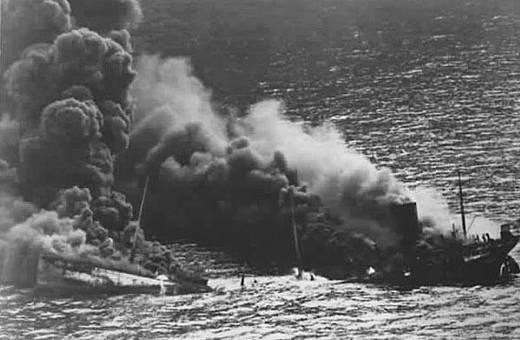
The destroyer was on convoy patrol escorting cargo ships to the UK, part of FDR's Lend-Lease program - regarded by many experts in international law today as an act of war, making the Reuben James a fair target for the German navy. As a sub-hunting destroyer, the James tracked the approach of a U-Boat "wolfpack" and steamed in its direction. What is not clear to this day is a)whether or not the ship that Reuben James was immediately protecting actually was carrying war materiel (as the Germans alleged, the Allies denied, and today seems likely but not certainly established); b) whether the U-552 under Capt Erich Topp (who died at 91 on Dec. 26th just three years ago!) was actively engaging the Reuben James or was firing at the presumed ammunition ship and hit RJ incidentally; and c) whether the rapid sinking and high loss of life aboard the destroyer was caused by the torpedo hitting the forward magazine, or whether the impact explosion set off the destroyer's depth charges stored right below the main deck.
I have never been completely satisfied as to why this did not lead to an immediate declaration of war against Germany - it is, after all, exactly what the Japanese did at Pearl six weeks later. I'm guessing - and check out the article at the end of our first video - that the FDR people realized that they were on shaky legal ground to begin with in using the US military to aid and abet an active combatant nation in war time.
In any event, it was a major national shock at the time, and oddly little remembered outside of the song today. Woody Guthrie, like his fellow Almanac Singers (including Pete Seeger and Bess Lomax, daughter of folklorist John A. and who would go on to co-write "MTA"), switched from opposing US intervention in WWII to favoring it after Hitler betrayed his pact with Stalin and attacked Russia in late summer of '41. Guthrie joined the Merchant Marine with close friend and folk legend-to-be Cisco Houston, shipping together on a number of transports (two of which were torpedoed and sunk, Cisco later remarking that when the ship "didn't sink too fast" he'd get out his guitar and sing the RJ song with Woody and the crew waiting for the lifeboats to deploy).
Woody originally intended to mention each of the 86 sailors who died on the Reuben James by name - one of his early drafts included this:
There's Harold Hammer Beasley, a first rate man at sea
From Hinton, West Virginia, he had his first degree.
There's Jim Franklin Benson, a good machinist's mate
Come up from North Carolina, to sail the Reuben James.
Dennis Howard Daniel, Glen Jones and Howard Vore
Hartwell Byrd and Raymond Cook, Ed Musselwhite and more
Remember Leonard Keever, Gene Evans and Donald Kapp
Who gave their all to fight about this famous fighting ship.
The other Almanacs (John Birchler identifies Pete Seeger) told Woody that no one would ever sing a song so long, so Guthrie cut it to four verses, adding the chorus "What were their names?" at the suggestion of Almanac Millard Lampell to keep the focus on the sailors themselves and not the incident only. The original last verse, a war-time rallying cry, went:
Now tonight there are lights in our country so bright
In the farms and in the cities they're telling of the fight.
And now our mighty battleships will steam the bounding main
And remember the name of that good Reuben James.
The last verse we know was added after the war with Woody's blessing by Weaver Fred Hellerman (who wanted the song to be timeless rather than specific to one war), and that group has a fine and dramatic performance of the song on one of the Carnegie Hall concert albums.
Most of us and much of the folk world only learned of this marvelous song, though, in the Kingston Trio's 1961 Close Up album - this is I think the definitive version of the song. This fine video includes the names of all of the dead from the Reuben James -
What an extraordinary performance! Perhaps in the shadow and under the influence of Goin' Places and their treatment of Guthrie's "This Land" - the Trio manages to be powerful at a very moderate pace, unlike the breakneck speed at which some other groups sang both songs. This would include the selfsame NBJ trio in the mid and late 60s concerts at which I saw them, and here in the 1981 reunion (which truncates a verse, dammit!):
And Trio fans have to be delighted that our current Trio of George, Bill, and Rick have chosen to include this KT classic in their performing repertoire. It seems to me that they split the difference between the two NBJ videos in terms of pace while retaining the power of the original, and George dramatically re-imagines the banjo part:
Only one other major folk group that I know of after The Weavers and the KT made a serious and original attempt at interpreting this song, and that was the Chad Mitchell Trio three years after the KT on the wonderful CMT album Reflecting. Paul Prestopino and Jacob Ander provide ample support for this fine but different version of the song, a bit more like the Weavers:
Banjo maestro and folk traditionalist Billy Faier critiqued the Kingston Trio version of the song as "all climax and no dynamics"; while I clearly disagree - well, the CMT were probably the best of the 60s folk acts at modulating the vocal dynamics in their songs, and their RJ is a great example of that.
3/27/10 - The Weavers And Woody
LordFearsarge has kindly uploaded the Weavers' version from their Carnegie Hall concert album. Aside from its drama and musical excellence, this version is significant because it is the template from which the KT and CMT drew their adaptations, and because the lead singer is the aforementioned Fred Hellerman, author of the last verse:
And since the original publication of this post, Tasedlak has posted Woody himself performing his composition from the series now known as the "Asch recordings" executed by Moses Asch, founder of Folkways Records:
A fine memorial and a wonderful song. The KT IMHO never sounded better.
Appendix
1) More Videos
First, a million thanks to Xroader/Bloodliner/FC Camper/Swede-living-in-Mallorca Bo Wennstam for taking and posting the video of the GBR trio doing the song last August - I ran out of space for acknowledgments on the first post.
Now, in addition to the video available of Woody Guthrie doing the song himself, there are two versions on YouTube that resemble WG's. First - Aussie Raymond Crooke, living in Hong Kong and a member of the HK Folklore Society, poster of hundreds of folk videos to YouTube, comes closest to Woody's version on guitar and vocals - this video has an extraordinary 42,000 views:
My occasional YT correspondent Alonso Garbanzo performs the song as Guthrie would have - if Woody had been able to sing and play better than he did.
Two years after this article was published, SuperZilla12 posted pop-country star Johnny Horton's version, which was a minor hit on the country charts. Horton sings Guthrie's original lyric in full:
2) Photos
The USS Reuben James
The Actual Sinking
Editorial Cartoon About The Incident
Today's USN Frigate Reuben James
Reuben James Himself Saving Stephen Decatur (Contemporary Illustration)
3) A Final Comment
From the notes by "ondeafears.com," the poster on YT who uploaded the RJ video with the KT and all the names:
This version is by the Kingston Trio. Some folk music fans do not like the Kingston Trio, quite possibly simply a backlash against the massive popularity they enjoyed in the late 1950s to mid-1960s. I'm no expert on folk and no purist--all I know is that they sing great together and that there is a lot of power in those guitars and vocals--"Reuben James" sounds great.
I threw this one together myself. The song famously asks, "What were their names?" I've answered that question.
Amen to that. Happy New Year!
__________________________________________________
Addendum - January 2014
A few months ago, The Almanac Singers' rendition of "Reuben James" was uploaded to YouTube. This is the first recorded version of the song. Pete Seeger sings lead.
Subscribe to:
Posts (Atom)