Showing posts with label Something Special. Show all posts

Saturday, March 23, 2013

John Stewart's "One More Town"

One of the unfortunate aspects of the unplanned hiatuses that I occasionally take from publishing posts here is that I miss dates and anniversaries that in the past have provided me with an opportunity to highlight topics in which I have had an interest stretching back decades. Last week, for example, was St. Patrick's Day - and in the four previous years I have had great fun profiling several of my favorite Irish songs. For several years I also did a late December retrospective on the best versions of songs that I had discovered in the expiring twelvemonth, but 2012 passed without such an article.

Most poignantly for me, I neglected in January to commemorate the anniversary of the passing of singer-songwriter John Stewart, whose death in 2008 I observed in a number of posts, including articles in 2010 and 2011 discussing two of his best-known songs, "July, You're A Woman" and "Chilly Winds," and what might well be a good introduction to the artist for those not familiar with his work, 2012's John Stewart's America. As a performer, Stewart had begun his career as a member of the Kingston Trio when it was America's most popular folk group, so it is no surprise at all that Stewart and his songs have figured prominently in these articles over the years, including last August's further reflections on his career while discussing his 1969 tune "Armstrong", this following the death of the first man to walk on the moon.

I had quite a bit to say about Stewart and his career in those two articles linked above and I don't want to be redundant here, but I would like to expand on a point that I made in each of those. Stewart's professional career lasted just under fifty years, and a protean career it truly was as Stewart moved from rock to pop-folk to country-folk to country-rock, back to rock and then roots and beyond - every format of  music popular in his lifetime except for disco. He released an album of "songs to run by." He recorded an album released after his death of piano-accompanied renditions of his songs. He anticipated and then god-parented any number of trends in music in this country and is often credited with being one of the first artists of what could truly be called the "Americana" style of music.

What enabled Stewart to have a viable career over all those years, however thin his concert schedule may have become at times, was his ability to write truly memorable songs. While the Monkees' mega-hit of his "Daydream Believer" - a song still heard and covered and performed today, 45 years after it broke through - may have paid the rent and bought the groceries for quite a while, it was the breadth and quality that his compositions evidenced from nearly the beginning of his career that has made him so remarkable if under-appreciated an artist.

I opined in a 2011 article that of Stewart's earliest work, the most professional and fully realized song that he composed was "When My Love Was Here" - but as beautiful as that 1950s-styled four-chord Kingston Trio ballad was, it was also completely atypical of the kind of songs that became his bread and butter, and to my memory he never again ventured into pop balladry. No, I would suggest that Stewart's coming-out party as a writer of top-notch folk-styled songs occurred in his second album with the group, 1962's Something Special, and what is probably the most memorable tune on the LP, "One More Town." Stewart was perhaps 22 when he wrote OMT, and though he had already had more than his share of adventures as a touring musician by that time, the lyric of the song is a forward-looking imagining, a young person's fervent hope that life can fulfill its early promise as an ongoing series of memorable and affecting experiences. Yet embedded in the lyric as well is an uncertainty - "I'm always goin', but I don't know where" that those of us who are four decades older than Stewart was when he wrote the words must find poignant and perhaps a tad melancholy. We may still be always going, but we know where we have been - and where we are headed.

The initial recording of "One More Town" was by the Trio on that aforementioned album, one that included for the first time in the group's history an orchestral background for the tunes, arranged by top-flight pro Jimmie Haskell:


The lead vocal is by the late Nick Reynolds, whose expressive and full-timbred voice is perfect for the song. While many KT fans found Haskell's orchestrations on most of the album's tracks to range from disruptive to wildly inappropriate, the strings work rather nicely here, I'd say, though I do believe they detract to a degree from the "folkiness" of the composition. Stewart delighted to relate in later years that Paul Simon had told him that Simon's "59th Street Bridge Song (Feelin' Groovy") had been inspired by "One More Town," and both the rhythm and general tenor of "Groovy" do bear a striking resemblance to Stewart's work.

As noted in the linked articles above, Stewart could get testy early in his solo career if people asked him to do KT songs, but by the mid-1980s when he was in his 40s, he appeared to have rediscovered his own professional roots, first in an EP with former Triomate Reynolds (The Revenge of the Budgie) and then in a full-length CD titled The Trio Years in which he re-interpreted songs he had written in his Kingston days. All of the tracks are high-quality listening, and "One More Town" is one of the best:


This is the "older and wiser" voice and attitude that Stewart cultivated later in his career. The understated guitar work is for me one of the highlights of the track.

A decade after the KT version, Australia's New World group recorded and released "One More Town." This performance is from a 1971 BBC show called The Two Ronnies:


This is a bit too uptempo and happy for my taste, but the arrangement is professional and the performance creditable. The hair-dos and outfits may give us pause, though. I'm not sure how many of us would like to be reminded that we may have looked that way once. Positively cringeworthy, to cop a term from critic Richard Corliss.

Jeff Hall and Cherokee Road posted this rendition just a few months ago:


It's hard to tell from the video, but I'm going to guess that Jeff and friends are perhaps rather younger than the rest of the artists on this page, and that has got to be encouraging to those of us who want to see folk music in general and quality songs like this survive into the next few generations.

Finally and most interestingly, not to say oddly - "One More Town" as a square dance "call" by Dan Sahlstrom:


I think somehow that John Stewart would have gotten a charge out of this, however strange it may sound. After all, someone thought enough of the composition to adapt it to this use, and that is at least flattering to the tune, however you look at it and whatever you think of the result.

I was a mere wisp of a lad of 12 when I first heard "One More Town." A sensitive and imaginative and sentimental boy I was too, and this song was perfectly attuned to my own dreams of a life of adventure and meaning. But fifty years later, I still think it a wonderful song, and not simply as a measure by which to reflect on how I've lived my life to this point. No, John Stewart gave us a song that as noted above looks forward to and imagines all that life can be, all its possibilities for adventure and achievement. There is no expiration date on dreams, and I believe that we most honor Stewart and this lovely work by holding fast to ours.

Thursday, September 8, 2011

"Go Tell It On The Mountain"

I was watching a screening of Murray Lerner's 1967 film Festival this morning, that widely-praised documentary of some of the performances at the Newport Folk Festival between 1963 and 1967. I have always been lukewarm toward the film; it presents some outstanding artists and renditions, but it slants away from festival founder George Wein's "big tent" approach to folk music and toward the political and the electric, as if Lerner's only understanding of the term "folk" had been derived from some smokey basement clubs in Greenwich Village and not out in the real world where dulcimer and banjo players from the Appalachians, cowboys from the Rocky Mountain and southern plains regions, whalers and sailors, and clean collegiate professionals were making very different brands of folk music than those represented in the movie.

The film still had its moments, of course. Though I have seen it many times, I had never really noticed until this morning that on the 1963 festival-closing number in which many of the performers had linked arms while singing "We Shall Overcome" that Liam and Paddy Clancy of The Clancy Brothers and Tommy Makem were among the singers. And I had likewise forgotten what a stirring snippet was included of the Staples Singers, led by Roebuck "Pops" Staples himself, doing "Go Tell It On The Mountain."

Though now performed most often by gospel groups, "Go Tell It On The Mountain" is actually a spiritual that dates from the days of slavery, and there is a difference. "Mountain" first appears in print and performance in the hands of the legendary John Wesley Work, Jr. (1871-1925 - pictured above), an African-American teacher and scholar who wanted to preserve the oral culture of his parents (who had been born in slavery) and consequently started the Fisk Jubilee Singers (named after Work's alma mater, Fisk University), arguably America's first great professional "folk" group and a healthy antidote to the demeaning and racist black-face minstrel shows that were also popular in the late 19th century. "Go Tell It On The Mountain" appeared in print in a 1907 Jubliee Singers songbook, though the group had been performing it for decades before. Work had the copyright but freely acknowledged that he had arranged and re-imagined a traditional slave song.

The "Jesus Christ is born" part of the traditional refrain seems to mark this song as a Christmas composition - but it ain't necessarily so. Despite the still-raging controversy over "coded messages" that some scholars believe are embedded in the lyrics of spirituals, it is most certainly a cornerstone of Christian theology across the entire range and breadth of orthodoxies within the religion that the birth, life, and death of Jesus leads to a profound spiritual liberation from sin and damnation. Hence - "Go Tell It On The Mountain" is a song for all seasons in its optimistic celebration of the coming salvation from sin - and it has been performed and recorded in all seasons of the year.

The Golden Gospel Pearls perform the song in a version that seems closest to what Work published in 1907:


This is likely my favorite of the versions presented here in its clean, unadorned, and deeply-felt performance.

Most white Americans born after 1930 or so owe a good deal of their knowledge of this music to the popular crossover appeal of Mahalia Jackson, arguably the greatest singer of spirituals that this country has yet produced:


Though there is currently no recording on YouTube of the Staples Singers' performance*(but there is now, courtesy of Eva - look below), the Blind Boys of Alabama are doing something very close to Roebuck Staples' arrangement. This is three of the longest-performing five Blind Boys, from 2017 with Ruthie Foster and the Preservation Hall Legacy Horns:

.

The Boys here use the Staples' mainly minor chord accompaniment that lends the song an almost grim seriousness, very different from Work's original.

Our next versions likewise demonstrate a transliteration of the song away from its roots and into the peculiar artistic visions of the singers. First - that unique combination of jazz, blues, and funk that Al Jarreau has been delivering for several decades:


Inimitable.

It could be argued that the large numbers of white singers and groups who have done "Go Tell It On The Mountain" are an indication of the universality of its message of celebration and hope. Yet each version creates a different spin. Peter, Paul and Mary are likely best remembered for their political songs, and at the suggestion of and with the help of their musical director Milt Okun they re-wrote the lyric with different biblical references to turn the spiritual into a civil rights anthem:


James Taylor works an alternative lyric as well into a satisfyingly JT-esque performance, as thoroughly stamped with his own brand as Jarreau's version is with his.


Likewise - three bars into the vocal here, you cannot mistake the distinctively mellow sound of the Brothers Four:


And as much as the B4 were known for their relaxed-sounding vocals, the Kingston Trio built a reputation for super high-energy, almost out of control vocals, as they do here in this version for their orchestrated Something Special album:


There are also many other wonderful versions on YouTube: country-inflected by Dolly Parton, reggae by Bob Marley and Peter Tosh, blue-eyed soul by Michael McDonald, many more - truly a song for all seasons.

*Appendix, 12/23/11

Courtesy of Eva (below), YouTube now is graced with a 1962 performance by The Staple Singers - maybe the definitive version:

.


And Further - 4/21/12


It is wonderful to find an upload of the Weavers' studio recording of the song with Ronnie Gilbert on lead:

.

...and yet further, an interesting instrumental from Christian gospel pianist Brian Howlett and his regular partner, fiddler Andy Leftwich:


.

And Further Yet - August 2013

....a fantastic performance by Odetta from 1989, one that wasn't showing up in my searches because it is from a YouTube channel in Germany. Absolutely sublime:

Saturday, April 9, 2011

Scotty Wiseman's "Brown Mountain Light"

North Carolina is yet again the setting for this week's song, and for once (as contrasted with "Tom Dooley" and "Poor Ellen Smith" and possibly "You're Gonna Miss Me") the topic is not a murder but rather an interesting paranormal phenomenon, one that has inspired a series of local legends and one often-covered country song, if you can excuse the Gone With The Wind-type attempt to romanticize slavery (a very big if, obviously).

Sightings of the mysterious "Brown Mountain Lights" have been verified back to 1922, though stories surrounding them apparently go back at least sixty years earlier to the Civil War era and maybe before. Brown Mountain is near Linville, NC, and that estimable town provides a fine and comprehensive brief history here:

Perhaps a little background information is in order here for readers who have never heard of the lights. Brown Mountain is a long sloping ridge on the edge of the Blue Ridge lying within U.S.Forest Service land at an elevation of some 2,600 feet.... One of the three main viewing points of the lights is at a roadside pull-off on highway 181. The other two look outs are at Wiseman’s View...and the Lost Cove Cliffs overlook on the Blue Ridge Parkway (milepost 310).
Since their first recorded sighting by the German engineer Gerard de Brahm in 1771 the
lights have attracted scientific scrutiny. Explanations for these mobile spheres of glowing light have ranged from nitrous vapor to ball lightning, from foxfire to a fourth form of energy known as plasma. The U.S. Geological Survey conducted an investigation of the lights in the 1920s, publishing findings that dismissed the lights as man-made...
About the only thing that most experts can agree on, however, is that the lights tend to
appear in late summer and autumn on cool evenings following some rainfall. Those fortunate ones who have seen them speak of the experience as wondrous and unforgettable. Mention the topic ofthe lights in just about any gathering in the Blue Ridge and cries of “Have you seen them?” and vivid anecdotes will swiftly follow.


Without further ado, the star of the show - from a few years back, one of several good videos of the lights on YouTube:


The song was one of the last that was penned by Nashville Songwriters Hall Of Fame member Scotty Wiseman (1908-1981), who partnered for most of his career from the mid-1930s til 1958 with his wife Myrtle Eleanor Cooper under the name "Lulu Belle and Scotty." (pictured above) They were regulars on The WLS Barn Dance broadcast from Chicago in the 30s and 40s - I've mentioned the program before as the main competition in the vast mid-section of the country for Nashville's Grand Ol' Opry. Wiseman wrote a string of hits that included "Have I Told You Lately That I Love You?" (the country number recorded by Jim Reeves, Rick Nelson, Elvis Presley and many more - not the Rod Stewart/Van Morrison song), and Cooper contributed the classic "Does Your Chewing Gum Lose Its Flavor On The Bedpost Overnight?" to the American song bag. The duo retired in '58 when Wiseman completed an M.A. from Northwestern University and went on to a teaching career; Cooper ended up as member of the NC House of Representatives.

"The Brown Mountain Light" song apparently dates to the early 50s. According to the Linville village web page cited above, Wiseman heard the legend of the slave and the lantern from his great uncle Lafayette "Fate" Wiseman, a drover born well before the Civil War and the man for whom Wiseman's View above is named. Great nephew Scotty always liked the story and came up with this:


I'm a bit more inclined to cut Wiseman some slack about the "faithful old slave" bit than I am for Hollywood depictions, both because of his own pre-modern 1908 birth date and because he was re-telling the story as he and others had heard it from Uncle Fate. But I still get more than a little uncomfortable with any attempt to romanticize slavery in the U.S., especially in the century after it was abolished. GWTW is in most respects a great movie, though unfortunately the somewhat dignified and Academy Award-winning portrayal of the house slave Mamie by Hattie McDaniel is counterbalanced by a truly vicious stereotype in the younger girl played by Butterfly McQueen ("I don't know nothin' 'bout birthin' babies"). I treated the subject at greater length when I wrote about the spiritual "My Lord, What A Morning" last October.

Sonny James' #1 country hit version has been removed from YouTube, but shortly after James's rendition Tommy Faile had a rockabilly-tinged hit with the song:


The 1962 date of James' hit suggests that it is the immediate antecedent of the 1962 version by the Kingston Trio:


The KT also seems to have borrowed James' idea for the narrative opening and that guitar lead in. John Stewart is doing a really creditable banjo arrangement here - which gets all but lost in the awful horns- and percussion-littered cut on the '62 Something Special release.

The Country Gentlemen also did "Brown Mountain," though I cannot find a date in their discography. It seems not to predate the KT's version, though the latter group freely borrowed material from the Gentlemen's first few albums, including "Jesse James", "Long Black Veil", and "Poor Ellen Smith". They do a classic bluegrass arrangement here:


Finally, two non-professional but really good folkish versions, first by Ronda Foust of Tennessee doing a clawhammer banjo accompaniment:


That's a fine banjo performance by Ms. Foust, and it shades the country composition toward folk wonderfully. She mentions that she first heard the song from the Kingstons.

And a bluegrass jam session, from Townsend,TN in 2008:


That's Bruce Fox on mandolin and lead vocal. I love to hear folk-styled music this way - being able to join in sessions like this is one of the chief attractions of going to the Trio Fantasy Camp in August each year. We'll have to see how many folkies remember and like this one when we assemble again in Scottsdale this year.

Addendum - July 2012

Just found this gem - bluegrass master of everything Tony Rice from a few years back:


Wednesday, March 2, 2011

Derroll Adams, John Stewart, And "Portland Town"

It has been just over 35 years since former Beatle George Harrison was forced into court in late February of 1976 to defend himself against charges of copyright infringement and plagiarism by Ronald Mack and Bright Tunes Music in the case of Harrison's hit single "My Sweet Lord," which Mack and Bright Tunes contended was stolen from the song "He's So Fine" that Mack had composed for The Chiffons in 1963. Harrison acknowledged that he had heard the song but contended that the guitar setting and overall meaning of the piece were different enough to warrant consideration as an original composition. The trial lasted three days, and the judge's decision was swift: Harrison was indeed liable and ordered to pay $1.6 million (rather more valuable dollars then than now). Thus the term "unconscious plagiarism" became a part of the world's vocabulary when discussing intellectual property. There is a good and relatively brief discussion of the case HERE.

The case involving this week's song "Portland Town" was a bit simpler and more straightforward, but some of the same issues of ownership of an idea or a musical phrase did crop up. "Portland Town" was written in about 1957 by Derroll Adams, an American who never achieved much success in the U.S. but was and remains highly regarded as a kind of godfather figure in the European folk revival, especially in the U.K. Adams was a colorful character, an Oregonian (from Portland, of course) who joined the Navy at the under-age of 16 in 1941 to fight in the war - until the military found out about his age and a debilitating medical condition and discharged him. Adams went to Portland's prestigious Reed College and its art school - where he saw Josh White and became enthused about folk music. He taught himself the rudiments of the five-string banjo while working at several different jobs but only became serious about it after he met Pete Seeger around 1952 - and learned how to tune it properly. Adams drifted to southern California, living first in San Diego and eventually on Will Geer's Topanga Canyon ranch, which was a sort of art colony for radicals. It was there that Adams met the newly re-named Ramblin' Jack Elliott (born as Elliott Adnopoz), and the two became fast friends and performing partners, eventually moving as all early 50s folkies did to New York City.

Elliott sought greener and less McCarthyistic pastures in Europe and urged Adams to join him. Adams did so and spent the rest of his life there, mainly in the U.K., Belgium, and Italy, with sojourns in Denmark several times as well. His now fully-developed banjo and guitar skills won him an impressive following of soon-to-be influential musicians, most notably Davy Graham, Donovan Leitch (who idolized Adams), Paul Simon, Bert Jansch, Ralph McTell, and dozens more. Despite a troubled personal life that included extended bouts of alcoholism and extended hiatuses from performing, Adams remained a seminal figure in the Old World, appearing at and being honored by folk festivals across the continent until his death in 2000.

Adams wrote "Portland Town," he said, as a response to a couple he knew who lost their only son in the Korean War. Here is the song as he wrote it:


It's easy to discern the mid-50s folk/radical/Seeger/Geer nature of the song - and to understand why an America in the shadow of the Red Scare and McCarthy hearings was none-too-friendly an environment for Adams. But it is equally easy, given the simple, traditional-sounding and compelling nature of the song, to understand how a 22-year-old John Stewart of the Kingston Trio could have mistaken it for a traditional number. Where Stewart heard it first is unclear; it may well have been in one of the Greenwich Village folk clubs that Stewart frequented as a member both of the Cumberland Three and the KT. In any event, Stewart re-wrote both melody and lyric in his first year with the Trio and chose the song as his solo for the second KT album on which he appeared, the orchestra-supported Something Special. Stewart took the basic structure and some of the lyrics of the piece but turned them from an anti-war statement [which interestingly prefigured Stewart's own "Oldest Living Son" from his early solo album Willard (1970)] to a plaintive love song. Here is his acoustic track for the album:


The dressed-up album cut sounded like this:


This is instructive, I think. There is a charm, innocence, and longing in Stewart's acoustic version, which retains the simplicity if not the meaning of Adams' original. The Jimmie Haskell orchestrations, however, distort those charms here as they did on most of the cuts on the album and turned Stewart and the KT into a kind of poor man's Brothers Four, a pop vocal group before the folk boom whose Four-Preps-type roots showed in most of their recordings, many of which were unabashedly similarly orchestrated.

Stewart was not the only artist to mistake Adams composition as a traditional song. British pop superstar Marianne Faithfull (who had folk roots as well) recorded the song for a 1965 album and cited it on the record as "Traditional." She performs the song as Adams wrote it:


At a distance of 50 years and with Adams now departed, it is hard to ascertain what exactly his response to these versions was. One music website claims that he "never even attempted to reclaim his lawfull [sic] rights on this song," citing Stewart's adaptation as an example. But Adams' good friend Frank Hamilton - co-founder of Chicago's influential Old Town School of Folk Music and one of Pete Seeger's banjo-playing replacements in the Weavers - wrote just three years ago that "Derroll didn't get anything for Portland Town 'cause John Stewart of the Kingston Trio stole it from him and used up the royalties supposedly to go to Derroll in court costs. Welcome to the music business." Hamilton clearly implies that Adams either sued or threatened to sue Stewart. I can find no hard evidence of this on the web, and it would take more time and better legal research skills than I have to determine exactly what the interchange between the two was. I suspect that legalities were involved if not an actual suit, and with songwriter's royalties for a tune on a #7 charting album with sales approaching 300,000 copies, there would have been quite a lot of money at stake, if not at the gargantuan proportions of George Harrison's liability. Two things seem to me to be uncontestable: first, Stewart was not cynically and deliberately plagiarizing, as Hamilton implies (which BTW would not have mattered in an actual lawsuit), and second, that Adams never made any money off of Stewart's efforts. History has had its revenge, however: Stewart's version today is largely forgotten while Adams' original is still performed. Here is an unnamed Korean trio from two years ago:


An equally eerie-sounding take on the song from A Hawk and a Hacksaw from 2006:


A more straight-on interpretation of the number from the now ragingly popular roots/rock band, the Avett Brothers from last August:


There is no great lesson here, no grandiose conclusion to be drawn. Adams' original marches on, like "Blowin' In The Wind," because there are always cannonballs flying somewhere that still need to be forever banned. Stewart's nearly forgotten rewrite remains only as a minor memory to those who loved the popularized folk music of an era that in public perception is practically invisible. That fact is more melancholy than the song itself.

Appendix

For comparison's sake -


Friday, February 18, 2011

"Old Joe Clark": Then And Now

Old fashions please me best; I am not so nice
To change true rules for odd inventions. - Shakespeare

Ah, the Bard! As almost always, the perfect phrase for every mood and thought. I was reminded of this line (culled from a funny scene about a music lesson, of all things, in The Taming of the Shrew) as I watched parts of last Sunday's Grammy ceremonies - and subsequently after an exchange of posts on the John Stewart message board regarding whether or not popular music has descended to a lower level today even than heretofore. For me, the main show was secondary to the internet-broadcast Special Awards ceremony at which the Kingston Trio, Julie Andrews, drummer Roy Haynes and several others were honored with Lifetime Achievement Awards. The Sunday broadcast of the 53rd awards left me with the impression that there is still a tremendous amount of genuine talent in American popular music, but that much of it is wasted in over-glitzed, over-produced, pyrotechnics-riddled refuse, vulgar at best and ridiculous at worst - or roughly the same as it has always been. Take the opening - Lady Gaga has written a genuinely fine pop-rock number in "I Was Born This Way," and she has the genuine vocal chops of a real singer. But the egg thing from which she emerged (intended to be symbolism of the kind that would be thought cool and deep by a 12-year-old) and the hyper-sexual costumes, dance, and overall visuals actually worked to obscure the quality of the number rather than clarify or enhance it.

Which is not to say that old things are always better than new, but rather as Shakespeare's Bianca notes above, the "true rules" of the better parts of the traditional are always under assault from those "odd inventions" of pop culture, which has an insatiable appetite not for the truly innovative as much as it does for the short-term novelty. Were this not so, we would have seen long before now some genuine innovation in rock music away from a pattern like the four or five instrument-based band that has been the ironclad rule since the Stones and the Who nearly fifty years ago. Instead - just more of the same, never done as well now as when it was new. Punk, hip-hop, glam - all the same - a burst of innovation followed by endless, unimaginative replication. Most years the Grammys simply add an exclamation point to that, as they did this year.

At its best, American folk music has been able to find a kind of middle ground between a slavish imitation of the old and a careless disregard for it. I fear that in last week's post I didn't clarify how much I appreciate what the so-called traditionalists of folk have done. What they have tried to preserve is worth preserving, and its near-invisibility now simply underscores the validity of their efforts. But it's too bad that the "big tent" idea of George Wein at the original Newport Folk Festival never actually took hold (even at that festival, which today tends to include nearly no traditional music at all). About all that you find on the American music scene today that resembles what used to be called folk are bluegrass bands (and that is a genre which can hardly be called traditional, dating as it does and as we've discussed here really only to the 1940s) and a large number of "Celtic" bands, many of which from Celtic Woman to Celtic Thunder to Celtic-What-Have-You are simply pop groups that affect an Irish accent and go in for the heavily-orchestrated and visually over-produced settings of their rock and "country" cousins. But folk in its original sense? It's AWOL.

Or almost. Here and there, scattered around the English-speaking world, there are bands and soloists who owe their musical aesthetic rather more to the New Lost City Ramblers than they do to Peter, Paul and Mary and the Kingston Trio. And this week's song, "Old Joe Clark," gives us ample evidence of where folk music has been and the crossroads at which it finds itself. Again.

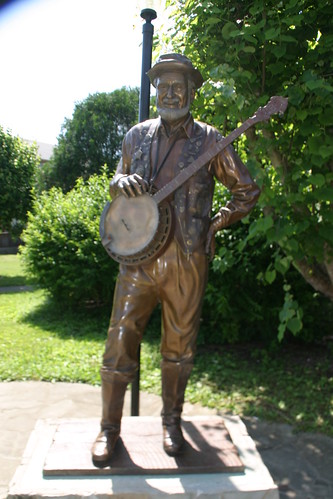
"Old Joe Clark" has been a popular number for more than 90 years, and there seems to have been a real character by that name who inspired the song. Most folklorists believe that the real Clark was born in 1839 in either eastern Kentucky (probably) or western Virginia (maybe) and was eventually murdered, date and circumstances subject to dispute. The real Clark (and the picture above is allegedly a statue of him) made moonshine, possibly under a government license. He may have been married twice, or three times. He may have been murdered by his first wife's second lover - or by his own son. What is certain is that a lot of mountaineer doughboys in WWI sang the song quite a bit, and a lot of Yankee doughboys and Rocky Mountain doughboys and Midwest farmer doughboys took a liking to it and brought it home with them after the war, which accounts for the explosion of published and later recorded versions following the initial printed versions from 1918. You can find several versions of the song's history on the excellent website of our first artists for this week, the UK's Rosinators:

Lisa Clark On Ancestor Joe

The Rosinators On Song History

The Rosinators deliver a fairly straightforward fiddle- and banjo-inflected interpretation, though I personally could do without the Seeger-Sessions-Springsteen-infected-not-inflected drums. A kindly word here - in traditional music, both the banjo and guitar ARE the rhythm setting for the song. Oh well.


Many of our contemporary recordings are derived from the one of the first waxed versions, the 1927 recording of Fiddlin' John Carson:


Carson sets as a pattern one of the more interesting aspects of the song - he opens with an instrumental, which you'll see is common to all all the versions below. An acknowledgment is due here from me to Chicago-area musician and folklorist Jeremy Raven, who knows more than I ever will about folk roots and whose writings introduced me first to Carson several years ago on the KT message board.

There were plenty of other old-timey recordings of the song, but Ol' Joe takes a major step into Big Time Show Biz when Pete Seeger in 1946 not only records a version of the song but films it as well. "OJC" is the third tune:


That opening banjo riff is amazing - and it sounds to me like Uncle Dave Macon's "Keep My Skillet Good And Greasy". Seeger and the Almanac Singers re-wrote the lyrics for "Round and Round Hitler's Grave":


The videographer made one clear mistake - Burl Ives was never in the Almanacs and was not on this recording - which should have been more controversial than it was, taking a traditional tune and appending topical lyrics to it. Tsk, tsk, Peter.

The Callahan Brothers in 1945 also played a bit fast and loose with instrumentation to create this sort of proto-country take on the tune:


And on to the crass popularizers of the 1960s - first the Kingston Trio from their 1962 album Something Special:


Traditional? Not quite, though you can hear the roots in it. Fun? I'd say so.

And speaking of fun - the great Chet Atkins:


Atkins had bona fide country/folk roots, but he is really breaking the versatility bank here - you can hear classic pop, a touch of blues, genuine rockabilly, and a bit of rock all in this one cut.

Finally to the contemporary. The Avett Brothers of North Carolina are an up-and-coming band who were featured last Sunday on the Grammy broadcast. They have been including their unique arrangement of "OJC" in their concerts for several years:


Folk-rock, I'd call this, and more legitimately so than bands like the Byrds or Mamas and Papas, who were singer/songwriter rock rather more than folk.

Yet in hidden and distant corners of our benighted land (smiley), the traditional continues, here by mountain autoharpist Kenneth Bennefield on Folkways Records in 2006:


The production and recording here were done by the late Mike Seeger of the NLCR, one of the last of his decades of contributions to American folk music.

Finally - maybe my favorite of all of these recordings, two guys at home making some good old time music and recording themselves. That's Casey Abair on fiddle and Hunter Robinson on clawhammer banjo:


George Wein had it right, I think - American folk music is a big tent, probably with room enough for all of these markedly different styles.

Friday, May 7, 2010

Stan Hugill And "Away, Rio"

Stan Hugill (1906-1992) was a Briton who styled himself "The Last of the Shanteymen" (he preferred that spelling), and he likely was, working as he did on the last British commercial sailing ship, the Garthpool that finally went down in 1929. Hugill made an enormous contribution to folk music by collecting, categorizing, and publishing songs that he actually sang at work for the twelve years or so that he worked "before the mast." Hugill's blue collar background and almost continuous decade at sea gave his understanding of the work songs of the sailors an authenticity that other admirable collectors like Cecil Sharp and Carl Sandburg just couldn't quite match.

Hugill pointed out that a shanty-man was usually just another working stiff who had a good strong voice and an extensive knowledge of songs that he could lead the crew in. But music was such a critical part of life at sea in the Age of Sail - the only entertainment, really, along with drinking the daily allotment of grog and dancing - that before Hugill's time in the great eighteenth and nineteenth century days of the British navy and merchant fleets, shanty-men were sometimes hired for that skill primarily even if they were of little other use. There were cases in the Napoleonic era of partially blind or crippled men hired to do a bit of galley work to justify their real reason for being on board - they could sing and play a tin whistle or recorder or (most prized) a fiddle. There are interesting fictional portrayals of this in films in recent decades - the near blind fiddler and singer in the 1984 The Bounty and the lead singer in the crew in 2003's Master and Commander (and note there how often even the officers break out in song).

As I've noted here before (and as Hugill confirms), there were different kinds of chanteys for different functions, fo'c'sle chanteys for relaxation for example, or dancing chanteys for hornpipes and so on, a sort of seagoing square dance group of songs. By far the largest group was the collection of capstan or windlass chanteys, the slower and more rhythmic songs that accompanied hard group tasks like weighing anchor. It is into this group that Hugill categorized what he called the "Santy Anno" group, which included "Lowlands" and "Bay of Mexico" and "Away, Rio" - all of which have a punctuating refrain like "Way up, Susianna!" and "Heave away, Santy Anno" and "Away, Rio!"

A word of clarification first on "Rio" before we get to the performances. I was confused when I first heard the song in 1962 because I couldn't figure out what British or Yankee sailors were doing sailing in the mid 1800s to the mouth of the Rio Grande in the Gulf of Mexico. Turns out they weren't. I found some book or other that pointed out that the "Rio Grande" of the song is actually Rio Grande do Sul - the great River of the South - the southernmost state in Brazil.

Note the port city on the Atlantic Rio Grande, where the Lago dos Patos leads to the capital city of Porto Allegre. That's the Rio Grande they're bound for. Also note the location of the state - where the pampas of Argentina, Uruguay, Paraguay, and southern Brazil come together. In the nineteenth century, this was an important trading port for all the exports of the region - grain, dried beef, leather goods, and so on. That's why in the lyric "We'll head for Cape Horn and then pull her about."


Our first version is from the Kingston Trio - the original recording before arranger Jimmie Haskell's orchestrations were added for the group's Something Special album:


I actually thought that this was the only number on the album that didn't suffer unduly from the secondary music - the french horns evoking the sea swells was a nice little trick that Haskell stole from Debussy and that John Denver used effectively on "Calypso." Also, John Stewart here is using those extra frets on the long neck banjo - the key is E so JS is playing without a capo, all the way down the neck of the instrument.

Next up is the Revel Players doing a Robert Shaw Chorale-type harmonized version - and pronouncing "Rio" as "Rye-O" as American sailors apparently always did:


Artist Lord Drako Araxis is really talented, though I don't much like anime, especially in this context. But he's assembled the best collection of choral arrangements of chanteys on the web - plus we get a bit of the Poxy Bogards doing "Up And Away" at the end.

Next - since about 1958 with the opening of the St. Lawrence Seaway, my hometown Chicago has in fact been a seaport - which is why they can have a Maritime Festival - here from 2009:


The Rambling Sailors with appropriate gusto from the Bristol Renaissance Faire last year:


The Metropolitan Opera's Leonard Warren did a full orchestra and chorus version:


David Peel, who performed for a time with Bob Shane of the KT after the 1967 break-up of the original group, here in a recent recording from Denver's Swallow Hill -


Finally, "Catmelodeon" gives us an authentic-sounding version on a melodeon, which is close enough to a concertina or an original keyless accordion to be maybe as sailors in the fo'c'sle might have heard it:


What a fine song it is, in nearly any version. The days of sail may be gone, but there are clearly a lot of musicians out there who are keeping its songs alive.

Friday, November 20, 2009

"The Wagoner's Lad"

One of the things that I have always loved about folk music is its capacity to surprise. You can be humming along through all the wonderful chanteys and cowboy songs and ballads and love songs...and then stumble unexpectedly on the surpassingly beautiful (like "Shenandoah" or "The Mountains of Mourne") or the darkly tragic (like "The Sloop John B") - or amazingly modern sentiments in a very old song, like "The Wagoner's Lad."

The very first verse of the song, which is known in a host of variants including "My Horses Ain't Hungry" (recorded famously by Peter, Paul and Mary as "Pretty Mary") and "Ramblin' Gamblin' Man" and which dates to the early nineteenth or even late eighteenth century, tells us that we are not in the standard folk universe in this song, where women are usually the objects of either romantic desire or borderline misogynistic humor or scorn. Instead, "Wagoner's Lad" opens with a plaint as old as time, one that remains distressingly true for a really unthinkable percentage of the world's women today - in the Middle East, in most of South Asia and much of East Asia, and in large parts of Africa. Perhaps half of the women in the world today do not choose their husbands freely, making that opening verse perpetually relevant:

O hard is the fortune of all womankind
They're always controlled, they're always confined...
Controlled by their fathers until they are wives
Then slaves to their husbands the rest of their lives.

The sad story of an unsuccessful courtship - due to the unsuitable poverty of the young man and the consequent forced and permanent separation of the young couple - is related in the voice of the girl, itself a bit unusual but not unheard of in English language folk songs. What is unique, though, is that the direct bitterness of the opening verse colors the rest of the tale of the lyric with an underlying and inescapable tragedy, as our narrator herself seems at some point in the future doomed to the "slavery" that she so despises, even sadder because love and happiness have flirted with her in the shape of her wagoner's lad, driven off by an unfeeling and unsympathetic father.

One of the earliest recordings of the song was by the legendary Buell Kazee, a Kentuckian who hit his stride in the 1920s a bit before the Carter Family came on the scene with a series of recordings for Brunswick records. Kazee's real ambition was the ministry, which he pursued for the rest of his life. The YouTube recording of Kazee has been removed,* but Smithsonian/Folkways Records has posted an equally authentic traditional rendition by Mr. and Mrs. John Sams of Kentucky - a field recording by John Cohen of the New Lost City Ramblers:


By way of contrast - here it is as sung by a woman, contemporary Anglo-Irish-American folksinger Sarah McQuaid - a fine a capella version:


And for contrast within a contrast, another lady's a capella version - who better than Joan Baez? This is the younger Baez, singing in that ice-clear soprano, very different from McQuaid's warm, full alto:


The Kingston Trio gives the song a respectful and almost traditional reading - they change the speaker from the girl to the wagoner's lad, much as they did in Ian Tyson's "Someday Soon", and add a chorus from a verse ("Pullin away...") but otherwise keep within the original thought of the song - one of the last times they did so with a folk number. This is the Something Special album version with the orchestra blessedly removed:


Our UK cousins Bert Jansch (of "Anji" fame) and John Renbourn deliver a wonderful, blues-tinged instrumental:


We sometimes forget that singer-songwriter John Denver began his career doing pop-folk versions of traditional songs, both with the Mitchell Trio and here in 1966 solo - the first song on the video with a fine 12 string guitar part:


Finally, Simple Gifts features the alternative version "My Horses Ain't Hungry" reminiscent of PP&M but featuring a guitar played in open D and a hammered dulcimer - really pretty:


Addendum, April 2012

Buell Kaze is back on YouTube, at least for a while: