Showing posts with label Sunny Side. Show all posts

Friday, August 23, 2013

Billy Edd Wheeler's "Jackson"

Billy Edd Wheeler has had a wonderful career that has taken him from the hardscrabble hills of the West Virginia of his birth in 1932 to the rarefied academic air of the Ivy League to the Nashville Songwriters Hall of Fame. Along the way, Wheeler has written songs that have topped a number of different music industry charts, twelve plays that are still performed across the country today, and several well-regarded books of poetry and humor. In his latter years ("the back nine of life," as he refers to it), Wheeler has turned to painting, with perhaps surprising success given his late start in the field. As his River of Earth (above) shows, his style is reminiscent of what you'd get if Vincent Van Gogh and Thomas Hart Benton were cloned into a single artist, and if you peruse the collection of images of his work on his own website HERE, you'll see a variety of other influences as well. Wheeler is a man of many parts. He has written great songs like "Coal Tattoo" out of the difficulties of his own upbringing and at other times collaborated to create hits with some of the great pop songwriters of the last century - and those songs have earned him gold records through the performances of the likes of Elvis Presley, Neil Young, Judy Collins, Johnny Cash, Kathy Mattea, and many more, with more than 57 million recordings sold worldwide of tunes that he composed.

By his own account, Wheeler was in graduate school at Yale studying playwriting when the idea came to him for what is undoubtedly his highest profile tune, "Jackson":

" 'Jackson' came to me when I read the script for Edward Albee's Who's Afraid of Virginia Woolf? (I was too broke to see the play on Broadway)...The way that couple dig at each other becomes mean spirited and nasty, even tragic, in Albee’s play.  But it’s natural for couples, married or not, to spar good-naturedly.  Otherwise, life would be boring.  In “Jackson,” the couple fusses back and forth, but there are subtle touches that let you know they are still in love."

I wonder if anyone else sees a bit of an anomaly here - that one of the biggest country-styled hits of the 1960s, a number still widely performed today, had its genesis in an Ivy League grad student's apartment in Connecticut and drew its theme from one of the great, dark classics of American literary theater. That fact is, I think, a testament of sorts to an unusual kind of genius, perhaps not surprising from an artist like Wheeler who could pen everything from goofball novelty tunes like "Humperdink, the Coon-Hunting Monkey" to achingly romantic torch songs like "The Coming of the Roads." That's some kind of genius indeed.

Wheeler's original concept for "Jackson" was to tell the story as a sequential narrative, but that idea was squelched by Wheeler's friend, associate, and sometime writing partner Jerry Leiber of Leiber and Stoller fame (who also helped Wheeler with "The Rev. Mr. Black," among other songs). As Wheeler relates:

"When I played it for Jerry , he said 'Your first verses suck,' or words to that effect. 'Throw them away and start the song with your last verse, "We got married in a fever, hotter than a pepper sprout."' When I protested to Jerry that I couldn't start the song with the climax, he said, 'Oh, yes you can.' So I rewrote the song and thanks to Jerry's editing and help, it worked."

Wheeler recorded the tune for his third LP, 1963's A New Bag of Songs. However, before the record was released, Wheeler sent the song west to the Kingston Trio, who had just scored a huge hit early in the year with "Mr. Black," and that group became the first to release the number in July of that year:


From the first, Wheeler had intended "Jackson" to be a male/female duet, and that quite naturally created a problem for the Trio. The group had bent genders a couple of times before, notably by turning the girl narrating her own story in Ian Tyson's "Someday Soon" into the young man of the lyric, but "Jackson" presented a different problem entirely. The solution was to create an antiphony between the young man's part (sung by John Stewart) and an adult authority figure, possibly the father, sung in the harmony responses by Nick Reynolds and Bob Shane. It works OK until the end of the last verse - you have to wonder what dad is doing behind a "japan fan."

"Jackson" remained in the vaults for about four years following the KT version, until Johnny Cash came upon Wheeler's Bag of Songs in 1966 and decided to record the tune with his soon-to-be wife June Carter:


The song, of course, became one of the biggest hits of Cash's long career and one of the three or four most identifiable duets performed by the Carter-Cash act. Nancy Sinatra and Lee Hazelwood were working on their own rendition when the Johnny and June collaboration came out, and Sinatra/Hazelwood were beaten to the punch by a matter of months:


Sinatra and Hazelwood are rather more laid back in their presentation than Carter and Cash, and that brings up an interesting point. One of the reasons that I prefer to look at traditional songs in these posts as opposed to songwriter tunes like this one is that trad tunes tend to have more variations in arrangements and performances. However, even a copyrighted number like "Jackson" can engender a pretty fair number of different approaches to it, as these first three videos demonstrate. Wheeler addressed that when discussing a lyric change from his original in the Carter-Cash version: "Songs often get changed as different artists do them, often for the better. I don’t mind minor changes. I like it when artists make the song their own."

Cases in point now follow. Jerry Lee Lewis and Linda Gail Lewis give "Jackson" that old time rock 'n' roll feeling in their 1969 release, complete with Jerry Lee's boogie-tinged piano accompaniment:


In the late 70s, an aging Carl Perkins teamed with Johnny Cash's daughter Roseanne at the beginning of her career for their duet on the song. Perkins, of course, was one of the pioneers of the rockabilly style that helped propel both Cash senior and Elvis Presley to fame and fortune, so it's rockabilly we get in this rendition:


Finally, the Carolina Chocolate Drops are one of the best contemporary folk and roots groups, rather more accomplished instrumentally and vocally than many of their higher-profile competitors. The clawhammer banjo and mountain fiddle in their version here makes an interesting match-up with the blues-inflected vocals - a stunning performance, in my judgment:


Billy Edd Wheeler seems to be enjoying the slower pace of his ninth decade with his painting and poetry, but this highly successful and widely honored star of the Nashville songwriting firmament has had some choice words of late for the current state of country music. Wheeler has said that he always liked story songs, songs that often took a while to unfold. But in an interview a year ago with NPR's Laurin Penland, Wheeler said that he's been shut out completely of today's country music world. "It's natural that not many of those young writers in their late teens, early 20s, even in their 30s — they don't want to write songs with a 79-year-old man. They don't even want to hear an idea. So it's tough. A good story and a well-sung song is not enough anymore. You've got to really honk it up. I mean, it's rock 'n' roll. If you can't rock, just stay in bed..." Given the third-rate drivel that is most of what Nashville is releasing today, we can all be thankful that Billy Edd Wheeler showed up there a half a century ago to write the kinds of songs like "Jackson" that once upon a time made country music - well, country music.


Saturday, August 17, 2013

A Whimsical Woody Waltz: Guthrie &"Those Brown Eyes"

"Woody saw the ravages of the Dust Bowl and the Depression firsthand...and he wrote tough yet lyrical stories about the men and women who struggled to survive, enduring the indignity of living life at the bone, with nothing to eat and no place to sleep. He traveled from town to town, hitchhiking and stealing rides in railroad boxcars, singing his songs for spare change or a ham sandwich...his eye was clear, unclouded, and unobstructed by sentimentality."
 - Bill Moyers

Moyers is writing here primarily about "This Land Is Your Land," and he does a fine job in a few sentences of summarizing what public memory celebrates about Woody Guthrie - the populism, the passion, and the politics, for the most part. Yet I would take minor exception to his final sentence, since Guthrie was indeed possessed of a strong sentimental streak, especially for children, and if that sentimentality never quite clouded his vision, it did remain a significant element in much of his songwriting. Throughout his career but especially toward its premature end, as his own brood of youngsters was expanding and growing, he wrote more and more children's songs. In fact, 25 years after Woody's 1967 death, a librarian at Sarah Lawrence College discovered a manuscript of such tunes written in Guthrie's hand, some of which were annotated as co-composed by his wife Marjorie. Guthrie sons Arlo and Joady and daughter Nora reconstructed the melodies both from memory and from some surviving tapes and with their own children recorded and released 20 Grow Big Songs in 1992. All told, Guthrie wrote several score children's songs that we know of, most of which have the virtue, according to Allmusic's Bob Hinkle, of "an unusually strong identification with actually being a child, in all its simplicity and charm..." I would guess that most folk and roots music fans have at least heard this one:


This is the perfectly charming Woody Guthrie, the memory of which has been largely obscured by his more familiar image as a firebrand and activist as articulated by Moyers above.

Another facet of Guthrie's writing and performing that is less remembered today than it should be was his romantic side, both in his selection of traditional and popular songs to record, like "Red River Valley" and "Who's Gonna Shoe Your Pretty Little Foot?," and in songs that he wrote or significantly re-arranged, like "Those Brown Eyes." This last one is one of those really delightful folk mysteries as to its origin. The version usually sung today has a copyright assigned to "Guthrie/Arkin/Carey/Darling," the last three of course being The Tarriers, who re-arranged Woody's version slightly when they recorded it in the late 1950s. Guthrie added a bit more instrumentation than he normally employed in this mid 1940s recording -


- and The Tarriers followed his general outline for their rendition a decade or so later:


Interestingly, the Guthrie recording cuts the story off at the point where the singer sees the beloved with another man, whereas The Tarriers include the older version - that the fellow was her brother and not a rival for her romantic affections.

Jim and Jesse McReynolds also gave the song a respectful reading in the best tradition of classic American country music:.

.

Guthrie's copyright tends to underscore the general supposition that WG wrote "Those Brown Eyes," especially since Guthrie was usually direct and upfront about songs that he thought were traditional when he recorded them. Yet an earlier version of the number, nearly identical in the lyric though somewhat different in the melody, had been recorded as "Those Dark Eyes" in 1929 by Jack Copeland Mathis, who released records at different times under the names of Blind Jack, Jack Mathis and Cowboy Jack. According to his daughter, Mathis was born in Kentucky but spent most of his life in Texas, recording, performing, and hosting a popular radio show. However, the year before Mathis's record, a certain Fay and the JayWalkers waxed yet another version of "Those Dark Eyes," again with the same basic story and lyrics but again with a different tune. Fay and the JayWalkers may have a copyright as well - evidence of it seems lost - but it appears as if even they were basing the number on a now-forgotten nineteenth century pop song.

What lends additional weight to that last possibility are several aspects of "Those Brown (or Dark) Eyes" that do not conform to the normal and expected parameters of most traditional American folk tunes. First, the song is written in a 3/4 waltz-like tempo, which while not at all unheard of in the country's folk catalog ("I Never Will Marry," "Streets Of Laredo," and the "Pretty Little Foot" mentioned above, to name three) is far, far less common than straightforward 4/4 time signatures. Further, the mistaken identity/lost love nature of the lyric sounds rather more like a cheesy 1800s melodrama or a Victorian morality tale than it does an Anglo-American or Scotch-Irish traditional ballad.

In any case, the song's popularity has persisted for decades, interestingly most especially in Ireland, where half a dozen major singing stars have recorded versions of the song, notably Johnny McEvoy, and rather more melodramatically here bySean O'Farrell:


The Kingston Trio picked up the song from The Tarriers, whose copyright they acknowledged in their 1963 rendition on the album Sunny Side:


This version is noteworthy only for the dependably excellent lead vocal by Bob Shane and the addition to the instrumentation of a fine supporting guitar line by session musician John Staubard.

For something with a more interestingly contemporary take on the tune, California's great Dave Alvin goes back to the 1929 Mathis lyrics, which echo an 1865 "Those Dark Eyes" published version attributed only to "Armand." Mathis seems to borrow some of the colorful descriptions of the first two verses from that one, and Alvin gives the tune a full-on modern country/roots treatment:


Alvin included this one on his 2000 album Public Domain: Songs From The Wild Land, which features Alvin's arrangements of traditional songs. While Jack Copeland Mathis's daughter does not seem to be interested in enforcing any copyright claims, I wonder idly whether or not some descendant of Fay and the JayWalkers might not be knocking on Dave Alvin's door at some point.

"Those Brown Eyes" is a slight if pleasant song, and I have always wondered at its durability since it keeps popping up somewhere or other, decade after decade. The very nearly mawkish sentimentality of the lyric's idea - the departed and possibly misunderstood lover looking down from heaven on her now-regretful suitor - and the fact that this appealed enough to the otherwise generally tough-minded Woody Guthrie that he chose to record it is certainly indicative of the fact that there was more to WG than anthems and angry protests. A definite streak of sentimentality manifests itself in Woody's recording, so - QED, as we used to say in geometry class.

Friday, September 24, 2010

Rod McKuen's "Doesn't Anybody Know My Name?"

I never really thought of Rod McKuen as having anything directly to do with folk music, and I kind of doubt that he did either. That is no kind of criticism at all - he is what he is, and that is a fine pop songwriter who writes rather more in the French cabaret tradition of pop music than in the American Kern-Gershwin-Berlin-Cahn-Bacharach/David tradition. And though pop folk groups like the Kingston Trio and the Limeliters had a lot to do with propelling McKuen's earliest songwriting efforts into the national consciousness, his staying power as a songwriter has come from the large number of pop vocalists who have recorded his tunes. Frank Sinatra's 1969 album A Man Alone is comprised entirely of songs by McKuen, the only time in Sinatra's long and legendary career that Ol' Blue Eyes paid any songwriter (and he worked with all the great ones) that kind of compliment.

I discussed McKuen's controversial career as a poet a year and a half ago when I wrote about his freehand rendering of Jacques Brel's song "Le Moribond" as "Seasons In The Sun: - but some of the exact points at which he is vulnerable to (often savage) critiques as a poet are precisely the points that stand him in good stead as a lyricist. His words are often simple, transparent, and emotional verging on the sentimental. This may or may not make for good poetry, depending on your tastes, but these qualities make for often very effective lyrics when set to the kind of reflective, often Brel-sounding melodies to which McKuen sets them. Now 77 years old, he still writes and performs, singing in that peculiarly affecting throaty baritone of his.

I always thought that McKuen the composer was at his best when, as with French writers like Brel, his lyrics and melodies were tinged with a kind of fin de siecle melancholy, a sadness as gentle as an autumn mist. Think, for instance, of the lyric derived from William Butler Yeats in McKuen's "Isle in the Water" - the subtle changes he makes to Yeats' poem and his original lines make even this love song quietly wistful. "Love's Been Good To Me" is one of the 60s best reflective ballads, and "Rusting in the Rain" is surely one of the loveliest of all laments for the passing of time and the inevitable changes that it brings.

McKuen's "Doesn't Anybody Know My Name?," also known as "Two-Ten, Six-Eighteen," falls right into line with the songs cited above. Like "Rusting in the Rain," a large part of the emotional impact of the song comes from an individual returning to a familiar place and finding that it has become most unfamiliar due to the changes wrought by the inexorable passage of time. That fact that the returnee is an American soldier coming home from an unnamed foreign war to a people who have forgotten him and his sacrifices on their behalf makes this tune about as close to a "protest" song as McKuen would write.

McKuen composed "Doesn't Anybody Know My Name?" in the 1960s, which could lead easily to a misinterpretation of it that would both undermine its universality and do it a great injustice. It is not about the Viet Nam war, though it is eerie how clearly McKuen's lyric anticipated what would become the experience of many a returning VN vet in the decade following its 1962 composition. Given McKuen's age, if there IS any specific conflict motivating him, it is far likelier the Korean War that was fought largely by men his age. In 1962, the U.S. had a smallish military presence in Southeast Asia - perhaps 25,000 soldiers then compared to the 600,000 at the height of the war - and U.S. participation in the growing conflict still at that point enjoyed fairly widespread popular support.

Part of the song's effectiveness is that it takes no political side about any war. It relates the experience of the return home through the eyes of the soldier. In his mind, he has "nearly died/To keep us free" - and perception in this case is the equivalent of reality. McKuen's comment that no returning veteran should be nameless and shunned is one that could and does apply to any war, any where, any time.

Our first version of the song is from McKuen himself, here from about 1970:


This is McKuen's original lyric, one that the Kingston Trio shortened by an entire line in each verse in their version. Once again, I'm using the 1963 concert version of the song from the 2009 CD Flashback because I think that Bob Shane's vocal is greatly superior to the studio version from the album Sunny Side:


Johnny Cash was gifted with a voice whose timbre lent itself most naturally to songs of melancholy and loneliness, and though the Man In Black was most often characterized in his lifetime as "country," he is more properly appreciated as what today is called "roots," which means with a healthy pure folk influence as well - which you can hear in this version remarkable a capella version of McKuen's composition by Cash:


No genre-identification problem with the next two artists. Return with me now to those thrilling days of yesteryear when country music really was country music, first with one of the genre's all time greatest artists, Waylon Jennings:


and Hank Williams, Jr. from 1963:


Both of these last two are solid, professional efforts. I think that Jennings does the greatest justice to the song of all the versions presented here.

A final thought. The peroration or grand conclusion of Abraham Lincoln's second inaugural address, arguably the greatest speech ever written by an American, looks past the awful cataclysm that any war is and urges the nation of his time - and really all nations in all times - "to bind up the nation's wounds, to care for him who shall have borne the battle and for his widow and his orphan, to do all which may achieve and cherish a just and lasting peace among ourselves and with all nations."

All you can say to that is "Amen."

Friday, July 30, 2010

The Byrds + Hot Tuna + The Dead + More - "I Know You Rider"

This is a song about which I knew relatively little except for the facts that a) a lot of folk revival singers covered it, and b) it was at least vaguely related to the folk/blues/country/rock "C.C. Rider." But when I Googled the song and was directed to the Wikipedia article, I discovered that I had the book in which a published version of the song first appeared, John A. and Alan Lomax's American Ballads and Folk Songs, published in the 1930s. Father John A. had collected part of the song from a young woman prison inmate and had fleshed out the rest of the lyric with standard blues tropes that appear in many other songs (like "the sun's gonna shine" line). He named it "Woman Blues" or "Woman Blue," the title under which Joan Baez and some others recorded it. (James Taylor recorded a version that he named "Circle Round The Sun" - I have no idea why.)

That the song is originally a plaint from a lady is clear from the suggestive terminology in the words. I remember that my mother objected to the title of the 1969 counterculture classic film Easy Rider because of the implication of the title, an "easy rider" as she knew from jazz songs referring to a man who pimps out his wife or girlfriend so he won't have to work. "Rider" itself was synonymous with the 1960s police slang "john" for a hooker's customer - for what I'm going to guess are reasons obvious to anyone who reads here.

But the "you're gonna miss me" tag line has proven just too appealing to be restricted to one sex - recall that Charlie Poole's song of that title is derived from "Frankie and Johnie," in which Frankie takes the initiative and tells Johnnie that he's a-gonna pay. Both "Rider" and its cousin "C.C. Rider" have been interpreted by singers of both sexes, to very different effect - much as listening to the song the Kingston Trio called "Pullin' Away" from the masculine point of view puts a completely different slant on the words than in the original song, a lament by a young woman named "The Wagoner's Lad."

Our first version from 1986 is a fairly trad-sounding country blues version from Jorma Kaukonen and Jack Casady (Hot Tuna) joined by David Bromberg, whom I used to see around Chicago:


This trio has a really traditional acoustic blues sound, rather like Mississippi John Hurt and Robert Johnson - down to Bromberg eschewing electrified slide guitar in favor of acoustic bottlenecking, the original blues sound (anyone else remember trying that from Jerry Silverman's Folksinger's Guitar Guide?)

Next, the folk-rockers - the Byrds from 1965 -


This group seems to refer back to the blues roots of the song a bit more than the Kingston Trio.....


..whose high-octane banjo-based arrangement actually seems almost to anticipate the eventual transformation of the song into a bluegrass number - here as done in 1979 by the legendary Seldom Scene:


Easy to see here why this group is so highly regarded. And apropos of an earlier discussion on the John Stewart message board - "Rider" is one of the songs that provided Stewart and John Phillips with part of the lyrics for "Chilly Winds."

Far and away the most famous version of "Rider" post-1960 belongs to Jerry Garcia and the Grateful Dead, here from 1972:


Garcia always listed the Kingston Trio among his influences - he was such a protean musician that he could (and did) borrow from multiple sources and come up with something completely his own.

The multiplicity of different approaches to "Rider" here demonstrates why I love the traditional music so much - as John Duffey notes in the intro to the Seldom Scene version - it's a folk song, so you can "steal" it and do whatever you want with it, just like everybody else has.

Thursday, June 3, 2010

Let Us Now Praise Famous Songs: Dylan's "Blowin' In The Wind"

"Blowin' In The Wind" may well not be Bob Dylan's best song, but it is incontrovertibly his best known song, the one that has already attained the Stephen Foster-type status of a composed song by a known author that has moved into the oral folk tradition. As with Woody Guthrie's "This Land Is Your Land," people all over the world sing "In The Wind" in English and/or in their own languages, often without knowing who wrote it - because like "This Land," its ideas, hopes, and longings are expressed in an idiom that is all but universal. Like Guthrie's composition as well, "Blowin' In The Wind" has most all of the virtues of a real, traditional folk song - a simple melody line, repetitive structure, easy chorus, and a simple trope (the rhetorical question here) employed in every verse.

But more than that, and again like "This Land," "Wind" resonates with a simply but superbly evocative poeticism in the verses. Where Guthrie writes of "the sparkling sands of her diamond deserts" - and has anyone else ever expressed that vision better? - Dylan demands,"How many ears must one man have/Before he can hear people cry?" - and again, the combination of anger at injustice and hope for remediation never finds better expression than in that and many other lines in Dylan's straightforward but passionate lyric.

"Blowin' In The Wind" has a melody derived from a spiritual, as the first video below describes, and lyrically it represents a quantum leap beyond Dylan's earlier topical songs, not least because of the aforementioned universality. Born as it was of the civil rights era, it has easily transmuted itself to every decade since - and could have done so as well earlier, at least as far back as there were cannon balls that could be banned. For this reason alone, it has my vote for the one song by Bobby D. that someone will definitely be singing - and marching to - in the next century.

National Public Radio did a piece a couple of years ago on the song's composition, and NPR does a better job that I could of detailing its origins:


And without further ado - a very young Bob on TV doin' it the way it was written:


Now NPR got one part of the story wrong, or at least they skipped a significant element. They do point out that Dylan was not a household name at the time of this song - his albums sold in the thousands of copies only. But Milt Okun, former solo folk singer, collaborator with Belafonte, and musical director for several folk groups, brought the song first to - his proteges the Chad Mitchell Trio. That Trio (already famous for its satirical political songs) was eager to record the number, release it as a single, and title what would be their third album after it. An old school producer at the group's Kapp Records label vetoed the ideas, however, maintaining that "no song with death in the lyrics was ever a hit," and the album was released as The Chad Mitchell Trio In Action.

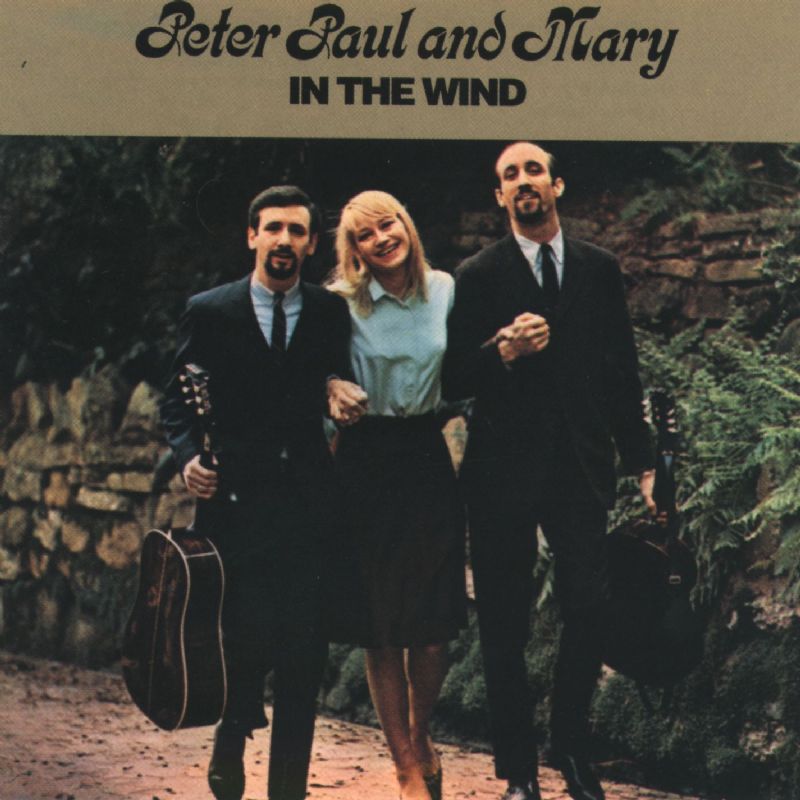
Okun, however, was also the musical director and arranger for another young and eager folk trio called Peter, Paul, and Mary, and he brought the song to them. PP&M did everything that the CMT had wanted to do with the song. They titled an album In The Wind, released the song as a single (it sold a million copies and hit #2 on the Billboard charts) and performed the number before ML King's "I have a dream " speech during the August, 1963 civil rights March On Washington. The success of the song made both Dylan and PP&M household names in the U.S.

So next - the stirring version by the CMT that was almost the first time most Americans would hear the song:


And a fine and feeling version it is to this day. But the vagaries of fate being what they are, here is the first that most Americans ever heard of Bob Dylan - Peter, Paul and Mary performing on the BBC what had been one of the great recordings of the era:


If you weren't around in '63 and didn't hear this on the radio for the first time - you have no idea of the electric thrill that went through millions who listened. And children - this was #2 on Top 40 charts. It signaled a new era in songwriting and popular music.

Almost immediately, other artists in droves began to cover the song, one of the earliest and best being the sublime Judy Collins, here live at the Newport Folk Festival:


Interesting variation on the melody, chord structure, and rhythm.

The Kingston Trio included a rather perfunctory cover of the song on their mid-1963 Sunny Side album, but that studio version paled in comparison to those by the artists above. In 2009, however, Folk Era Records released a CD of a 1963 concert in Kentucky by the group with a version of the song that rivals the CMT and PP&M for its power:


Of the thousands of other covers, hundreds of which are on the web, here are some of the best:

Dolly Parton:


Dylan's old friends Liam Clancy and Odetta, who died within months of each other:


Bruce Springsteen, 1985:


Glen Campbell and Stevie Wonder:


Joan Baez & Bobby D:


Punk Version From Cover Artists Me First and the Gimme Gimmes:


Poet W.H. Auden once wrote that poetry makes nothing happen; he was being slightly ironic, of course, because without poetry and the visions that it creates, nothing ever happens. Cannon balls may still fly and too many people still die - but if misery ever lessens or ceases, it will be because people will question why it has to happen. And they'll be singing "Blowin' In The Wind" when they do.