Friday, October 15, 2010

Country, Folk, Harlan Howard, And "Everglades"

A long time ago, back in the early days when radio and records were getting their nearly simultaneous starts as mass media, marketing categories and their accompanying labels didn't really exist as we know them today. Basically, all music was divided into "serious" (what we today would call classical or orchestral) and "popular" (encompassing everything else).

Radio and records in the 1920s helped to create a national audience for popular music that initially had had viable markets only in fairly well-defined regional and racial communities. Ragtime had enjoyed a pre-radio burst of popularity in the very early 1900s thanks to sheet music, but it was not until the 1920s that originally regional music like Dixieland, other forms of jazz, pop Hawaiian, and "hillbilly music" began to reach gradually into the national consciousness.

That last category was the radio station and record company name for what later came to be called country, western, and folk music. In 1940, no great distinction was made among these, though with hindsight we can see the different origins of each - and recognize that the "western" music of, say, Bob Wills and the Texas Playboys was a different breed of cat than the "country" music of Bill Monroe and the Blue Grass Boys. Both may have had some points in common with Jimmie Rodgers and The Carter Family, but a lot of people today might find it odd that in 1950, Pete Seeger and the Weavers and Burl Ives were pigeonholed for marketing purposes into the selfsame category. A glance at old issues of Billboard from the late 1940s includes frequent references to both those artists as "hillbilly singers." It also explains why the National Association of Recording Arts conflated "country" with "western" music to award its first Grammy in that category to a group that would next year win the association's first award for "Best Ethnic Or Traditional Recording," the Kingston Trio.

Country music and folk music have always been somewhat like cousins who look alike but really don't get along. As much as the two related forms of music have cross-pollinated with each other over the decades, there has also been a fair amount of public antagonism between them. Some country artists were among the most scathing critics of the instrumental simplicity of the early pop folk groups, and I imagine most of us of a certain age remember country singer Charlie Rich burning the envelope on stage and on national television that awarded the 1975 Country Music Association's "Entertainer of the Year" trophy to folk-oriented John Denver.

And yet - given contemporary country music's nearly total abandonment of its roots (with exceptions like Ricky Skaggs) and the morphing of what record and Grammy people call folk into an unrecognizable hybrid or mishmash - is it any wonder that the now-wide umbrella of "roots music" should include artists like Johnny Cash (always more folk than country), the Carters, Pete Seeger, Willie Nelson, Woody Guthrie, and it seems nearly anyone else who ever played an acoustic guitar?

At the height of the folk revival, the artists borrowed frequently across genre lines. Jimmy Driftwood was country, but "The Battle of New Orleans" could have been done by any pop folk singer and his "Very Unfortunate Man" was, by both Burl Ives and the Chad Mitchell Trio. Billy Edd Wheeler and Danny Dill both wrote songs performed across those genre lines as well.

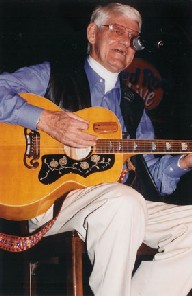
So it cannot be much of a surprise that one of Nashville's most prolific and successful country composers, Harlan Howard[pictured above] (1927-2002), contributed this week's chestnut, "Everglades," to the folk repertoire. Howard was just getting his start in Music City in 1960 when the Kingston Trio included this composition on String Along, their fifth consecutive studio album to hit #1 on the national charts and earn a gold record. Howard had already had two recorded hits, but in 1961, fifteen Howard-composed songs hit the country charts - eventually in his long career, more than 100 of his songs became hits, including such standards as "I Fall To Pieces" and "Busted." He is in the Country Music and Nashville Songwriters Halls of Fame - which he well could be simply for his pithy description of what songwriting should be - "Three chords and the truth."

The delightful "Everglades" has a couple more than three chords, and I'm not sure how much "truth" there is to it - but then again, it's an early Howard composition, just for fun, and not fraught with the heartbreak and hard times themes that characterized his best-known songs and helped to shape country music writing ever since. So our first version ought by rights to be from a country singer, and I know of none better than Waylon Jennings, who recorded an entire album called Waylon Sings Ol' Harlan:


This would seem to be the way Howard conceived of the song; he played along with Jennings on the recording. But he couldn't have been unhappy when the Kingstons sold about three quarter of a million albums with his song on it, however they adapted it to their own style. He would have made well into the six figures in today's dollars in royalties for this version:


A minor note on the recording: trio member Dave Guard is playing a jumbo Gibson 12 string guitar here, perhaps for the first time on a KT recording, a special order of his inspired by seeing the jumbo Gibsons played by the Everly Brothers (see below) referenced in the joking last line of the song.

Roots music pioneer Willis David Hoover gave the song a go (I think I have to thank Dave Long or Curt Dalton for posting this one - gentlemen?) late in his career. He seems to mock the KT a bit in the intro but without any genuine malice, and he does point out Howard's good-natured joshing at the end of the song:


We also have one delightful non-pro version inspired by the KT. John Dennis Dickey is a YouTube friend of mine who is a long-time trio fan, a member of the his own South Coast Trio, and creator of a goodly number of solo multi-track recordings. I'm happy to be able to include his take on the song:


My own upload of the KT version of the song presented above has generated more nostalgic and positive comments than any other single song of theirs of the 70 or so I've uploaded for this series. The general tenor of the comments is - "I'd forgotten this gem and why don't they make music like this any more?" Amen to that.

Appendix

Here is Howard himself performing the song in an upload appearing a few years after this article first appeared:


Further....Howard's "I Fall To Pieces" that became a monster hit for Patsy Cline:


Finally, the Everlys with their jumbo Gibsons and "Bird Dog," whose guitar riff figures in the KT and Hoover videos above:


And Howard's official website and bio are certainly worth a look here:

Harlan Howard's Official Website

Friday, October 8, 2010

"My Lord, What A Morning"

There is an odd little religio-literary motif that originated in the high middle ages called "The Paradox of the Fortunate Fall." The good monks and scribes and eventually the university theologians and philosophers who emerged from their ranks, inspired by some thoughts from the very early St. Augustine and St. Ambrose, decided that hidden within the Christian belief in the catastrophic fall from grace of original sin was a blessing - that only through the awful evil of sin could humanity have learned of the profound love of a creator who would send and then sacrifice his son for its redemption.

That may seem like a very, very strange beginning for a piece on folk music, even for me. But there was something about that phrase that kept popping into my mind as I was plotting this post as I always do while commuting to work. The Fortunate Fall - that a great good could come from a seemingly ultimate evil. I recalled that a character on the television show The West Wing a few years back described slavery as "America's original sin," and it would be hard to dispute that, not simply in its initial 17th century inception in the colonies but in the fact that it took eight decades and the greatest cataclysm in U.S. history to expunge that sin, or at least begin to.

Yet it is equally beyond dispute that from this great wrong emerged some of the most important, vibrant, and enduring elements of American culture, the first and perhaps the most enduring of which is the spiritual. Before ragtime and blues and jazz and the rock music that emerged from these were the religious songs of the slaves that became the prototype for all of the rest of American music that emerged from African-American culture - European chromatic-scale melody lines underpinned by African rhythms and harmonic tonalities. The spiritual is our first wholly American form of music.

I've presented profiles of several of these that were covered fairly often during the folk revival period - "Oh Mary Don't You Weep," "All My Trials," and "Good News." I mentioned in one post the belief held by a number of responsible scholars (and vehemently rejected by others) that in some of these songs were "coded messages," including instructions to slaves on how to escape bondage on the Underground Railroad in songs like "Follow The Drinking Gourd." Whatever one thinks of the validity of that supposition, a fact that is self-evident is that a very large percentage of the spirituals included references to the end times - the day of judgment and the salvation from the bondage of sin and death. Coded messages or not, the parallel between Christian eschatology and the slaves' dream of freedom is obvious and undeniable.

One of the greatest of these forward-looking songs is "My Lord, What A Morning." We might think of it as the inverse of "When The Saints Go Marching In." The latter song's lyrics are full of the dread of judgment and are clearly a fervent prayer "to be in that number" of the saved, whereas "My Lord" is upbeat and optimistic: the singing congregation by contrast fully expects to be among the elect, and the dire disasters of the apocalypse are for them a clarion call to the "new world to be revealed."

The original song was performed at that moderate-tempoed, swinging rhythm that we associate with many contemporary gospel numbers. Here from France a couple of decades back the Elikya Gospel Singers performing "My Lord" in that style:


The great operatic soprano Marian Anderson often delved into her musical heritage to perform spirituals, but she did so in the idiom in which she had been trained:


Anderson recorded this in the 1930s, and she is attempting to communicate the essence of black American culture in what she felt was a dignified manner that white America could understand.

Also in the operatic vein is Switzerland's legendary Hugues Cuenod, who just celebrated his 108th birthday in June. What is most remarkable about this performance is that Cuenod is the only singer here - all three voices (counter-tenor, tenor, and baritone) are himself alone:


On perhaps a more familiar footing for this blog, the Kingston Trio in 1962 gave the song the familiar uptempo KT treatment:


As usual, there are the kinds of innovations here that made purists uncomfortable. The Kingstons, not unlike Marian Anderson, have translated the song into their own idiom and make no attempt to replicate the distinctively black American intonations and rhythms. Even more - the bongos in the accompaniment give the song a Calypso-styled lilt that the Trio was comfortable with but which in no way resembles any traditional approach to the song.

Likewise, Australia's wonderful Seekers given an effective folk-styled reading with a bravura lead by Judith Durham:


My good friend and fellow folkie Bob Burlinson of Pennsylvania (soon to be Northern California, though) was kind enough to point this one out to me. That last high note that Durham sings is sublime.

And since we seem to be - and I emphasize seem - far afield from the roots of "My Lord What A Morning," why not a jazz-blues-flavored saxophone instrumental by Croatian jazz artist David Kocijan:


I love what Kocijan is doing here. The protean nature of a good folk song means, as I think Comparative Video 101 has demonstrated thoroughly over the last couple of years, that this music can be successfully and respectfully translated into a wide variety of different styles. And neither of these last two versions, the Calypso-tinged Trio version and Kocijan's jazz rendition - is quite as far from the roots of the song as some might allege. Or have we forgotten so thoroughly and so soon from whence those Caribbean rhythms and jazz tonalities originate?

Addendum, July 2012


A fairly recent upload of the song by the progenitor of all pop folk groups, The Weavers - this the second troupe with Erik Darling.They had recorded it as "When The Stars Begin To Fall."

Thursday, September 30, 2010

"The Erie Canal/Low Bridge"

"The Erie Canal" song represents a confluence of many of the deepest, longest-term, most cherished and most abiding interests of my entire life. It is one of the very first songs that I ever remember hearing and singing along with, back in the very early 1950s to a children's record that featured what was probably Burl Ives' version. It reflects on what was one of the most moving chapters in early American history, which with literature has been the greatest intellectual joy of all my years. It is, as we shall see, a nostalgic reflection on a time that had already past when the song was published - and we Hibernian Americans are nothing if not nostalgic. Finally, it reflects in its lyric the best of what America used to be and can be again - a land where government in partnership with energetic individuals works best to serve the interests of the common people who work for a living, and not the interests of those already-fabulously wealthy folks who plead, then as now, for just one more break that will somehow mystically redound to the Greater Good while it further enriches them.

The Erie Canal project was the Mission to the Moon of its day - widely considered an impossible folly, it was completed on-time and at budget and began immediately to pay for itself, not only in dollars but in the improvement of the quality of life for hundreds of thousands of Americans in the Northeast, the Great Lakes region, and the Upper Midwest in general. Just as the voyage to the moon engendered directly or indirectly a plethora of useful technologies (including most of the advances that led to the computer I'm typing on and the internet to which this will be published), the Erie Canal provided an economic lifeline for all of the Americans who had moved into the old Northwest Territory that we now call the Midwest (my birthplace, not coincidentally). The Canal created a cheap and dependable transportation link that enabled farmers and miners and settlers and lumbermen to put cold, hard cash in their pockets and improve their lot and that of their families.

While canals linking Lake Erie at Buffalo, NY with the Hudson River (and consequently the Atlantic Ocean) at Albany had been proposed as early as the 1760s, it took the vision of career politician (an honorable term, once upon a time) DeWitt Clinton to realize the dream. Clinton had held virtually every important office in the short history of the state of New York - state legislator, mayor of NYC, U.S. representative and senator (and nearly successful presidential candidate), lieutenant governor, and finally governor. In the latter two capacities, Clinton cajoled, bullied, and persuaded the NY legislature to budget $7 million to build the canal - an unthinkable, TARP-like sum at the time, when the federal budget in DC was a mere $19 million per year. Clinton understood that no amount of privatization or outsourcing could make this project happen. It was a government enterprise all the way, and it was government that succeeded in accomplishing a task that most rational people thought impossible.

It took a mere seven years to complete the 363 mile "ditch," including 83 locks that enabled the flat-bottomed barges to rise the 600 foot differential between Albany and Buffalo. It was the most stupendous and amazing feat of civil engineering of its era - and this despite the fact that none of the men who planned the route and the locks were professional engineers or government employees. It was truly a marriage of the vision and energy of private citizens with the sponsorship that only a government acting as its incorporated citizenry could provide.

The Erie Canal also gave rise to a subculture of teamsters and boatmen and merchants who quite naturally gloried in their roles in this wondrous achievement and consequently and of course sang about it. There were some great songs - "The E-Ri-E Was A-Rising," "Oh! Dat Low Bridge!," "Raging Canal," and of course, this week's selection, likely the most famous of all, published in 1905 as "Low Bridge, Everybody Down" by Thomas Allen. Allen maintained that he composed the song as a nostalgic tribute to the then-vanished mule teams and drivers who had originally pulled the barges through the canal at fifteen miles a day, replaced eventually by steam cars that could do the job cheaper and faster. But Allen was likely drawing to a degree at least from songs that had actually been sung by the workers themselves - in the best folk tradition, he borrowed and stole and invented and re-arranged until he had a song that was simultaneously all his but with a musical DNA stretching back decades before.

I found it just a tad discouraging that I couldn't find on YouTube or elsewhere a Burl Ives recording or one that sounded really like the version I learned as a child - but this amusing video from theBigFish [sic] comes fairly close:


You can hear Allen's musical sophistication here - the key and tempo shifts, with the melancholy minor-keyed verses resolving gently into the positive, upbeat major chord chorus. This version is a bit too Springsteen-ish for my tastes, but it is the basic song with minimal embellishment.

[Interpolated Edit - May 2012: Eureka! A video of Pete Seeger doing part of the song has been uploaded to YouTube. I wish Seeger had done the whole thing - but at least we can get the idea of how the song should sound:


Now this really amateur home recording from RoseMarama of New Zealand at least has the virtue of solo guitar accompaniment:


I think Rose does a commendable job - at least she performs it like a folk song and really seems to enjoy doing so.

This version from 1958 features Mitch Miller's group on background and the Sandpipers:


The Corndoggers start out promisingly and carry a good boat-man-sounding vocal throughout - but then instrumentally they go all Springsteen on us. Too bad:


I can do without the drums, guys. It's a FOLK song.

Sony-BMG has blocked virtually every video of Bruce Springsteen performing his 2006 Seeger Sessions version of the song, except for an occasional bootleg that manages to pass under the radar, as in this crude cellphone video from a Dublin performance:


I had a mixed reaction to the Boss's Seeger project (much as Pete himself did). Springsteen is a rocker, one of the best that this country has produced. But as we all know, rock is derived primarily from black blues and rhythm and blues traditions. I thought that Springsteen's best efforts on that album were those that tapped into black traditions, spirituals like "Oh Mary Don't You Weep" and "When the Saints Go Marching In." I didn't feel that Euro-Anglo-Irish derived tunes like "Jesse James" or this one worked particularly well at all.

And now for some genuinely different versions - first, the Kingston Trio:


This is one of the last Public Domain numbers attempted by the group. It's a serviceable arrangement - kind of a "generic uptempo folksong" reading that sacrifices the emotional nuances of the original for a kind of good-timey feeling that is more anticipatory of what in 1962 the New Christy Minstrels were about to do with pop folk music than reflective of the more sensitive and often introspective folk arrangements of the original Trio.

Speaking of different - here is a soul arrangement by The Juke Box Band:


The rhythm here is a fascinating melding of reggae with straight-up R&B. Maybe not folk, but a "noble experiment."

Frank Macchia's All Star Jazz Band likewise combines a bit of Dixieland with a more contemporary ex-temp jazz style - a really interesting crossover:


This CD of Machia's is called Folk Songs For Jazzers, and that about says it all. It is a great effort, and if the song is propelled far beyond its folk roots, it's still nice to see kissing cousins jazz and folk getting along so well.

When I was a boy, I loved "The Erie Canal" song's shift into the major key on the chorus, and I sang along lustily. I suppose that now I am a lot older, it is Allen's nostalgia that touches me most deeply. Our boatman's affection for ol' Sal - an anachronism whose time has passed - connects somehow with my wistful memories of a time when folk was folk and an acoustic guitar and/or banjo and a good song like this one was all that you needed to make compelling music that people would connect with and listen to.

Friday, September 24, 2010

Rod McKuen's "Doesn't Anybody Know My Name?"

I never really thought of Rod McKuen as having anything directly to do with folk music, and I kind of doubt that he did either. That is no kind of criticism at all - he is what he is, and that is a fine pop songwriter who writes rather more in the French cabaret tradition of pop music than in the American Kern-Gershwin-Berlin-Cahn-Bacharach/David tradition. And though pop folk groups like the Kingston Trio and the Limeliters had a lot to do with propelling McKuen's earliest songwriting efforts into the national consciousness, his staying power as a songwriter has come from the large number of pop vocalists who have recorded his tunes. Frank Sinatra's 1969 album A Man Alone is comprised entirely of songs by McKuen, the only time in Sinatra's long and legendary career that Ol' Blue Eyes paid any songwriter (and he worked with all the great ones) that kind of compliment.

I discussed McKuen's controversial career as a poet a year and a half ago when I wrote about his freehand rendering of Jacques Brel's song "Le Moribond" as "Seasons In The Sun: - but some of the exact points at which he is vulnerable to (often savage) critiques as a poet are precisely the points that stand him in good stead as a lyricist. His words are often simple, transparent, and emotional verging on the sentimental. This may or may not make for good poetry, depending on your tastes, but these qualities make for often very effective lyrics when set to the kind of reflective, often Brel-sounding melodies to which McKuen sets them. Now 77 years old, he still writes and performs, singing in that peculiarly affecting throaty baritone of his.

I always thought that McKuen the composer was at his best when, as with French writers like Brel, his lyrics and melodies were tinged with a kind of fin de siecle melancholy, a sadness as gentle as an autumn mist. Think, for instance, of the lyric derived from William Butler Yeats in McKuen's "Isle in the Water" - the subtle changes he makes to Yeats' poem and his original lines make even this love song quietly wistful. "Love's Been Good To Me" is one of the 60s best reflective ballads, and "Rusting in the Rain" is surely one of the loveliest of all laments for the passing of time and the inevitable changes that it brings.

McKuen's "Doesn't Anybody Know My Name?," also known as "Two-Ten, Six-Eighteen," falls right into line with the songs cited above. Like "Rusting in the Rain," a large part of the emotional impact of the song comes from an individual returning to a familiar place and finding that it has become most unfamiliar due to the changes wrought by the inexorable passage of time. That fact that the returnee is an American soldier coming home from an unnamed foreign war to a people who have forgotten him and his sacrifices on their behalf makes this tune about as close to a "protest" song as McKuen would write.

McKuen composed "Doesn't Anybody Know My Name?" in the 1960s, which could lead easily to a misinterpretation of it that would both undermine its universality and do it a great injustice. It is not about the Viet Nam war, though it is eerie how clearly McKuen's lyric anticipated what would become the experience of many a returning VN vet in the decade following its 1962 composition. Given McKuen's age, if there IS any specific conflict motivating him, it is far likelier the Korean War that was fought largely by men his age. In 1962, the U.S. had a smallish military presence in Southeast Asia - perhaps 25,000 soldiers then compared to the 600,000 at the height of the war - and U.S. participation in the growing conflict still at that point enjoyed fairly widespread popular support.

Part of the song's effectiveness is that it takes no political side about any war. It relates the experience of the return home through the eyes of the soldier. In his mind, he has "nearly died/To keep us free" - and perception in this case is the equivalent of reality. McKuen's comment that no returning veteran should be nameless and shunned is one that could and does apply to any war, any where, any time.

Our first version of the song is from McKuen himself, here from about 1970:


This is McKuen's original lyric, one that the Kingston Trio shortened by an entire line in each verse in their version. Once again, I'm using the 1963 concert version of the song from the 2009 CD Flashback because I think that Bob Shane's vocal is greatly superior to the studio version from the album Sunny Side:


Johnny Cash was gifted with a voice whose timbre lent itself most naturally to songs of melancholy and loneliness, and though the Man In Black was most often characterized in his lifetime as "country," he is more properly appreciated as what today is called "roots," which means with a healthy pure folk influence as well - which you can hear in this version remarkable a capella version of McKuen's composition by Cash:


No genre-identification problem with the next two artists. Return with me now to those thrilling days of yesteryear when country music really was country music, first with one of the genre's all time greatest artists, Waylon Jennings:


and Hank Williams, Jr. from 1963:


Both of these last two are solid, professional efforts. I think that Jennings does the greatest justice to the song of all the versions presented here.

A final thought. The peroration or grand conclusion of Abraham Lincoln's second inaugural address, arguably the greatest speech ever written by an American, looks past the awful cataclysm that any war is and urges the nation of his time - and really all nations in all times - "to bind up the nation's wounds, to care for him who shall have borne the battle and for his widow and his orphan, to do all which may achieve and cherish a just and lasting peace among ourselves and with all nations."

All you can say to that is "Amen."

Friday, September 17, 2010

"The Streets of Laredo"

Like baseball, jazz, the personal computer, and about a million other things, the cowboy ballad is a strictly American invention. Of course, as we'll see shortly, many of them are based on older songs of everything from work to murder, but the peculiar alchemy of the American experience has distilled those earlier tunes into a very distinctive folk form, one that reflects the hard life that engendered the songs in an underlying melancholy and an often mordant and biting (if very dark) humor. While my personal favorite cowboy song has always been "Get Along Little Dogies" - probably because that is one of the first songs I remember ever hearing in my life - my own number two would be what is by common consent the best-known and quite possibly the best of the real traditional tunes, "The Streets of Laredo." The very name conjures up a host of images - the paintings of Remington and Russell, a book and TV miniseries, and a scene or two from just about every Western film ever made. The real Laredo, Texas is a border town in the southwestern part of the state - not exactly prime cattle country and far off of the beaten trails of the great cattle drives that started in the center of the Lone Star state and ended in the truly wild and lawless prairie railhead destinations of Wichita, Dodge City, and Abilene. "The Streets of Laredo" has about as fine a pedigree as you could ask for in a folk song. Most sources will tell you that it appears to be descended from a 17th century English folk number called "The Dying Rake" - that last word meaning, of course, what our generation would have called a playboy and what the young 'uns today call a player. But we who are blessed to be of Irish extraction know better. Sure, the dying young man lyric might indeed come from the Brits - but the tune is note for note a derivation of the great Irish lament "The Bard of Armagh," composed by the very real if mysterious Phelim Brady. But that song (video below) is written in a straight 4/4 time signature, which means that it's just a regular da-da-da-da beat, if a bit slow. In an exceptionally odd transformation, the American Laredo version takes the melody and converts it to 3/4 time - DA-da-da - which is a tempo most commonly associated with the romantic waltz and not really what you'd expect from a dying cowboy. See note above about a mordant sense of humor. So out first performance here is of the Irish ancestor of the Laredo song, performed by one of the great folk singers of the last century, Tommy Makem, whose signature song this was and who himself hailed from Keady in Armagh and hence was himself called through his life "The Bard of Armagh": Makem's best version this is not, IMHO. That was at the 1959 Newport Folk Festival, where Tommy was accompanied only by the supremely tasteful Bruce Langhorne, who realized that the point of a guitar accompaniment is to support the vocal, not overwhelm or upstage it. And whoever is playing guitar here (definitely neither Makem nor Liam Clancy, who in a score of lifetimes would never play this way) is distorting the melody with a bunch of major and minor seventh chords that just don't fit here. Sadly, as of now, this is the only Makem performance of the number on YouTube. An offshoot version of this song, one that incorporates the dying youth motif from the British version, is a well-known blues/jazz standard from New Orleans called "The St. James Infirmary." The melody is only vaguely similar to "Laredo/Armagh" but the kinship of the lyric is clear. Doc Watson here does an Appalachian version called "St. James Hospital": For "The Streets of Laredo" - why not start with maybe the best of all cowboy singers, Marty Robbins: All Robbins ever needed to turn in a sublime performance was that impossibly small guitar he often played. But his studio version of the song has other virtues, including some secondary orchestration that includes a brushed snare drum that emphasizes the waltz tempo even more clearly than Marty's strumming does above: Johnny Cash recorded several versions throughout his long career, never more effectively than in this moving rendition on his American Recordings series from the years just before his death. Cash includes the reference to the "dance hall maidens" in the unexpurgated lyric. The "Rake" song makes it clear that the British youth is dying of syphilis, but that indelicate fact is masked in the American version by the fatal gunshot wound. The great Chet Atkins uses "Laredo" as the second half of a medley with "Greensleeves" to wonderful effect: Atkins plays the "Laredo" melody with a harmony a third under the melody and gives it just a bit of a flamenco-like lilt, which I believe is a tip of his guitar to the Mexico border town origin of the song. Finally, we come to what I have regarded since the first time I heard it as a major disappointment and a massively missed opportunity, as the Kingston Trio turns the song into a one-shot joke: The live audience clearly enjoyed it, and I suppose that the fact that every folk/western/country singer had given the song a try made it ripe for satire. But no one else even thought to create the arrangement that Shane, Reynolds, and Stewart did. Note that all of the "Laredo" arrangements above are roughly similar, based as they are on a mostly two chord accompaniment, often in the key of D. The chord progression there is then mostly a I - V7, or just a D to an A7. But the Trio infers the tragedy of the lyric and comes up with two radical changes. First, the second chord in the pattern is an A minor 7th, which lends a real sense of drama to the accompaniment, a dark shading perfectly consonant with the bleak tale of the lyric. Second, though they preserve the basic 3/4 timing, they hurry the accompaniment with Nick Reynolds' intense and almost-flamenco-sounding speed strumming that supports what I have called the "quiet urgency" of so many vocals of the Guard era Trio and almost never invoked in the Stewart years. The stage is set for a classic Kingston Trio non-traditional but brilliantly re-imagined folk song. And then the deflation - a joke that I didn't find funny the first time and never have since. I remember being tremendously disappointed and chagrined. One big problem with the joke is just that it is way too self-referential. From "Zombie Jamboree" through the Seven-Up commercials through concert patter, Nick Reynolds was the butt of much of the group's onstage humor. The concert audience knew this - the Kingstons were the most popular act in the U.S. at the time, and it's a safe bet that most of the people knew of the ad campaign and the other NR jokes. But without that frame of reference, the joke becomes as flat as a week-old open can of soda. Most folks who didn't know the internal group dynamic would not have found it funny in the first place, and literally no one for whom I've played the cut today even cracks a smile. But each to his own. "The Streets of Laredo" is such a great song, so evocative, so American that I still feel bad that we missed out on hearing what would have been the best recorded version of the song - which is why I invariably stop this last video at 1:08.

Friday, September 10, 2010

"Rockabout My Saro Jane"

Rivers seem to play a larger part in American folk music than they do in that of just about any other country. Sure, there are some Irish folk songs about the Shannon, and the Scots' "Flow Gently, Sweet Afton" is a standard; students of French probably remember singing "Sur le pont d'Avignon," and I have no doubt that the Rhine and the Volga and the Yang-tze and all the other big rivers have inspired some folkloric response.

But consider the rivers of America and the scores of songs they have inspired. The Hudson. The Chattahoochee. The Potomac. The Shenandoah. The Ohio. The Rio Grande. The Arkansas. The Red. The Wabash. And the Father of Waters himself, the Mississippi...and those are just the high profile waterways that have songs attached to them.

It is easy to understand why, since first, those rivers were the principal highways to and through the vast interior of North America in the days before railroads. But fully as important, I think, is that fact of the sheer majesty, power, and beauty of so many of them. If you'll forgive another short list - the Hudson at West Point. The Shenandoah at Harper's Ferry. The Ohio in southern Indiana. The Mississippi a mile wide near Cairo...so many more.

I have always loved the river and riverboat folk songs, perhaps second only to my love of a good sea chantey. Bob Gibson's first album in 1957 was called Folk Songs of the Ohio, and it was one of my favorites. The Weavers' "The E-Ri-E Was A Risin'" is a song that I still love to sing and play, as well as that great and stately cousin song, "The Erie Canal." You could do an entire book or a boxed album set on wonderful American river songs - and folkies have done so.

I suppose that reflecting on the very old "John Webb" song last week is part of what prompted me to pick "Rockabout My Saro Jane" for this week. I hadn't really thought much about the song for many years until recently. Last April when I was profiling Lou Gottlieb and his arrangement of "Good News", I remembered a passage from folk historian Ronald Cohen's Rainbow Quest that I used in the linked article and cite again here - Gottlieb told Cohen that

I had a wife and children and no money so I started working as a stand up comic and got a job at the Purple Onion. There were three guys there who used to hang around the Hungry i all the time. In fact, they'd be in the dressing room half the time. But they were cute....They were the opening act at the Purple Onion...Well, sir, these kids really had something different. There was a magic about that act that was hard to explain. When they made their first record...they needed a tune. I had a couple of old charts from the Gateway Singers that I quickly re-scored for three voices. They sang a song I stole from Uncle Dave Macon called "Rock About My Saro Jane" and put it on their first album. And they let me publish it. The royalties ultimately came out to thirty grand.
 
Here is Uncle Dave's recording from which Dr. Lou derived the arrangement to which he refers, courtesy of Chicago area roots expert Jeremy Raven:


Gottlieb was referring, of course, to the wet-behind-the-ears boys who were forming the Kingston Trio, and his arrangement of "Saro Jane" was a rousing opening number to the second side of that first album. I promptly forgot about the song (after remembering that I had indeed enjoyed it greatly) until late one night at the recent Trio Fantasy Camp in Arizona. A bunch of us were playing a few old KT songs in the Burns/Askins Hospitality Annex when Bob Shane and his wife Bobbie walked in and sat down to listen and sing along. Bobbie requested two songs that she said rightly that no one ever seemed to play at the camp, Stan Wilson's "I Bawled"...and "Saro Jane." Play them we did, and I was struck by what a fine arrangement Gottlieb had come up with and how much fun the song was.

As is obvious in the lyric, "Saro Jane" is a roustabout or stevedore's song from the Mississippi River. Alan Lomax also cites Uncle Dave Macon as the source, asserting that Macon learned the song in 1887 from black workers on the Cumberland River docks in Nashville but maintaining that the song was much older, probably of Civil War vintage. The late Rod Cook specialized in covering Macon's tunes and style - here he is with some absolutely first-class clawhammer on the song:


That is one fine sounding banjo, expertly played.

And here is what Lou Gottlieb came up with for the Trio - what they lack in finesse they make up for in energy:


Dr. Lou puts the verses completely in a minor mode and then creates a wonderful transition into the chorus by going to a major chord and then to a seventh leading into "Come on and rockabout..." - really nice.

Immortal Grass is a semi-pro assemblage from Haysi, Virginia whose rendition is a sort of bridge from Macon's old-timey mountain style to the more modern bluegrass interpretations upcoming next:


Something inside me says that folk music ought to be played this way - by a group of friends in a paneled parlor - with the lead singer in white socks. Perfect.

The Grascals are an up and coming "new grass" kind of act who put a good deal more professional polish on their rendition than the previous three videos demonstrate:


Finally, Wayne Shrubsall bills himself as "The Banjo Guy," and he delivers a different take on Dave Macon's arrangement than Rod Cook's. This video is well worth a listen for Shrubsall's introduction and his use of a century-old Vega/Fairbanks banjo:


In introducing "Saro Jane" in his Folksongs of North America, Lomax says that our country's interior rivers have been "pathways of folklore and song...made by men who shouted in triumph as the loads were hurled down, made by men who were driven by their own unbridled and beautiful strength to bring melody and rhythm...to the breast of the great rivers."

That's unusually poetic for Lomax - but it seems to me to fit perfectly for "Saro Jane" and a few dozen similar songs.

_____________________________________________________________

Appendix, April 2017

As I wend my way through the tedious taskk of changing the embed codes (the HTML that enables us to see these videos on this site) per the note on the left, I often run across an absolutely essential version of a song that was not available when I wrote the original essay. Just such a case is here. The New Lost City Ramblers - John Cohen, Tom Paley, and the late Mike Seeger - were the exact contemporaries of the Kingston Trio and other pop folkies, all of whom got started in 1958, but the Ramblers were as radically opposed to the popularizers as could be imagined. The NCLR wanted to demonstrate an absolute fidelity to the arrangements and identities of the tunes that the commercial groups were popularizing, and that is just what the Ramblers do here with this outstanding rendition of "Saro Jane:.