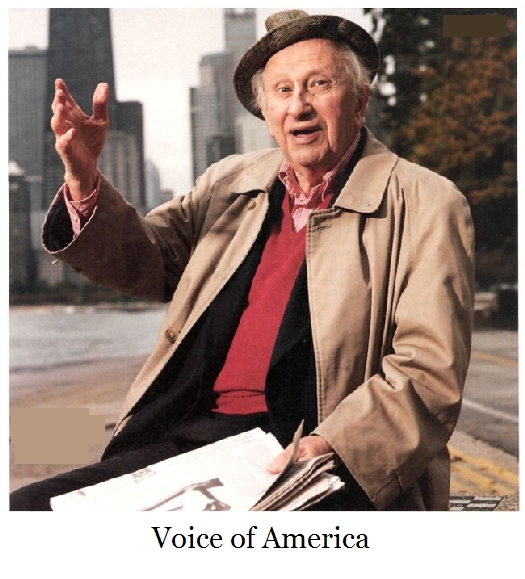
Friday, October 31, 2008

In Memory Of Studs Terkel (1912-2008): "The Midnight Special"


Studs Terkel died today at the age of 96, and though you likely have to be from Chicago as I am fully to appreciate the import of that loss, everyone who loves folk music and a good read and oral history and the United States of America should take some note of his passing.

I'm betting that the obituaries will focus on Terkel's really marvelous series of oral histories, most of which reached best seller status and whose titles are likely familiar to many who read here : Hard Times with ordinary people telling of their memories of the Great Depression at a remove of forty years; Working , in which ordinary people talk about the jobs they do and how they feel about those occupations; and maybe the best known, The Good War , in which ordinary people (sensing a trend here, are we?) recalled their parts in World War II , written in the 80s long before "the greatest generation" commotion began to surface and when Terkel's interviewees were still vigorous and about the age that most of us here are now - with a developed sense not only of what they did and what they lost but how it colored and shaped the rest of their lives.

But Terkel was much more than a writer with an innate sense of the stories that needed to be told and an interviewing genius that enabled him to elicit the most intimate, profound, and frequently moving revelations from his subjects (and Terkel rarely put himself into his narratives at all). He was an activist, a blacklistee, a bit of a poet, founder of the Old Town School of Folk Music with Win Stracke and Frank Hamilton (later of the Weavers) that produced luminaries like Bob Gibson and Jim (Roger) McGuinn - and the host of an incredibly interesting radio show in Chicago for well over forty years. Though the show was eponymous, it was promoted by Chicago's WFMT-FM radio station for all the years of the folk revival as "The Midnight Special" (though memory tells me it started at 11 pm).

Terkel loved all kinds of music and played them all - experimental jazz, blues, occasional show tunes, and anything that could be called folk. Though he favored populist/leftist and traditional singers - no surprise there - he also enjoyed pop folk and played the KT, the Clancys, and the Chad Mitchell Trio frequently. It was on Terkel's show that I first heard many of the old folk performers I'd only read about on album covers or in articles, Leadbelly, Big Bill Broonzy, Sonny Terry, Cisco Houston - all of whose records I subsequently bought and enjoyed because of Studs Terkel.

When I heard that he died this afternoon, I changed my plan for Weekend Videos and recalled that Terkel often opened and closed his show with this recording of Leadbelly doing "Midnight Special" - this very recording:


You can't compete with the original cats, as Dave Guard said of Hawaiian musicians on Live At Newport - but NBJ gave them a run for the money with the raw, uptempo energy of their performance of the song from the first Decca album - a performance that deserved a much better production and mixing than it got (can we spell V-O-Y-L-E-G-I-L-M-O-R-E?):


As I'm sure most here know, the song is a chain gang/jailhouse song from the penitentiaries of the Deep South at the turn of the last century, most especially from the work farms of Louisiana and Texas that gave birth to many great songs like "Old Riley" and "Ain't No More Cane On This Brazos." According to the legend most closely associated with the song, some prisoners believed they would be able to escape their (usually) life sentences if they could scratch their way up the high walls of their cells to the barred windows to catch the beams of the headlight of the passing train, whose lonely whistle fading into the night must have been a wrenching reminder of the freedom that they had lost, given away - or been robbed of.

I think you can hear all that and more from Odetta, who blessedly is still with us:


The first notes you hear on the next version are a then- unknown Bob Dylan playing mouth harp to introduce Harry Belafonte's bluesed-out and typically intense version. Reminds you of what a great singer Belafonte is.


Speaking of being blessed with the ongoing presence of a legend - here is Pete Seeger and his grandson Tao doing the song in January of this year when Pete was only 88. See my comment about Belafonte:


Even a good song can be done badly and a good group overreach itself. Here's a bad 70s flashback of ABBA trying their hand at the number.....


...and finally, a good 70s flashback which, if not exactly folk, deserves to close the show - John Fogerty and Creedence Clearwater Revival:


Always one of my favorite songs - and one I wish the KT had used as a show opener more often than they did.

Additions At 3.5 Years +

The huge catalog of folk songs on YT has grown exponentially since this post first appeared in 10/2008. Among the best and most classic performances of this song - The Weavers from around 1950:


...and Paul McCartney from 1991, reflecting his early roots in R&B and skiffle:

Friday, October 24, 2008

A Terrible Beauty Is Born: "Roddy McCorley"

We know their dream; enough
To know they dreamed and are dead;
And what if excess of love
Bewildered them till they died?
I write it out in a verse -
MacDonagh and MacBride
And Connolly and Pearse
Now and in time to be,
Wherever green is worn,
Are changed, changed utterly:
A terrible beauty is born.

- W.B. Yeats
One of the now-vanished delights of Trio Fantasy Camp was the Q&A session on Thursday night conducted from 2000 til 2005 by Nick Reynolds and John Stewart (with Bob Shane joining the party in 2006 and 2007). The guys would answer campers’ questions and regale the assemblage for up to an hour and a half with tales of the road, odd memories that would occur spontaneously, stories behind some of their song acquisitions, and memories of people and places long gone.

Nick and John were especially warm in their memories of The Clancy Brothers and Tommy Makem – John’s tale of a party in Theodore Bikel’s Greenwhich Village apartment where an over-earnest Bikel kept trying to sing some quiet and intense folk number, only to be interrupted at every start by a tipsy Tommy Clancy bellowing the opening notes to the brothers’ raucous version of “Haul Away Joe” [see appendix below] – Nick speaking feelingly of his close friendship with Paddy Clancy’s widow following the eldest Clancy’s 1998 passing - both recalling the drinking party in a Chicago hotel where Bob Shane taught the Clancys the pleasures of drinking rum.

At one FC after such reminiscences, Nick asserted with some asperity, “People criticized us for not doing enough protest songs. What the heck did they know? You want to hear a protest song? Listen to the Clancy Brothers sing ‘Roddy McCorley!’"

I had always loved Nick Reynolds for his humor and warmth, but at that moment I was ready to canonize him for his citing of what I had always regarded, years before I heard the Kingston Trio do it, as the very best of the hundreds of Irish songs of rebellion, a song finely crafted and demonstrating the touch of a genuine poet.

Though Roddy McCorley himself is a shadowy figure from the Great Wexford Rising of 1798 (more below), the song’s origins are clear. Poet Ethna Carberry  (the pen name for Anna Johnston) wrote the words in the late 1800s, nearly a century removed from the uprising; they were later set with her blessing to a fragment of an old air.

The original poem is rather longer than the four verses commonly sung today; the modern adaptation, which rearranges parts of some verses and leaves out others altogether, was done by Paddy Clancy, the eldest of the famous brothers, apparently with an eye to the standard length of the folk-type songs being sung in the U.S. at the time. The text of the complete poem is HERE.

For reasons that I cannot figure out, the song – though ragingly popular in Ireland since its creation – never caught on in the U.S. when other Irish rebel songs did, like “Kevin Barry” and “The Rising Of The Moon” and “Bold Fenian Men,” all of which were well-known in American Irish communities as long ago as the time of my own parents’ childhoods in the 1920s. All three of those and many more made their way into American movies, often as incidental or background music in John Ford’s westerns.

It was not surprisingly the Clancy Brothers and Tommy Makem who brought this wonderful piece into the heart of the American folk revival – and from them it was picked up by the Kingston Trio, whose massive commercial punch, even as relatively late as 1962, propelled it into the subconscious of two generations of Irish Americans and folk fans in general.

But first, back to Roddy himself. In the Rebellion of 1798, known by many names including The Year of the French (because of revolutionary France’s attempt to aid the rebels) and as noted The Great Wexford Rising (though there were more than a dozen counties involved in the coordinated attacks on the English military), local leaders became overnight heroes – and almost universally martyrs as well. We know little of McCorley except that he was a member of the group United Irishmen, founded by angry Protestant Presbyterians like himself (yes – Roddy was not Catholic!) who were infuriated by the British exploitation that in forty years would lead to the Potato Famine that killed two million and sent another two million packing, through the melancholy port cities of Waterford and Cork and Liverpool, to the foreign shores from which they never returned. (Thus did the Stevenses, Conways, Flahertys, and a Moran come to Chicago and combine to be my ancestors.)

McCorley was the leader of a sadly under-armed squadron in the town of Toombridge, County Antrim – pitchforks, no less - against a regiment of redcoat infantry. The rebels were cut to pieces with a few including McCorley escaping for a time. Roddy was later captured, convicted by a drumhead court martial – apparently with no defense attorney – and summarily executed by hanging from the ruined bridge in the town of Toomebridge. His body was dismembered by our British cousins and buried at different points along the road to Ballymena, though later his remaining friends exhumed the fragments and re-buried them secretly in a proper grave that was unmarked and unknown to this day. His descendants remain in Ireland, some actively involved in politics, and there is an active Republican “Roddy McCorley Society” linked below.

And now for the music. Instead of my usual practice of starting with the KT version, I’m starting with the first recorded version I heard, courtesy of Grandma Moran, around 1959 – from the Clancy Brothers and Tommy Makem’s first album on Tradition records (Paddy Clancy’s label – the records were at first recorded in the kitchen of his Greenwich Village apartment) to identify them as a group. This remains and will always be my favorite version of the song – just Liam on guitar, singing his heart out with Tom, Paddy, and Tommy Makem.

Since that audio-only piece was yanked for copyright, hers a similar performance from a live TV show in Chicago from 1962.)


It's clear that the KT took their cue from the Clancy's rousing performance. Here, familiar to us all, is the Trio from College Concert.


It took me a while to like this - I thought the drum stuff that frames the song was an unnecessary artifice, as if the guys didn't trust the inherent power of the words and their own fierce energy to carry the import of the number. I also thought that John S's banjo strum here was just wrong for the number - too syncopated and "Little Light"-ish for a song that should by to the 4/4 martial beat of boots tramping on sacred ground.

I heard it with new ears, though, when my young YouTube Irish friend Daragh, newly entranced with the KT, pronounced it the best version he had heard - and when he posted it, his Irish commenters universally loved it. And the Trio undeniably brings its signature, unmatchable energy to its performance.

County Antrim is in the ancient kingdom of Ulster, as is Keady town, birthplace of Tommy Makem. I have no evidence, but I believe that he brought this song to the group - the southern Tipperary-born Clancys had not included it on their Rising of the Moon album of Irish songs of rebellion prior to Tommy's joining the group, and it's certainly now one of the best-known of all the songs of that genre. Here is the authentic real deal - Tommy Makem solo toward the end of his life - a GREAT rendition:


And here's a fine performance that has another curious KT connection. The Wolfe Tones (a really popular and prominent folk group in Ireland associated with radical IRA politics and named for the most famous leader of the 1798 rising, James Wolfe Tone) perform "Sean South of "Garryowen." The tune is clearly the same as "McCorley" - but Sean South (pronounced 'Soot' or 'Sowt') was the other teenager killed in an abortive IRA attack on a British military barracks in 1957 that went awry when the IRA explosives failed to detonate. The first teen to be mortally wounded was Fergal O'Hanlon - referenced in "The Patriot Game."


In any form, it's a great song. Just as you don't have to be a Texan to love "Remember The Alamo," you don't need to be Irish to love what the KT and the others do with this one.


Appendix
Here's some extra stuff:

1) The website of the Roddy McCorley Society:
Official Roddy McCorley Web Page
2) 1962 video kinescope of the Clancys doing the posted version:


3) One of John Stewart's great hidden talents was as a mimic. I mentioned in the main post that John told a story about Tom Clancy interrupting Theo Bikel - well, here's how the Clancys sounded doing "Haul Away Joe" - and JS could do a stunning imitation of Tom Clancy, who sings this lead:


4) Finally - especially for Pa Mick Coates Down Under - the Dubliners' version, with Barney McKenna - as Mick says, the greatest tenor banjo player that ever was - if you don't believe so, just lsiten:

Saturday, October 18, 2008

Print The Legend: "Remember The Alamo"

For fans of classic western movies, it just doesn't get better than John Ford's wonderful The Man Who Shot Liberty Valance. The film's components are hard to beat - what's not to love about John Wayne (in one of his absolutely best performances) playing Tom Doniphon, an upright tough guy who is reduced to alcoholism and failure by an act of self-sacrifice for the woman he loves, or James Stewart as Rance Stoddard, a good man corrupted into a false success by that selfsame act, or Lee Marvin as a villainous Valance who would be a comedic stereotype were he not so casually, psychotically, and believably evil?

The film seems somehow perpetually relevant as well in its implied commentary on the nature of fame, especially in politics. Stoddard is retiring from a brilliantly successful political career as the movie ends - but a career based on a fundamental falsehood, one that contributes to the destruction of a better man than Stoddard will ever be.

Liberty Valance is also notable for one of the great tag lines of any western of that or any era - the newspaper editor's comment that "When the legend becomes fact, print the legend."

I'm always reminded of that line when I listen to what for many years was my second-favorite Kingston Trio song (after "Bay of Mexico"), the group's stirring performance of Jane Bowers' "Remember The Alamo," the last cut on the B side of At Large.

The album's liner notes, as I recall, identified Bowers as a "proud Texan who knows much of Texas lore" - and it is the lore of the Battle of the Alamo that we get in this excellent song.

Much, perhaps most, of what actually happened in San Antonio in February and early March of 1836 has been lost to history by neglect, personal and political agendas, and the simple passage of time. The motives of the defenders of the mission were not wholly pure (commander William B. Travis and perhaps a quarter of the Texians or Texicans were intent on creating Texas as a slave state in the Union, viewing an independent republic as only a temporary step), as many as a third of the garrison were Tejanos of Mexican descent, the garrison attempted to negotiate a surrender at least twice, and many of the casualties among the Mexican soldiers resulted from friendly fire because of the incredibly doltish plan of attack by General Antonio Lopez de Santa Anna, which called for simultaneous assaults from three sides causing his troops to fire into each other in volleys.

Other cherished myths about the battle reflected in the Bowers' song also do not stand up to historical scrutiny - to wit: serious historians question whether or not Travis ever drew a line in the dirt with his sword (likely not), Bowie was probably unconscious and near death when bayoneted in his pallet (ouch) by Mexican soldiers who took him for a coward hiding from them, and Davy Crockett was 50 years old, alas! young neither then nor now.

I'm not sure how much of this Bowers knew, and in light of the intent of the song, I don't think it matters much. Here's the KT's version (parenthetically, my first attempt at making a Windows Movie - pardon its crudeness, but it's still better than a stationery image!):


The highlights of this outstanding recording are IMHO first the arrangement (more on that below) and second Bob Shane's incredible rhythm guitar strumming, unmatched in any other version.

I had always thought that Bowers had written this either for the KT with them in mind - but not so, as this version from 1956 by country legend Tex Ritter demonstrates:


Ritter's version, perhaps the first recorded, differs significantly in the chord structure of the accompaniment from the KT's. NBD replace the major chords that Ritter uses with some unexpected sharps and minors that create that flamenco-based sound in their version - very unusual for a banjo, BTW, and I think hugely more effective.

I always try to find an unusual version for these weekend video posts - and here's one from an Irish group called Gaelic Mist:


Surprisingly - the flower-power icon, Mr. Mellow Yellow himself, Donovan Leitch in a creditable version:


Apparently Bob Dylan also recorded this, though I can't find a video of it.

Finally - a real performance video from someone who really knew how to give a performance - Johnny Cash from a 1982 TV special. Cash recorded the song first in the 60s, and I think it's particularly well-suited to his voice and style:


The cultural value of legends, of course, is that they codify the values and beliefs of the people who tell and believe in them. What actually happened at the Alamo and how one regards it is today something of a political Rorschach test, much as is the Battle of the Little Bighorn.

But five decades ago, Jane Bowers and the Kingston Trio seemed more primarily concerned with honoring the mythic courage and sacrifice idealized in the song than in teaching a history lesson.

They printed the legend, and did an up-and-walking good job of it.

Saturday, October 11, 2008

The Mountains Of Mourne

I was always a bit puzzled by Dave Guard's comment in the Elizabeth Wilson interview (most of which is available at Dave Guard Interview under "Read, Look, and Listen" starting on p.22 of the Popular Folk Music Today DG Memorial Issue and appears in full in Allan, Ben, and Jack's Kingston Trio On Record) that the original Trio began to "run out of ideas" "halfway through Here We Go Again." I say puzzled because in addition to my personal preference for that record, I regard it as critically the best of all Trio albums in design, pacing, song selection, harmony, solos, cover,the kitchen sink, and everything else.

But I am more puzzled because the next two albums, String Along and Sold Out, which Dave apparently regarded with some disdain and which Bob has indicated he disliked several songs included therein ["Don't Cry Katie" comes to mind], include some fabulous songs, one of the most memorable of which is on the short list of the best songs Nick Reynolds ever sang and possibly his finest solo, "The Mountains of Mourne."

Not quite a real folk song, "The Mountains of Mourne" was penned in England in the late 1800s by Percy French (with collaboration from H. Collisson), a music hall composer who realized that he would never make a good living in impoverished Ireland and hence moved to London, where his often comedic songs and stage routines earned him great success for more than 20 years and led to tours of Canada and the U.S.

What might not be immediately apparent to American listeners is the source of the clear satire of the early part of the song. The ethnic jokes that in the U.S. are "Polish" or "dumb blonde" or take-your-pick-of-the-group-you-wish-to-mock have for more than a century been "dumb mic" or "dumb Irish" jokes in England. So in "Mourne" we have a poor, rural, rube of an Irish boy gullible enough to take literally the sardonic comment of sewer workers that they are "digging for gold in the streets" - and who is appalled by the high fashion, high society décolletage of Victorian ladies, a style that violates his Irish Jansenist and puritanical sense of propriety. In one of the verses that the Trio omits but that Don McClean (below) includes beautifully, our lonely young man sees a hometown friend who is a London traffic cop and ascribes to him "great powers" because the traffic stops "at a wave of his hand."

But unlike several of his expatriate peers (see the "Finnegan's Wake" song for a wickedly funny stereotype of Irish drunkenness), French redeems the humorous portrait with the poignant devotion of the singer to his "wild rose that's waiting for me." Unlike many an Irish song popular in America that tend toward sometimes over-wrought feeling ("Danny Boy," "Galway Bay," "When Irish Eyes Are Smiling" and the like), French manages to present the emotional framework of the song in such a way that it skirts the edge but never falls over the cliff of pure sentimentality.

We start, of course, with the audio of the best version of the song on record, Nick Reynolds singing the solo but with Bob and Dave both playing and "ooohing" in the background.


A close second to this, IMHO, is Don McClean's version, which adds the verse about the policeman (but not the three others about French's hope that Ireland and England could be friends - some chance of that). Piano adds a nice touch.


Even a good song can be overdone, and Irish singers do have a tendency to drift into overly-florid singing. I thought I'd upload a Frank Patterson version, or Daniel O'Donnell, or some other less-than-reserved Irish tenor - but since Celtic Thunder is the flavor du jour in over-wrought imitation Celtic music, here's how the song would sound if sung on American Idol.

(2/3/11 - CopyVio got Celtic Thunder - so until they return to YT, here's a fine folk version from Irish Mist:)


Despite the satire, the song is beloved in Eire, as well as in much of the rest of the Celtic world - or perhaps because of it. The Irish do have a sense of humor, and the song is just too lovely and too authentic-sounding to ignore. Here's Scots-Canadian tenor Johnny McDermott:


From England, famed British tenor (from the D'Oyle Carte operatta company and a long career in light opera) Webster Booth, around 1940:


And finally, a nice a capella choral version from 1982 by a group called Wall Street Crash (how timely!) that includes the verse about being friends with England.


I always wished that Liam Clancy would sing this - I believe it would have been comparable in excellence to Nick Reynolds' superb version.

Saturday, September 27, 2008

Another Classic Sea Chantey: "Santy Anno"

Capitol T996 "The Kingston Trio" was reputed to be producer Voyle Gilmore's favorite effort of the 21 or so KT albums that he oversaw, and in all its monaural glory still ranks as among the Trio's best efforts. The eclectic mix of the contemporary ("Fast Freight" and "Scotch and Soda"), the novelty ("Three Jolly Coachmen," at least in its droll presentation), the foreign language ("Coplas"), the calypso ("Banua," "Bay of Mexico," and "Sloop John B") and the dramatically re-imagined traditional ("Tom Dooley," "Saro Jane," and "John B") is a great collection in and of itself, and in addition sets the general pattern for most all of the albums released by the original group of Bob Shane, Nick Reynolds, and Dave Guard.

The old Gold Rush era sea chantey "Santy Anno" is an excellent example of the the way that the musical imaginations of three very young men [with a great add-on by Gilmore] transcended the simplicity of the original source material to produce something new and exciting. [Gold Rush era San Francisco Bay, above]

The origins of "Santy Anno" are obscure - English certainly, but possibly Irish before that - and clearly adopted by American round-the-Horn sailors - the Weavers' version (immediate antecedent of the KT begins "From Boston town we're bound away..." following the text of one of the published Lomax versions). Further, though the English might well have cause to celebrate an enemy of their former colonies, why Americans would take to their hearts a song whose chorus refers to a widely-hated figure (even in his own country) is equally mysterious.

Antonio Lopez de Santa Anna, general and several times president and dictator of Mexico, was an arrogant, self-important figure. An officer of limited skills (his victories over the Spanish, the French, and rebels within his own country seem frequently to have been products of good luck rather that tactical skill), his subversion of the Republic of Mexico's 1824 constitution (the flag over the Alamo was the Mexican tricolor with the usual eagle/serpent design replaced simply by the date 1824) undermined the brief, flickering possibility for land reform in that country and is the grandparent of the unending widespread economic problems in Mexico to this day.

The Kingston Trio's version is a gem. Gilmore's abovementioned contribution is Buzz Wheeler's wonderful bass run as an intro that presages the dark shadings of the minor key of the song; Gilmore insisted that the album should include Wheeler, whom Gilmore had heard accompanying the group in its first serious professional engagement at San Francisco's Purple Onion nightclub, where Wheeler was the house bassist. The Trio's vocals have the almost hushed urgency that I  love about so many songs on that first album - "John B,""Fast Freight," and "Tom Dooley" especially. No banjo here - but a ton of energy:


Perhaps the best-known classic folk performance is by Odetta, who combines basic instrumentation with a thrilling vocal:


For another take on the song (and please overlook the weird and incongruous anime/manga images), here is a marvelous Seattle-based group called Northwestern Musicians on the album Victory Sings At Sea.* This sounds like the British version of the song - and note how many verses here appear in another KT song from Capitol 996 - GREAT vocals here:


I'd thought this was a completely original arrangement - and then I heard Liam Clancy with cousin Robbie O'Connell and son Donal. And typical Clancys it is - less polished, more direct, and undeniably energetic:


I was delighted to see in the late 90s that former Trio member John Stewart returned to his folk roots with a group called Darwin's Army, which  included Stewart stalwarts John Hoke, Dennis Kenmore, and Dave Batti (all currently touring as part of the John Stewart Band) and John's wife Buffy. They have a classic version of the song, contributed by Kingston Crossroads message board regular Mr. Banjo:


For the more contemporary minded - Nebraska folk-punk (that's what they call themselves) group The Killigans, who put this on a CD. Note their incorporation of the KT/Buzz Wheeler closing riff here:


Finally - a really interesting variation - Spanish-French singer Hugues Aufray, who actually had a hit with this, singing it at his farewell concert in 2001 - in French:


Stan Hugill, himself a former sailor in the last days of the age of sail and who referred to himself as "The Last of the Shanteymen," named an entire category of sea songs the "Santy Anno group," which included "Lowlands" and "Bay of Mexico" and "Away, Rio" - all of which have a punctuating refrain like "Way up, Susianna!" and "Heave away, Santy Anno" and "Away, Rio!" The darkly mysterious power of this old song, performed with gusto and drama as we can hear in the renditions above, assures that we will be hearing it for a long time to come.

Addendum, 5 Years Later - August, 2013

I just found that a few months ago, some kindly soul had uploaded The Weavers' version of this marvelous song - and it was that version that is clearly the direct inspiration for The Kingston Trio. The Weavers at their best:


*And Further....6/1/2014

I have since found out that the commanding lead vocal in this version is by the redoubtable Hank Cramer, one of the Pacific Northwest's finest folk performers (and busiest, looking at his performing calendar). I think this arrangement and Hank's singing make this the best rendition of the song currently available.

Saturday, August 2, 2008

The Water Is Wide

In The Kingston Trio On Record, Ben Blake and Jack Rubeck's comment on the original Kingston Trio's ninth album Make Way was that it lacked "the spark of vibrant enthusiasm" of earlier LPs, that its jacket suggested a "brooding aura" of "dark tones" - and their estimate that many fans regarded it as the "least effective" of the NBD efforts. While the album lacks the all-out banjo blaster that became the Trio's hallmark, it does in fact have some outstanding cuts: the song that in a faster version became the show opener for the NBJ trio's last two years (Guthrie's "Hard Travelin"), one of Bob Shane's best solos - one that really showcases the range and color of his voice ("Blow The Candle Out"), two fine and original versions of English folk songs ("Hangman" and "Fair And Tender Ladies"), and three nicely-turned Celtic songs in "Bonnie Heilan' Laddie," "The Jug of Punch," - and "The River Is Wide."

"River" is copyrighted by the Trio as a Nick Reynolds arrangement, and in the best KT tradition, Nick simply changed the rhythm and a few words of a very old Irish (or Scots - no one is sure) song entitled "The Water Is Wide," also known as "O Waly Waly." Authoritative websites like The Contemplator [a treasure chest for traditional music lovers - here's his "Waly" page: The Contemplator] suggest the song dates to 1734 - but they're not entirely correct - I found a version of it in the crumbling leaves of a Renaissance song book from about 1590 in the Rare Book Room of the University of Illinois many years ago.

The song has a multitude of variants - the Irish "Carrickfergus," which to me sounds little enough like the original until the very end, and with distant echoes in Ray Hannisian's choral number "I'm Moving On" and even Rod McKuen's "Isle In The Water" (this last not surprising since most of McKuen's lyrics are derived directly from a poem by William Butler Yeats, who was steeped in his own Irish folk traditions).

The sheer plaintive beauty of the song, with its older-but-wiser and lost love themes, is given a simple, direct, and effective reading by the Trio in their album cut - which is here from Make Way:


The song has been re-interpreted scores of times in scores of ways by a plethora of really famous and talented musicians.

Speaking of whom - I believe my earlier posting of golden-voiced New Zealand soprano Hayley Westenra's "Shenandoah" scored some points with a few Xroaders who hadn't heard her before, and she has several performance videos of her interpretation:


The most traditional-sounding version I could find - and interestingly, the one closest in some ways to the KT's - is not surprisingly Liam Clancy's solo effort:


Back to the ladies - I alluded above to an Irish song called "Carrickfergus" - which I knew as a child through the rough voice of Tommy Clancy. Well, before Hayley W. there was Charlotte Church, to whom Hayley is often compared. Here Church sings "Carrickfergus," and you can hear the extent to which it echoes "The River is Wide":


A search on YouTube will yield many more female singers giving it a go, from the sublime version of the late Eva Cassady to the disappointingly awful bluesed-up version attempted by Sheryl Crow. Bob Dylan gives it a shot - a rather poor one, I think, even with Joan Baez trying to help. But Joan B's solo rendition is, as you would expect, sublime:


Of the many instrumental versions out there (often over-done - something about the simplicity of the melody seems to encourage guitarists and pianists to start riffing all over the place), the most unique I found was this slightly syncopated yet still traditional sounding one - by a chorus of harp-guitars:


The last word for this post will be a blast from the past, black and white, sung in mid-Sixties syncopated pop fashion by a great pop singer of the era, gone now for nearly a decade from cancer - Dusty Springfield:


It's a great song that keeps getting reinvented - many more versions out there on YT.

Addendum 6/11/10

The late actor Pernell Roberts (1928 - 2010), most famous for TV roles on Bonanza in the '60s and Trapper John, M.D. in the 80s, was also a trained and professional singer whose ten years on the boards in NYC included a number of musical comedy roles. He released one album of folk songs, and his rich baritone on "Water" is a revelation to those who knew him only as an actor:


Addendum II - July 2012

The explosion of popularity of YouTube over the last four years has led to the posting of dozens of more quality versions of this and most any other good song. Here are a few of the ones that I regard as the best.

2009 - Emmylou Harris & Ensemble At Pete Seeger's 90th Birthday Celebration


Australia's Seekers, About 1966


Judy Collins, 2005


Fred Neil From His 1965 Debut Album - The Only Song On The Record That He Did Not Compose