"We are all Woody's children" Pete Seeger remarked famously several decades ago, and by "we" he clearly meant everyone who loves American folk and roots music every bit as much as he meant those who collect and perform it. The folk revival in this country, however you wish to define it and whatever parameters you put on its duration, has certainly had its oracles and prophets both before and after Woodrow Wilson Guthrie, from John A. Lomax and Cecil Sharp through Phil Ochs and Bob Dylan and beyond. But the central figure of the revival, the one whose cultural significance a century after his July 14, 1912 birth still stands above that of all the rest, is the skinny kid from Okemah, Oklahoma whose personal charisma, charm, and talent for writing songs that touched and moved ordinary people to both emotion and action make him the single indispensable figure in American folk music.
That Guthrie was also a canny self-promoter who told a lot of tall tales about himself and was the primary painter of his own icon is also true as well. That he was a sometimes troubled soul with profound character flaws, a deep resentment of authority, and lifelong trouble maintaining stable relationships is equally true - and ultimately not especially relevant to his achievements except in one regard - and that is that his very iconization obscures, as it often does, the true nature of what he was able to accomplish in a musical life that was essentially over for him at the age of 40, fifteen years before what we would see today as his shockingly early death at 55.
The nature of that achievement and its importance is currently being celebrated, debated, and discussed across the airwaves and print media and websites of the nation, and properly so. I'm sure that many of these discussions will point to the popularity of Guthrie's work as essential to the creation of a genuinely national folk music in the U.S. where a mere 80 or so years ago none had existed - it was all regional material, and before the near-simultaneous arrival of Guthrie, radio, and records, Americans seldom heard much music from outside of their own localities and cultural niches. Many others will discuss Guthrie's lifelong commitment to unions and other progressive and radical causes and his willingness to put his own welfare on the line for what he believed in. Still more will praise him for his influence on later and usually lesser lights of the folk world that he helped to create. All of this is true, all of this is real - and all of this misses the simple and essential point of why we should and do still care about Woody Guthrie.
He wrote great songs. I mean, really really great songs - songs that decades after his death people still sing, people still march to, people still embrace, people still connect with, here and around the world. Guthrie's songwriter acolytes in later generations may have exceeded him in lyrical complexity and apocalyptic anger - but those are precisely the points at which they ceased to be folk musicians in any recognizable sense of the word and converted themselves into self-conscious artistes and percussionists for political movements. Folk music is in its very nature simple and repetitive - it is the music of The People, as poets Walt Whitman and Carl Sandburg termed them, and that is the music that Woody Guthrie wrote. Many of his best songs sound familiar the first time you hear them, and you can usually sing them the second. Yet Guthrie is capable of lyrical brilliance unrivaled for its Whitman-esque beauty of simplicity -
I roamed and rambled, and I followed my footsteps To the sparkling sands of her diamond deserts...As the sun was shining, and I was strolling And the wheat fields waving, and the dust clouds rolling As the fog was lifting, a Voice was calling - "This land was made for you and me."
No American lyricist has ever surpassed those lines for sheer American-ness - for an unselfconscious imagery derived from the real sight of his own two eyes and not from the pages of other people's poetry. You can remember those lines and hundreds more like them, and you can sing them again and again - and you want to. And Guthrie was able to do that in song after song, marrying his words to tunes sometimes traditional and sometimes of his own making but always ending up with compositions that were just, well, supremely singable.
Guthrie's radical politics still give some people pause, perhaps more in these benighted and reactionary times rather more than in decades earlier - but even in this regard there are serious misunderstandings of what he actually created. Consider, for example, the lyrics of two of his most famous creations, the above-quoted "This Land Is Your Land" and "Plane Wreck At Los Gatos," better known as "Deportee." Singers today often jubilantly include the verses from "This Land" that didn't make it into the school songbooks or folk revival LPs - the one about the "No Trespassing" sign most famously. But take a look at the real penultimate verses:
Nobody living can ever stop me, As I go walking that freedom highway; Nobody living can ever make me turn back This land was made for you and me.
In the squares of the city, In the shadow of a steeple; By the relief office, I'd seen my people. As they stood there hungry, I stood there asking, Is this land still made for you and me?
Not a lot there to argue with there, I would think - no party-line commie-loving armed-revolutionary sedition, just the powerfully evocative compassion of a poet who loves his country and his people and who wants to see justice done both for them and for himself. Or take the conclusion of "Deportee" about the crash that killed more than twenty itinerant farm workers -
The sky plane caught fire over Los Gatos Canyon, A fireball of lightning, and shook all our hills, Who are all these friends, all scattered like dry leaves? The radio says, "They are just deportees"
Is this the best way we can grow our big orchards?
Is this the best way we can grow our good fruit?
To fall like dry leaves to rot on my topsoil
And be called by no name except "deportees"?
Again - could anyone seriously argue against such a sentiment or condemn it as radical? This is the real political Woody Guthrie, if not the sum total of his beliefs at least the very core and essence of them - compassion for people and passion for justice.
In the four years of this blog, even focusing as it mostly does on pop-folk music, Guthrie's name has appeared in dozens of posts - as how would it not? - and six of his songs linked below have full articles on them, with a selection of different interpretations by various artists and more reflections on Guthrie and his legacy. For this post, I would like to conclude with three videos, one of Guthrie's first disciple and great friend Pete Seeger recalling WG, and two covers of the songs alluded to above that I find especially moving. It's the best way I can think of to remember the man who gave us so many other wonderful songs to sing.
Pete Seeger On Woody Guthrie
Seeger, Springsteen et al. 2009 Inaugural ConcertArlo Guthrie, Emmylou Harris et al, - "Deportee"
_________________________________________
Comparative Video 101 Posts On Woody Guthrie Songs
1. "This Land Is Your Land"
2. "Deportee"
3. "Pastures Of Plenty"
4. "The Sinking Of The Reuben James"
5. "Hard Travelin'"
6. "Hard, Ain't It Hard"
I am delighted to return after a brief hiatus (for radio show production and folk music performance in Big Bear, CA) with an absolutely genuine traditional folk tune, one that is complete with uncertain and disputed authorship, alternative sets of lyrics, cousins in several countries, and at least one significant derivative song. "The Unfortunate Miss Bailey" is all of these and a delightful satire to boot, and like its music hall relatives "New York Girls" and "With Her Head Tucked Underneath Her Arm" manages to take an incident that in real life would would dismay us at the least and appall us at the most - and make it somehow amuse us in song. That may be because unlike the decapitated Queen Anne or the pants-less sailor of "NYG," our Miss Bailey manages to exact a measure of revenge on her heartless seducer, rather more completely as we shall see in the full lyric to the piece and in its sequel than in the standard versions that we will hear below.
The root song of "The Unfortunate Miss Bailey" is alleged by most scholars to be an Irish number by piper Larry Grogan called "Alley Croaker," written and published around 1725. I have a bit of trouble with this, first because the lyrics don't fit metrically or thematically with the later tune, as they involve a young man whose drinking, gaming, and whoring destroy his chances of marriage to the prim Miss Alicia Croaker (or Crocker in some versions) - making the jilted narrator the inverse of love-'em-and-leave-'em rakehell playboy Captain Smith of "Miss Bailey." Alley's guy dies of a broken heart, or syphilis, or a combination of the two. Smith, on the other hand, seems at first to suffer no consequence for his betrayal of the maiden Bailey other than a very brief and easily exorcised haunting. Second, the melody of "Croaker" doesn't sound to me to be similar enough to consider it an ancestor (a MIDI version of "Croaker" can be heard HERE), not nearly so much as "Hunters of Kentucky" below borrows most of its tune from "Miss Bailey."
The same scholars believe that "The Unfortunate Miss Bailey" was adapted from Grogan's work in about 1804 for a London play called Love Laughs At Locksmiths by George Colman the Younger (1762-1836) - but despite the superior academic credentials of those critics (vastly superior to mine, in any event), I doubt that Colman junior is responsible. First, the aforementioned "Hunters of Kentucky" was penned in the U.S. in 1821 about The Battle of New Orleans, and composer Samuel Woodworth remarked that though he had heard the melody in the Colman play, the song as "Miss Baily" had been well-known in America for years before the 1804 date. In addition, Edith Fowke and Richard Johnston note in their Folks Songs of Canada that
The words are credited to George Colman, an English dramatist (1732-1794), and were very popular in England for at least fifty years. By the early part of the nineteenth century the song had also spread throughout North America, for when Samuel Woodworth wrote his famous ballad of the War of 1812, 'The Hunters of Kentucky', the old broadsheets bore the inscription: 'To the air of Miss Baily'. The original setting for the story was, of course, in England, but when soldiers sang it on this side of the Atlantic [italics mine] they would naturally associate Captain Smith with Halifax, Nova Scotia.
My italics point out the problem: the only time that there was a significant British military presence in the U.S. was from Colonial times through the Revolutionary War - the only time that Americans might have heard redcoats singing a popular bawdy ballad and learned it themselves. The Brits weren't around much or for very long during the War of 1812, so I would go with Fowke and Johnston in supposing that it was Grogan's contemporary George Colman the Elder who adapted the tune and turned the Irish piper's tale on its head to give us "Miss Bailey," included without attribution by his son in the play. After all, daddy was dead by then.
Interestingly, there is a seldom-heard fifth verse in the original, one in which Miss Bailey completes her revenge in a rather "New York Girls"-ish manner:
Next morn' his man rapped on the door, his voice shook with emotion, "Just how you're going to dress today I really have no notion. Miss Bailey has your five pound note, the sum of all your riches, And now she's vanished down the street inside your leather breeches!"
A sequel to the song apparently written by a certain Joseph Kertland about 1806 (lyrics below*) also references the stolen trousers.
"Miss Bailey" enters the era of recorded music courtesy of the now-forgotten 1930s and 40s duo of John and Lucy Allison, friends of Pete Seeger and with him involved in leftist labor rallies of the time. The Allisons often rewrote tunes and lyrics for folk songs (imagine that) and contributed a number of those to the Seeger/Weavers repertoire, notably the lovely "Wild Goose Grasses" (one of my personal Weavers favorites). But the Allisons also recorded a goodly number of traditional tunes straight up, as they did for both "Miss Bailey" and "Hunters of Kentucky." The Allisons inspired a delightfully off-beat version of our song by the delightfully off-beat Marais and Miranda in the 1950s, as well as versions by progressive singer/actor/activist Will Geer (Grandpa Walton and crazed mountain man Bear Claw Kris Lapp in Jeremiah Johnson, remember?) , Dean Gitter (also popularizer in the 50s of the Boleyn song), and Will Holt.
The Kingston Trio learned the song from their arranger and later Limeliter founder Lou Gottlieb and released what was probably the most widely-heard version of the song, appearing as it did on their 1959 album Here We Go Again that spent eight weeks as the #1 album in America and sold just under a million units:
(Reminder: when the video starts, toggle the little wheel in the lower right area of the frame to get a full 1080p hi-def view)
For my money, this track wears through the years better than nearly any of the Trio's other attempts at novelty and humor, likely because they (and Gottlieb) didn't mess much with the original lyrics. It is for me certainly the most successful of the songs in which they attempted a broadly self-mocking English accent.
Despite the tune's popularity on vinyl in the 50s and 60s, the only other musical version currently on YouTube is by Henry Martin:
Martin is a mainstay on the pirate/Renaissance fair circuit, a truly odd conflation when you consider that the actual 16th century Renaissance was pretty much a done deal by the great 17th century era of high seas piracy. Still - whatever works for you, and I think Martin does a fine and spirited job, and it's good to know that some strolling troubadours are out in the world keeping the music alive.
The stage-named Tom O'Bedlam has a YT channel dedicated to spoken verse, often of the off-beat and weird. Here is his take on "Miss Bailey," complete with two final stanzas from an alternate published text:
This may well be from the 1840 publication of the song (which some clearly inaccurately assert was the earliest appearance) because the final stanza's moralizing, however humorous, is much more characteristic of the Victorian period of that date than the Empire era 40 years prior when Colman's play was staged.
As noted above, Samuel Woodworth took the popular melody and turned it into a patriotic tune called "The Hunters of Kentucky" that Battle of New Orleans victorious commander Andrew Jackson used as his official campaign song in his successful presidential runs of 1828 and 1832. This version is anonymous, but internal evidence suggests it may be sung by a teacher named Fethermen.
While it's good of Mr. Fetherman to include the lyrics plainly and visibly, the error in the opening frame is a problem. "Hunters" composer Woodworth also wrote the popular classic "The Old Oaken Bucket" and was consequently fairly well-known in his day - but Fetherman is using the Lesley Nelson-Burns version and mistaking that estimable lady as the author. Nelson-Burns' site TheContemplator.com is one of the best on the web for traditional songs, with hundreds of lyrics and MIDIs for folk songs in English. Ms. Nelson-Burns makes it very clear that Woodworth wrote the lyrics and borrowed the "Bailey" tune.
The great Oscar Brand, with Pete Seeger the godfather of popular and mainstream performances of traditional American songs, gives "Hunters" his usual enthusiastic treatment:
Brand and everyone else who does the song knew that a quarter of Tennessean Jackson's troops at New Orleans were from Kentucky, whose woodsmen had been prized as soldiers for half a century even then because of the skill and marksmanship they demonstrated with the long-barrelled rifle that they invented and which is named after them.
The earliest versions of "The Unfortunate Miss Bailey" satirize rather than sermonize, and there is a hint that Miss B's revenge may well go beyond the one (or five) pound note and a pair of purloined pants. Some critics have suggested that Captain Smith's debilitating fever in the second verse may well be induced by the final stages of the syphilis he may have contracted from his nights of debauchery and dissolution - and that the hallucinations common to the tertiary phase of that terrible disease may render poor Miss Bailey nothing more than the dream of a fevered brain. Maybe so, but I think not. Miss Bailey does about as well as the ghost of a girl can do in getting even with her tormentor, and I refuse to believe that so fine a song as this is the result of a mere illusion. As far as I am concerned, Miss Bailey is as absolutely real as the Tower's headless Ann Boleyn.
________________________________________
*Kertland's Sequel, "Miss Bailey's Ghost"
The dog had ceas'd to bark, The silver moon shone bright, When, in the lone church-yard, Stood poor Miss Bailey's ghost. Oh! what will become of me? Ah! why did I die! Nobody coming to bury me! Nobody coming to cry!
The first time I saw Captain Smith I was fair, though he treated me foul, So here tête à tête with the moon, All night will I bellow and howl, Oh! what can the matter be, My own ghost in the cold must expire, While wicked Smith, o'er his ratafie, Is roasting his shins by the fire.
The last time I saw my deluder, He gave me a shabby pound-note, But I borrowed his best leather breeches, To wear with my wooden surtout. And its oh, to be covered in decency, For a grave I the parson did pay, But Captain Smith's note was a forgery, And I was turned out of my clay.
And here I am singing my song Till almost the dawning of day; Come, sexton, come, spectre, come, Captain, Will nobody take me away? But hold, yet I've one comfort left, Delightful to most married fair, Though cold, and of all joy bereft, Yet still I've the breeches to wear. ___________________________________________ And finally, an 1842 recipe for the "light, fruit-flavored liqueur" of the song, Ratafia:
Into one quart of brandy pour half a pint of cherry juice, as much currant juice, as much of raspberry juice, add a few cloves, and some white pepper in grains, two grains of green coriander, and a stick or two of cinnamon, then pound the stones of cherries, and put them in wood and all. Add about twenty five or thirty kernels of apricots. Stop your demijohn close and let it infuse for one month in the shade, shaking it five or six times in that time at the end of which strain it through a flannel bag, then through a filtering paper, and then bottle it and cork close for use; you can make any quantity you chose, only by adding or increasing more brandy or other ingredients.
___________________________________________ Addendum, May 2017
Thanks to JMarie's comment below, I searched YT again and found that the site has posted a copyright-permitted version of the delightful Marais and Miranda version of "Miss Bailey" alluded to in the article.
"You think you know a story," intones the voice of Jonathan Rhys Meyers as Henry VIII over the opening credits of Showtime's The Tudors television series, "but you only know how it ends. To get to the heart of the story, you have to go back to the beginning." As far as much of the mainstream pop audience in the U.S. (at least outside of New York City) was concerned in the 1950s, calypso music began with the landmark recordings of Harry Belafonte and pretty much ended there as well, with minor exceptions like Terry Gilkyson and the Easy Riders' "Marianne" and The Tarriers' "Everybody Loves Saturday Night." Of course, most all of the pop-folk groups of the 1950s and 60s - the Kingston Trio, Peter, Paul & Mary, The Brothers Four, The Limeliters, The Chad Mitchell Trio, the large ensembles like The New Christy Minstrels and The Serendipity Singers - also included calypso numbers in their repertoires in what was a kind of extended afterthought to the fad or craze centered around Belafonte. That they did so was an homage not only to Harry B but also to The Weavers of the late 1940s, who were at one and the same time the first commercial folk group and an extension of the leftist People's Songs outfit of earlier in the same decade.
The roots of calypso's popularity in the U.S. go back rather earlier than Belafonte and are entwined to a degree with the history of People's Songs. While Trinidad's Lionel Belasco was recording calypso numbers as early as 1914, much of the credit for bringing the music to the U.S.* has to go to Lancelot Victor Pinard (1903-2001), better known by his stage name of Sir Lancelot. Pinard was the well-educated son of a well-to-do Trinidadian family, the very opposite of the banana-slinging dockworker that became a kind of calypso cliché. After a private school education in the islands, Pinard went to New York in the early 1920s to study medicine but was drawn into music by seeing performances of African American singing stars Roland Hayes and later Paul Robeson. Pinard's early performances were of almost exclusively classical music, though gradually over the next decade he began to introduce the calypso songs of his homeland as novelty pieces in his repertoire. "This orchestra leader from Trinidad who had a nice band in New York heard one of my concerts and said, 'Would you condescend to record a couple of calypsos for me?' " Pinard remembered. "This is the music of my country," he replied. "I'd be proud to do it." Eventually the novelty songs became more popular with his audiences than the serious ones, and in 1940 Pinard adopted his stage name and did calypso full time - when he wasn't acting on Broadway and in films.
It was during this period and later in the postwar 1940s, when Pinard and other calypso singers were all the rage in NYC if largely unknown outside it, that Pete Seeger and Alan Lomax of People's Songs began to host a series of concerts in Carnegie Hall that they called "The Midnight Specials," including one called "Midnight Calypso." The political underpinning of the concerts was the same one that has illuminated most of Seeger's musical career - that folk music was the music of the common people, possessing a kind of virtue because of that fact, and that the reformation of the world was going to begin with people everywhere embracing the music of their own cultures and everyone else's as well. Pinard was drawn to this vision and participated in several Seeger-initiated concerts that had grown out of Midnight Calypso. These shows were hugely popular in New York and solidified Pinard's position as one of the leading nightclub acts of the city, right up to the time he was seen around 1949 by an ambitious young singer and actor named Harry Belafonte, whose repertoire and musical approach he has always acknowledged to have been strongly influenced by Pinard.
But Pinard's rather aristocratic family back in Trinidad had a position to maintain and were less than thrilled by his double career switch, first from medicine to music and then from serious music to vulgar. "They have a whole British style down there and figured this is the music of the lower classes," Pinard recalled. "Gentlemen didn't sing calypsos at that time. I was the first, and when I went back . . . my friends did not receive me." Nor did his family, which according to several sources all but disowned him, despite the tuxedoed dignity with which Pinard invariably performed in the posh music clubs of 40s New York. It was this rejection that gave Pinard the idea for the chorus of "Shame and Scandal," which made its first appearance with Pinard performing it as "Fort Holland Calypso Song" in the 1943 horror classic I Walked With A Zombie:
In the 50s, Pinard expanded his Zombie song into a full-blown calypso number with a plot more familiar to modern fans, including it on his Trinidad Is Changing album (along with soon-to-become-standards "Marianne," "Matilda," "Sweet Like A Honeybee," and "Oken Karenge"). Embedding is disabled for the video of that version, but it can be heard HERE.
Pinard's now-complete and humorous song was re-written slightly by "Lord Melody" (Fitzroy Alexander) around 1960 in what would become the template for the many version that followed:
Though Burl Ives had recorded a version in the late 1940s, it was Lord Melody's arrangement that inspired this 1964 take by the Kingston Trio, which of course had started its career seven years before as a calypso group:
Trini Lopez, whose proto-Latin-folk-rock impact is all but forgotten today, was the next to pick up Pinard's creation - about 1965:
Also in 1965, the recording in Portugese and in Brazilian jazz style by the Cords anticipates the crossover into ska and reggae about to come...
...which it does here, with this version by Shawn Elliott's band that features ska master Peter Tosh on lead vocals and reggae master Bob Marley singing backup:
The song has remained an international favorite. A kind of French reggae was waxed by Sascha Distel:
Harry und Ronny "Die Schande unserer Familie" - 1965 from Germany:
Britain's Tomcats singing in Spanish:
A French instrumental semi-ska arrangement - now there's a category for you - by Franck Pourcel:
There is a goodly number of interesting, scholarly, and entertaining sites across the web that deal with the calypso phenomenon, and it was fascinating to see how few of them mentioned Belafonte and how many wrote about '30s NYC stars like Roaring Lion, Attila the Hun, and Sir Lancelot. What was also moving was the number of warm personal recollections of Lancelot Pinard by fans who sought him out toward the end of his very long life. Even in his 90s, Pinard would receive uninvited guests in his Anaheim, California home, apologize for the fact that his recordings were long out of print (they did not come out on CD until after his 2001 death), and offer a personal photo to those good enough to remember him. The music world owes a good deal of remembrance to Lancelot Pinard, and when you think of the contributions through the decades of his acolytes direct and indirect like Belafonte, Irving Burgie, Bob Marley and more, it is hard not to think of his near-anonymity in death as just another garden variety injustice of memory perpetrated by an industry whose leading lights today know not where they came from and thus do not know who they are. Given the state of popular music in America today, this just cannot be a surprise.
______________________
*The popularity of calypso and other Caribbean music in the UK is quite another story, with major figures like Edric Connor and Lord Kitchener.
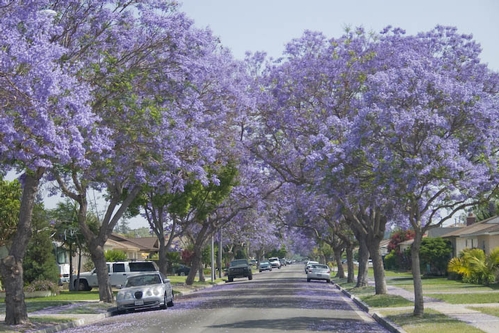
The summer time indeed is coming, and the trees in most of the U.S. have already bloomed sweetly, one major exception here in southern California being the jacarandas*, whose delicate and light violet blooms are only now making their appearance. The many and varied beauties of spring across our continent all possess their own special charms - the first pale green dusting of buds across the still-black branches of elms and hickorys and oaks in the Illinois of my boyhood; ice floes and break-ups in northern rivers and high mountain lakes; cherry, peach and pear blossoms swirling like snowflakes across lawns and fields.
It is, however, the evanescent nature of spring - the very transient time of its loveliness - which lends an edge and an urgency to its charm. "Death is the mother of beauty," wrote poet Wallace Stevens, and by that he intimates that it is impermanence that gifts all things with both beauty and worth. Without darkness, philosophers tell us, the word "light" would have no meaning. Without the burning inferno of summer to come, spring's brief and light-footed dance before our winter-weary eyes would pass us unnoticed and unvalued.
In poetry and art, spring is a worldwide and universal metaphor for youth, which is a time of both romance and hope. That accounts in large part for the number of love songs that are set in spring, from "Barbara Allen" ("It was in the merry month of May / When green buds they were swelling / Sweet William came from the west country / And he courted Barbara Allen") in the fourteenth century through "When The Swallows Come Back To Capistrano" (in March) in the twentieth. It is also the season of "The Wild Mountain Thyme," surely one of the loveliest of all Celtic tunes that celebrate youth and love.
The grandparent song for "Thyme" is naturally Scots, what with the "blooming heather" and all. The earliest published version is credited to Robert Tannahill (1774-1810), a contemporary and admirer of the rather more famous Robert Burns. Like Burns, Tannahill was an ardent Scots nationalist who believed that in the traditional tunes and tales of Caledonia there existed a treasure trove of artistic expression every bit the equal of the high literary culture of neighboring England. Also like Burns, Tannahill freely adapted traditional airs and lyrics to his own purposes, the greatest of which was to insure that British political dominance over his country never led to the amalgamation of the Scots identity into that of Giant Albion to the south.
Tannahill's proto-"Thyme" song is called "The Braes Of Balquhidder," or the hills around this small town:
If you already know "Wild Mountain Thyme," you can hear easily the number of similarities in the lyric and the rudiments of the more famous later tune. This version is from the Kells, which is an Argentinian group committed to performing Celtic music. Their command of both accent and feeling for this song is astounding.
The more modern song that we know as "The Wild Mountain Thyme" and "Will Ye Go, Lassie, Go?" is attributable to a single source, Belfast folk performer and collector Francis McPeake. In about 1957, McPeake re-wrote Tannahill's lyric into contemporary English and altered the tune to suit his words. This relatively recent birth of the song (and McPeake's copyright) accounts for the similarity of the lyrics sung by the groups in the videos below.
You just have to give the Scots first crack at this gem, so we start with one of Scotland's greatest solo folk performers, Dick Gaughan:
And yes, that is Emmylou Harris in the backup vocal group and singing the second verse, along with the McGarrigles and Rufus Wainwright.
Next, Scotland's equivalent of Ireland's Clancys or America's Kingston Trio - The Corries:
The Corries were a national treasure in Scotland; their career stretched from the early 1960s to the early '90s. Note that they do not have to ask the audience to sing along.
I first heard the song around 1962 from the Clancy Brothers and Tommy Makem, who included it on their wonderful The Boys Won't Leave The Girls Alone album:
This performance is from late 1984, when the quartet was on a reunion tour after a nearly 20 year split. The CB&TM are joined in the audience by John Sheahan (pennywhistle), Ronnie Drew, and the recently and lamentably departed Barney McKenna on tenor banjo - all from The Dubliners.
For something a tad different, The Byrds gave the tune their trademark folk-rock treatment in 1965:
Roger McGuinn is riding that jingle-jangle instrumental sound as usual, though I think the highlight of this cut is the harmony between McGuinn and David Crosby, whose voice you can clearly hear at the top of the mix.
One of the most popular recent versions is by Scotland's folk-rockers The Silencers:
Sounds to me a bit like the Corries meet the Byrds and produce some New Age offspring.
The New Christy Minstrels did a rather free adaptation of McPeake's version:
This is thus an adaptation of an adaptation. Lyrics were rewritten by NCM founder Randy Sparks; the musical arrangement is by my friend and radio co-host Art Podell - we used this one in our St. Patrick's Day show on KPFK.
Finally, an interesting combination that somehow works wonderfully - U.S. traditional country singer Don Williams backed by Ireland's greatest traditional music group, The Chieftains:
The Scots-Irish roots of much of the music of the southern Appalachians that gave birth to American country music is on display here, I think, in the natural and easy synergy between Williams and the Irish group.
There is, I think, a quiet urgency hiding behind the lyrics of "The Wild Mountain Thyme," one that is expressed whether consciously or not by most of the artists above. It is a kind of carpe diem or "seize the day" urgency - let us go now, my love, in the springtime of our lives and gather flowers, for summer follows hard upon, and after that.... We who are deep into autumn know well what comes after that.
There was an urban legend circulating among my fellow coffeehouse folk performers in the late '60s that went something like this. Once upon a time, some time in the early 1960s, two enterprising young men were given what they regarded as an impossible assignment in a class in the UCLA department of folklore, one of the most distinguished of such university departments in the world. The assignment was to do some field work in folk music - to go off into a rural section of the Mountain West and find either a traditional song that had been as of then undiscovered, or a significant variant of a song already known. Well, our two young heroes made a valiant attempt to do so over a long spring break, covering hundreds of miles and visiting dozens of small towns in the rural Nevada/California border country in the shadows of the lofty escarpment of the Eastern Sierra and along the Walker River (pictured). Their efforts proved fruitless, and in desperate fear of failure on the assignment and perhaps in the class, the two decided to write an original song in a traditional ballad mode about a pair of ill-fated young lovers in the Old West and submit it as a "discovery." The song sounded so convincingly authentic that the professor of the class awarded them an A for the project. The students were alleged to have been Steve Gillette and Tom Campbell (who hailed from Nevada, not too far from the "Yerrington town" of the lyric) and their creation was what many a singer back in the day referred to as "the fake folk song, 'Darcy Farrow.'" There are variations on this tall tale, which has itself turned into a bit of folklore, but that's the way I heard it first years ago.
The tale is not nearly so far-fetched as our jaded 21st century media-saturated sophistication might have us believe. Only a bit more than a decade and a half before the real Gillette was a student in 1965 in Westwood, a bright young English lit major at the University of Virginia named Paul Clayton was hired as a research assistant by celebrated folklorist Arthur Kyle Davis and given just such an assignment. In the company of his fellow assistant Matthew Bruccoli, later America's most renowned scholar on the writings of F. Scott Fitzgerald, Clayton scoured the 'hills and hollers' of central Appalachia for several months and actually uncovered a number of variants of established folk songs and fragments of several that had been previously unknown, including two that Clayton appears to have fused into a song whose copyright bears his name, "I Feel Like I Gotta Travel On." Even later in the mid-1950s, at the urging of mountain dulcimer legend Jean Ritchie, American Diane Guggenheim (yes, those Guggenheims) went to Ireland on a similar mission, returning to the U.S. with a passel of hitherto unknown Celtic folk tunes and a very young Liam Clancy in tow.
Such doings lent an air of believability to the "Darcy Farrow" story, but alas! - it was cut from wholly fabricated cloth by what appears to have been none other than Ian Tyson himself. Ian and Sylvia were the first to record the Gillette/Campbell composition, and the liner notes on their 1965 Early Mornin' Rain album on which Darcy made her graceful debut are a bit vague about the song's origins. Gillette had been a major fan of the Canadian duo, catching their act as often as he could and eventually opening for the pair as the "local talent" musician at The Golden Bear in Huntington Beach, CA, where he and Campbell played a number of their own creations for the folk stars. It was "Darcy Farrow" that made the deepest impression, and Ian and Sylvia became the first of more than three hundred artists to perform and/or record the song, additionally employing Gillette as the opening act for most of their California engagements and helping him to secure a contract with Vanguard, the label on which they themselves recorded.
Gillette has told the rather more interesting real story of the song's composition in a number of interviews. "The song is based on something that happened to my little sister, whose name is Darcy. At 12 years old she was running behind her horse, chasing it into the corral, when she was kicked. She broke her cheekbone but had no other lasting effects; there was a three-day period where she was in the hospital, and we were all concerned she might have a concussion. During that time, my friend, Tom Campbell, my co-writer on the song, took a melody I had written and came up with a story about the two young lovers and the tragic fall. I was a little horrified about the idea since it was so dark and involved my sister's name, but as we worked with it and took it in the direction of the old cowboy songs, I was much more comfortable with it. So many of the old cowboy songs take their melodies from Scottish-Irish musical traditions." Gillette added to Jon Einarson in Einarson's recent Four Strong Winds biography of Ian and Sylvia that "The story that Tom and I wrote the song to fool a college professor isn't true, but Ian told that story for years. That wasn't the case. We really wrote it just as a song."
The very genuine and quiet loveliness of "Darcy Farrow" has moved scores of musicians to record it, each remolding it to fit his or her own skills and artistic visions. Still, as with many other great songs, the very best version may well be that by the composer himself - here is Gillette from his eponymous debut album from 1967:
"Darcy" was a highlight on an album full of highlights, including other tunes like "Back On The Street Again," which became a hit single for The Stone Poneys with twenty-year-old Linda Ronstadt singing the lead and which was covered wonderfully by The Sunshine Company and The Sandpipers as well, and "A Number And A Name," which I heard both John Denver and Michael Johnson perform live on different occasions. And lest we think that time must have its way with us - here is Gillette just a couple of years ago sounding as good as he did in '67, with his wife and performing partner Cindy Mangsen:
Ian and Sylvia's recording predated Gillette's own by a year or so, and the duo speeds the tune up a bit to that Canadian country tempo that they pioneered:
And in a moment of harmonic convergence, Ian and Sylvia included the aforementioned Ms. Ronstadt in their rendition for their 1984 reunion show. All the videos of this single performance have been taken down from YT for copyvio, but for some reason the whole show is still there. Ronstadt joins the Tysons for "Darcy" at exactly the 33 minute mark:
Ronstadt's third part lends a sweetness to the song that contrasts to the high lonesome sound of Gillette's original, and Ian and Sylvia have clearly slowed the tempo from their own 1966 recording...
...most likely because the highest profile that "Darcy Farrow" ever enjoyed was due to its inclusion in the 1972 multi-platinum Rocky Mountain High album that boosted another young singer-songwriter named John Denver into pop super-stardom - and Denver chose the slower tempo of Gillette's own first recording above:
This video is from the 1995 Wildlife Concert that Denver staged just two years before his tragically early death in a light plane crash. It was a wonderful show in most respects, though in many cases I preferred JD's earlier studio recordings of some of the songs. This "Darcy," however, is much better vocally than the '72 version and it fully and completely illustrates his most committed fans' contention that he was singing better at the end of his career than he was at its beginning. Even Denver's most rabid and contemptuous critics had to admit that he was a masterful showman, and this is a brilliant arrangement: note the gradual and sequential introduction of accompanying instruments verse by verse, the understated quiet of the performance, and Denver's own mellow, rounded, and emotional vocals. This video reminds me more than almost any other of how much I miss having Denver as part of the musical landscape today.
John McEuen and Jimmy Ibbotson, founding members of The Nity Gritty Dirt Band, reunited last year for an album and DVD called "Nitty Gritty Surround." This video is of only about half of the song and is a promo for the discs, but the arrangement and performance are so lovely that it needs inclusion here:
If you are not a Dirt Band fan - that's Ibbotson on lead vocals and McEuen, master of all things stringed, leading off the recording on guitar.
For something startlingly different, roots music star Nanci Griffith a capella, or almost so:
I will hazard the opinion that the light conga accompaniment is intended to evoke the canter of a pony without replicating it. Griffith's vocals have the slightly rough edge of genuine old time country music.
Matthews Southern Comfort is the name of several differently configured bands organized by UK roots legend Iain Matthews, himself a member of Fairport Convention and several other high profile groups. This performance is from a house concert in the Netherlands last June:
The piano accompaniment and vocal harmony make this version unique, and Matthews' singing is beautifully restrained.
Finally - in 1967, the Kingston Trio was at the point of disbanding after a ten year run, but the group wanted to put out a final album of contemporary numbers before breaking up. The three performers of the group, Bob Shane, Nick Reynolds, and John Stewart, each recorded in the San Francisco studio that they owned some rough run-throughs of songs that they planned to include on the record. However, when Decca (their label at the time) shelved the project, the unfinished tapes went into the vault for 40 years until Collectors' Choice Music resurrected them and released them in 2007 as The Lost Album. John Stewart, who was himself about to embark on a long and distinguished if under-appreciated career as a singer-songwriter until his death in 2008, laid down this very rough track of his take on "Darcy Farrow":
I had mixed feelings about making this video and posting the JS version to the article because his "Darcy" was never intended to see the light of day in this form. Stewart was a far better singer and guitarist than this shows, though you can hear the rudiments of what could have become a good recording here. Stewart had a tinge of loneliness in his voice that served him well on this track as it did in many of his own best songs, and a refined and finished cut might well have been a worthy one.
I have to say that despite my 40 years as a college teacher (or maybe because of them), I find the image of a couple of clever students snookering an old prof to be an appealing one somehow. But as is almost always the case, the reality of what Steve Gillette and Tom Campbell achieved with the writing of "Darcy Farrow" far transcends the myth of undergraduate hijinks that has become attached to the tune - because they succeeded in creating a song that does indeed and in fact evoke both the Celtic and Old West melodies that they sought to emulate and that is so well-crafted and so moving that we can be pretty sure that someone will be singing it a century from now when we are all naught but dust and bones. And that is what I would term a "real" folk song.
...And A Late Addition 7/5/2012
I just found this outstandingly arranged version by bluegrass band Chesapeake from their album Rising Tide - sublime harmonies and instrumentation:
Appendix
Steve Gillette has uploaded to YouTube two instructional videos on how to play "Darcy Farrow" as he wrote and performed it. It's worth pointing out how generous this is of Steve - after all, he could be charging folks for sheet music or tabs off of his website (which is HERE and which includes the one, true, accurate rendering of the lyrics to the song). There are plenty of far wealthier musicians who do just that. Hats off to Mr. G, who seems to understand that he has created a classic that has found its way into our popular folk culture.
Gordon Lightfoot's career as a performer and songwriter now extends back more than 50 years, starting with a 1962 album of folk-oriented songs with Terry Whelan as a duo called The Two Tones, whose repertoire demonstrated clear influences from The Weavers, Bob Gibson, the Kingston Trio, and classic country music. Later that same year, Lightfoot scored a Top 10 solo hit on Canada's country charts with a song of his own composition, "Remember Me I'm The One,"* which sounds a bit like it was written by Hank Williams and sung by Elvis Presley. It took another couple of years before Lightfoot got his songwriting feet under him: in his own words, his compositions "lacked an identity" until he began listening seriously to the early work of Bob Dylan and more particularly of Ian Tyson. Oddly, though, GL's songs never sounded much like either of those two artists whom he has claimed as mentors, though both Tyson and Dylan had a hand in promoting Lightfoot as a concert act. In what might at first seem even stranger, GL lists 19th century American composer Stephen Foster as perhaps his most important songwriting predecessor in shaping his own craft, remarking that what he most appreciated about Foster was the"simplicity and individual character of each melody. We all took Foster songs in school and some of that rubbed off on me. I was always a fan of Stephen Foster."
The two compositions that brought Lightfoot his first wide notice in the U.S., "For Lovin' Me" recorded by Peter, Paul and Mary at the height of their popularity and "Early Mornin' Rain" recorded by virtually everyone who sang folk or country in the mid-60s, are characterized by a hard-bittenness that borders on cynicism, and those are two terms that just don't pop into your head when you think of "My Old Kentucky Home" or "Swanee River" or most any other Foster classic.
But the connection is definitely there, and on several levels. First, Foster was a commercial songwriter who nonetheless had a profound understanding of both serious music and the folkways of the country. Lightfoot studied composition and voice in the late 1950s at the now-defunct Westlake School of Music in Los Angeles, and there is a complexity to some of his melodies and instrumental accompaniments that goes well beyond the usual three chord perimeters of the folk and country music that he grew up listening to. Further - though Foster was a lifelong Northerner who lived mainly in Pennsylvania, Ohio, and New York, his songs are primarily identified with the American South. Lightfoot is a native of Ontario, which is sort of the Ohio of Canada - not east enough to be East and not west enough to be West - but except for "The Wreck of the Edmund Fitzgerald," his compositions often wander off to Canada's Rocky Mountain west or Maritimes/Nova Scotia east.
The most important Foster/Lightfoot link, however, may well be in the emotional landscapes explored in their songs. Both composers are unabashed in the open romanticism of many of their best lyrics, with Foster often yearning for a mythic and nostalgic past and Lightfoot frequently mourning love either lost or carelessly tossed away. Both writers seem to dance on a cliff's edge, always in danger of losing their footing in honest feeling and plunging into a sinkhole of mawkish sentimentality - and both have been accused of doing exactly the latter.
At their best, however, Foster and Lightfoot combine genuine emotion with deceptively simple-sounding melodies and the imaginations of great storytellers. Though not one of GL's high profile hit records,"Bitter Green" demonstrates all of those qualities and has been a favorite of Lightfoot aficionados since its appearance on his fourth studio album, 1968's Back Here On Earth on the United Artists label. "Bitter Green" has a lovely melody, and in the mode of many fine traditional songs like "The Escape Of Old John Webb", it supplies the listener with just enough detail to establish a kind of plot, the rest of which must be created in each person's individual imagination. We start with the original '68 GL studio recording:
The instrumental backing here is supplied by Red Shea on lead guitar and John Stockfish on bass, the pair who supported Lightfoot on all of his UA albums. For me and for many long-term GL fans, Shea and Stockfish created the best and purest accompaniment that Lightfoot ever enjoyed. Shea especially is taking the basic major and minor chord accompaniment and embellishing it with fifths and an occasional major seventh - which just means that the accompaniment is rather more complex than you'd normally expect in a simple folk ballad of lost love.
Just a couple of years after the original recording, Ireland's The Johnstons added a bit of Celtic-flavored close harmony to the song:
In addition to the harmonies that lend the song an even more ethereal quality than the original, the accompaniment features two 12 string guitars playing off each other, which is something you don't hear every day in folk music (and in fact had been one of the most unusual aspects of Erik Darling's The Rooftop Singers, which is a tale to be told another time).
The Idle Race was a well-regarded English Midlands rock and folk-rock group of the 60s, a precursor of sorts to the Electric Light Orchestra:
This 1971 version moves along with a percussion and guitar rhythm that seems to anticipate the soon-to-appear country rock phenomenon of the Eagles and their cohorts in the early 70s.
American bluegrass legend Tony Rice, one of the finest flatpickers since Doc Watson, recorded a mid-90s album of Lightfoot tunes called appropriately Tony Rice Sings Gordon Lightfoot, and "Bitter Green" is one of the highlights:
Rice here demonstrates a genuine interpretive artist's ability to translate a song across genres. I would never have thought it possible to take so quiet a ballad as this and turn it into a bluegrass number - but I don't possess the spark of genius that Rice has. A great cut, IMHO.
The New Kingston Trio was organized by KT founder Bob Shane in 1969, two years after the original group had disbanded, and Shane was seeking to broaden his new group's repertoire and contemporize it with singer-songwriter selections popular at the time. This rough bootleg recording from 1971 (with Pat Horine and banjo master Jim Connor) gives some indication of the direction in which Shane wanted to take his group:
Shane has said that he thought there might be a studio recording of the NKT doing the song somewhere but that it seems to have been lost. He has also said he regrets that because he really liked the song.
Finally - veteran Canadian folkster Valdy has performed the song for decades, here from October 2010 in Nova Scotia:
Note how much of this Canadian audience is singing along with the performer...
...and that is because in the last half century Gordon Lightfoot's music has embedded itself in Canada's cultural consciousness fully as much as has that of Ian Tyson or Joni Mitchell or Neil Young. Lightfoot has garnered more than his share of awards for his career, though Americans seem seldom to place GL on as lofty a pedestal as those others, possibly because of the very transparent emotion of his songs that make compositions like "Bitter Green" so beloved. But that transparent emotion is part of what has enabled Stephen Foster's songs to remain popular 150 years after their composition, and I'd bet that if you asked Lightfoot if he would rather be equated with Neil Young now or with Stephen Foster in a century or so, I think I know what he would say.
_________________________
*Here is a very early video of GL singing "Remember Me I'm The One" right after the dancing stops:
Comparative Video 101 is a resource for performance videos of some of the classic popular folk songs of the last several decades with personal commentary on them by Jim Moran, a teacher of literature for nearly forty years and a folk musician and writer for a decade longer. He was also co-host of the "Roots Music And Beyond" radio program on KPFK-FM in Los Angeles. Some of these posts appeared originally on the Kingston Crossroads message board, and many of the profiled songs were performed by the classic pop folk group the Kingston Trio. The page will be updated once or more per month. Your comments are welcome.
Use the Google Search Bar above as you would use the Google web search. Enter the name of a song or artist, press "search," and the results will appear showing every mention of your search term in the 150+ articles on this blog. An alphabetical index of song titles is coming soon; until then, the Google Search This Blog will substitute for it.
Since Blogspot/Google has recently begun including readership statistics as part of its service to bloggers like me, I have become aware that the readership for these pages is far more extensive and international than I had ever dreamed, usually approaching 1,000 visitors per week from literally all around the world. I am profoundly appreciative of the interest in these posts and glad that folk music fans find enjoyment and value in them.
There are currently more than two hundred articles here, and nearly all of the twelve hundred posted videos in those articles are from YouTube. Most readers will already know that because YouTube is another subsidiary of Google, the latter company is being sued for copyright infringement by a significant number of content providers like Sony-BMG and Warner's Music Group. YouTube/Google's normal response to infringement claims is to remove the disputed videos or ban them from certain countries in which the claims have been filed.
This, of course, has a profound effect on the content of posts like the ones in this blog. Videos that I have selected for any given article can be and often have been removed at any time without warning. I try where possible to replace deleted videos with other versions of the same performance or with similar renditions of the songs, though this is not always possible.
Policing the hundred plus posts to be sure that there are interesting and representative video performances is itself a major undertaking, one that involves a significant commitment of time. I hope that those of you good enough to stop by this blog will have a bit of patience. I review as many of the older articles as I can every week with the goal of maintaining the integrity of each, and sometimes this enables me to find newer, better, and more exciting performances of the songs profiled here.