"This will be our reply to violence: to make music more intensely, more
beautifully, more devotedly, than ever before. And with each note we will honor the spirit of John Kennedy, commemorate his courage, and
reaffirm his faith in the Triumph of the Mind."
- Leonard Bernstein, November 25, 1963
Friday, November 22, 1963 was the only day I missed during my freshman year of high school because I was in bed with a left ear severely infected from early-season practice for the school swimming team. I had been hospitalized briefly two years before for mastoiditis in the same ear, a potentially very serious ailment, so my parents insisted I stay home that day (really against my wishes since I was terrified of falling behind in algebra) and allow the antibiotics prescribed by Dr. McMahon after his house call the day before to take their effect.
Not long after 12:30pm in Chicago, my mother came into the room I shared with my older brother, her face ashen and serious. "Mrs. Schroeder just called," she said. "She heard on television that several shots had been fired at President Kennedy's car in Texas. They don't know if he was hurt or not. I know how important history is to you, and today may be a day that people will remember for a long time." With that, she helped me bundle up and go downstairs to the family room and turn on the television, the television that was absolutely never on during the day except on weekends for sports - which is why Mrs. Schroeder, a devotee of the classic soap opera As The World Turns (which began in the Midwest at 12:30) and a good friend and neighbor who knew of the blanket of electronic silence that enveloped the Moran home during the daylight hours, thought it important to call my mother with the news.
My two youngest brothers, the only ones of the nine of us at the time (the tenth was gestating at that point) who were not in school yet, were already down for their afternoon naps, so my mother and I watched the events of the afternoon unfold as they happened, largely in undisturbed silence, broken only by my mother several times after the 1pm death announcement with "Those poor little children! Those poor, poor children!" in reference to Kennedy's daughter and son, both younger than seven and now fatherless. In the midst of the earliest hours of a developing national cataclysm, this was exactly the aspect of the event that for me was quite understandably what affected my mother most deeply.
But she knew also her many children well, and she was exactly right about my preoccupation with all things historical - at that point, primarily the day-to-day remembrances of the events of the American Civil War a hundred years earlier. The centennial of the delivery of Lincoln's Gettysburg Address had just passed on November 19th, and the memorials of that event were fittingly quiet and sober, in memory now almost a prelude to the darkness to come upon the nation so swiftly and so soon after.
For me, history was never a dry compendium of names and dates. It was rather a set of vivid stories of people and events and conflicts, much more like a great and engrossing novel or an epic film than a subject fit only for school time boredom and resentment. I can trace much of my love of folk music to my love of history, or perhaps I could better explain them as twin children born of the same colorful childhood imagination. Robert Rogers of Rogers' Rangers, for example, was not for me merely a minor footnote in colonial history but was rather a giant figure of daring romance whom I had met in the 700 pages of Kenneth Roberts' wonderful Northwest Passage, still among my all-time favorite novels. Similarly, "The Escape Of Old John Webb" was more than just a song that I enjoyed hearing and singing; it was an adventure of which I was a part, a tale in which it was I who was breaking locks and bolts to free old John, if only in fantasy.
Hence my mother's concern that since I was home, by chance or by an act of providence, I should be able to see what was happening on a day that indeed people have remembered for a long time.
I cannot say that I was thinking of songs or music during the dark weekend that followed the assassination - but others were. The producers and crew of the UK's satirical Saturday evening revue That Was The Week That Was hosted by David Frost, a show already familiar to many Americans from excerpts broadcast on U.S. network variety shows, quickly re-tooled the program to become a memorial to JFK. At the center of the shortened and somber broadcast was a song written that day by Herb Kretzmer and David Lee that they titled "The Summer Of His Years." It was sung on the show by regular cast member Millicent Martin. While no video of the actual show is currently available (even though it was broadcast on Sunday the 24th on American networks), Martin reprised her performance a month later on TW3's year-end review. The song begins at about 2:05.
I remember being stunned by this performance. I could not conceive that a song so articulate, so appropriate, and so complete could be composed, arranged, rehearsed, and performed so quickly after the event.
Across the continent from me in California, Beach Boys Brian Wilson and Mike Love were working on songs for a new album on November 22nd. Years later, Love remembered that
"The Warmth of the Sun" was started in the early morning hours of the same morning that President Kennedy was killed in Dallas. The melody was so haunting, sad, melancholy, that the only thing that I could think of lyrically was the loss of love, when interest slips and feelings aren't reciprocated... though I wanted to have a silver lining on that cumulus nimbus cloud so I wrote the lyrics from the perspective of, 'Yes, things have changed and love is no longer there, but the memory of it lingers like the warmth of the sun.'
Love's commentary notwithstanding, I never saw much of a connection between the teen angst of "The Warmth of the Sun" and Kennedy's death - but others have, and the date and circumstances of its composition make it a necessary inclusion here.
Also in California on the same Friday, the Kingston Trio was in San Francisco working on its own new album, an uncharacteristically sober group of songs for an LP to be titled Time To Think. The news of Kennedy's assassination struck Trio member and songwriter John Stewart especially hard, and on Friday evening he tried to come to terms with his emotions by writing "Song For A Friend." When the album was released a few months later, the liner notes reported that the song was recorded on November 25, 1963, the day of JFK's funeral.
Stewart would go on to a long and distinguished if under-appreciated career as a singer-songwriter, but here at the age of 24 he is clearly still a journeyman learning his craft."Song For A Friend" has utter sincerity and some fine if sentimental imagery going for it, but it is a far cry from the sophisticated imagistic lyrics that would characterize much of Stewart's later work, including more than a dozen songs that referenced the assassination in one way or another. Compare "Friend," for example, to the recently-profiled "Dreamers On The Rise" from the 1980s, which though growing more directly out of Robert Kennedy's death also makes at least oblique reference to JFK's - and is a far better song.
In fact, all of these first three selections are probably of more interest as historical artifacts than they are as representations of great songwriting. I would not put either the Wilson/Love tune or Stewart's composition in the top 25 of the best songs of either of them.
"The Summer Of His Years" may be a bit of a different story, though as a topical song addressing a specific event it has probably outlived its ability to have the same kind of impact that it did at the point of its initial performance. Pop singer Connie Francis had a somewhat successful single with it in early 1964, but I thought that a far better recording was released by the Chad Mitchell Trio later that same year on its album Reflecting:
The CMT fused "Summer" with George F. Root's Civil War classic "The Battle Cry of Freedom," and if the former song does not rise to the same level of excellence that the latter does, the trio's medley works well as an expression of hope and the need to go on - and "Summer" bears up well while occupying the same track as "Battle Cry."
Roger McGuinn, who had cut his teeth professionally backing up the Chad Mitchel Trio under his real name of Jim, also reacted quickly to Kennedy's murder. He took an old public domain song that had been popularized around Greenwich Village in the 1950s by Dave van Ronk and Erc Von Schmidt called "He Was A Friend Of Mine" and according to McGuinn "[re]wrote the song the night John F. Kennedy was assassinated. I suppose you could say it's one of the earliest Byrds songs. The arrangement used was as I'd always sung it." McGuinn's lyrics point directly to the assassination:
The formation of The Byrds was a year in McGuinn's future when he completed his adaptation; the band waxed it in November of 1965.
That same month, singer-songwriter Phil Ochs, whose work is currently enjoying a long-overdue renascence, was touring England and wrote the first draft of what might be regarded as his magnum opus, "The Crucifixion." Where Ochs' previous best-known and best songs had been pointed, pithy, and often by turns uproariously satirical or prophetically angry, "The Crucifixion" is a long and sometimes rambling meditation that uses the Passion of the Christ as a metaphor for the contemporary propensity to sacrifice society's heroes.
While Ochs' larger point might have been philosophical, he also made clear that the parallels to Kennedy's death were intentional. "The Kennedy assassination," said Ochs, "in a way was destroying our best in some kind of ritual. People say they really love the reformer, they love the radical, but they want to see him killed. It's a certain part of the human psyche..." Robert F. Kennedy reportedly teared up when Ochs sang the song for him, sensing immediately the connection to his brother, whose death even a mere two years later had begun to assume the mantle of a martyrdom.
Probably the highest profile song to grow out of the assassination trauma appeared three years later in 1968. Again and like Stewart's "Dreamers" primarily a reaction to the murders that year of Martin Luther King and Robert Kennedy, Dick Holler's "Abraham, Martin, and John" continued the mythologization of the three title figures, and as recorded by former teen heartthrob Dion DiMucci reached #4 of American singles charts late in the year:
The commercial success of the recording resuscitated Dion's flagging career, and the overt and unapologetic sentimentality of the number seemed perfectly attuned to the needs of an American public that had grown understandably weary of the senseless and seemingly unending sequence of horrendous, violent shocks - the murders and riots and bitter, divisive civil strife - that assaulted the nation's consciousness through the decade and shook its self-perception to its very heart. It was far more comforting to picture four men who had died pointless, brutal, and bloody deaths "walking up over the hill" than it was to confront the awful truth that a republic of ideas had become, as it sometimes had at prior points in its history, a shooting gallery for the psychotic, the alienated, and the disaffected. Leonard Bernstein's "triumph of the mind" quoted above seemed a distant dream at best and mendacious and fraudulent lie at worst. Transgressions born in blood just could not be redeemed in song.
Yet through the decades since 11/22/63, songwriters have kept on trying to do so - or at least to come to terms with what did or did not happen that day. A number of websites have attempted to develop comprehensive lists of tunes that have touched on that event, the most nearly complete of which seems to me at be at TurnMeOnDeadMan.com (the site's name being an allusion to the "death of Paul McCartney" flap around 1970). Scores of songs and versions of songs are listed here, including quite a few from punk and indie and alternative rock bands ranging from major artists to the deservedly anonymous. Some of the selections there and on other lists border on the silly. Paul Simon's "Sounds of Silence" may have been written in 1964, for example, but Simon is concerned with urban alienation, with how Walt Whitman's beautiful and vibrant 19th century "Mannahatta" - "The beautiful city, the city of hurried and sparkling waters! the city of spires and masts!" - could have degenerated into the lonely dark alleys and mean streets of his later "The Boxer" - and neither Kennedy nor his assassination had anything to do with that.
That list also omits some of the songs and some of the renditions included here - not surprisingly, I would say. Most of the selections in this post emerged from the pop folk era, and the impact and importance of that style of music has been largely forgotten, however extensively its DNA remains in the American pop bloodstream. Could I add but one song to the list, I think it well might be this one - an obscure John Stewart number written around 1990 that expresses a sense of all that has been lost since that day in Dallas:
I am not sure that I have ever fully endorsed the sentiment of Stewart's last line, much as I have a visceral recognition of what he is trying to say. The world changed on that day, and something was lost that has never been fully recovered. To suggest as many have that our "innocence" perished in Dealey Plaza that day would be to ignore the reality of an American history filled with awful experiences as recent as the Second World War or as remote as slavery and the Civil War it spawned. We could hardly have been termed "innocent" in 1963, whatever else we were. And two generations of Americans - my students, many of them - have been born and come of age in the five decades since the assassination. Each has grown to maturity with its own sense of itself, of its country, of what the promise of America has meant to it.
I have thought long and hard as this anniversary approached about what it meant to me and to my country, and I have no simple or easy answers. I was not, as my friend Mike Peterson observed in his excellent posts on 11/20 and 11/22 in his popular Comic Strip of the Day website, personally traumatized by the assassination, though I remember being fearful and disoriented for some time afterward, and I wept unabashedly during the broadcast of the funeral on Monday the 25th - not at the rehearsed salute of JFK's son but rather at the sight of his two grief-stricken brothers standing in despairing silence at the eternal flame. Something was lost indeed - but what? Simplicity? Security? my own childhood? I cannot say in clear and uncertain terms.
But for me the answer may well exist somewhere in the pairing of these last two videos. In 1993 at a John Stewart show I picked up a CD called The Trio Years in which Stewart in the late 1980s had re-recorded some of the songs he had written when he was a member of the Kingston Trio 25 years earlier. One track hit me with overwhelming force, a song called "New Frontier" that had been the title song of a KT album released in early 1963 and that in its first incarnation had been the youthful Stewart's ebulliently optimistic response to the ebullient optimism of the early Kennedy years:
Twenty-five years later, Stewart heard his own song this way:
The forward-looking voice of the young man has evolved into the retrospective voice of the old, a progress from unquestioning idealism to, perhaps, a wisdom tempered by experience. The man who died in Dallas exactly fifty years ago as I write this - 12:30pm CST - left behind a promise unfulfilled, a promise touched upon to one degree or another in many of the songs here. The imperative to fulfill as much of one's own promise in that time allotted to us may be the one lonely, solitary meaning to take away from the otherwise pointless tragedy of a half century ago.
Showing posts with label NewFrontier. Show all posts
Friday, November 22, 2013
Thursday, January 27, 2011
"With You My Johnny Lad"
I can well remember fifty years ago being intrigued by an anomaly that I noted in many of the folk records that I was listening to regarding a Scots song (one that was often covered by Irish groups) called "My Johnny Lad." It's a fun little song about dancing and courtship and a whole bunch of other things. What was odd, though, was that there were two rather radically different versions of the song that I was hearing. By itself, perhaps, that was not such a big thing - after all, it's hard to imagine how a song like "The Raggle Taggle Gypsies/Black Jack Davy" morphed into a variant like "The Gypsy Rover" - but the different and associated "Johnny Lad" songs were at the same time very different in tone and pace while sharing many of the same words.The first version that I heard was from the Clancy Brothers and Tommy Makem's first album on Columbia Records in 1961 (they had three full albums on their own Tradition Records prior to this release). Here is a live performance virtually identical to the album cut from a 1962 Chicago PBS broadcast:
This is one of the all-too-few CB&TM numbers that features eldest brother Paddy on lead vocal. I remember a comment made on this site when I wrote about "The Jug of Punch" two years ago that Paddy had a distinctly aggressive way of presenting a lyric, one that was refreshingly manly. The same could also be said for the Clancys' general approach to Celtic songs, one that generated for them the same kind of criticism in Ireland that the pop folk groups here in the U.S. were getting at the same time. This is not surprising, because as Liam Clancy related in his autobiographical The Mountain of the Women a few years back, the group patterned themselves after the Kingston Trio, even including the decision to wear nearly matching versions of those impossibly warm, cable-knit Aran Island sweaters (or "jumpers" as they called them). Many of the Clancys songs - their trademark opener "Brennan on the Moor," for example - were originally medium to slow reflective tunes that the group powered into high energy numbers, replete with shouts and barks and whistles. And that approach to the music, as we'll see below, became standard for Scots and Irish folk groups that followed them.
A couple of years before the Clancy release, the Kingston Trio had recorded a song called "With You My Johnny" on Sold Out, one of their musically most satisfying albums. This version has distinct lyrical similarities to the Clancy version but with a radically different melody:
This is vintage popularized folk music. The Guard-Reynolds-Shane lyric is simply an anglicized rendering of the traditional Scots dialect version done a couple of years before by the great Ewan MacColl and his lady Peggy Seeger, which you can see on Mudcat.org HERE. The group's musical setting - somewhat slower and in a minor key compared to the Clancy rendition - is a clear attempt rhythmically to catch the feeling of the drone of bagpipes, with its heavy, punctuated emphasis on every fourth beat - listen to Bob Shane's guitar intro to hear it.
To muddy the waters further, the Kingstons two years later recorded a number with a Clancy-type melody and chorus and verses that evoke the same feeling as the traditional number - but that they called "Genny Glenn" (with a June 2013 thanks to Capitol/EMI as noted at right for permitting playback of KT videos on YouTube:
The reconciliation between the two versions, it turns out, was not at all that complex. Ewan MacColl, a folklorist as well as performer (and radical and actor and 20 other things as well) wrote that the "Johnny Lad" song was "originally a very beautiful pastoral song in the tempo of a slow (minor) strathspey. Johnny Lad moved to Glasgow during the late 19th century and was transformed into a children's street song. The lyrics became urbanized and the original air was abandoned in favor of a catchy but much plainer tune." A strathspey is a Scots dance that featured a moderate tempo, named after a region - as can be heard in the Kingstons' "Johnny" above. That's the original rural version, with its slyly naughty lyric. The Clancys are doing the second, later, urbanized version with the slightly more sophisticated and satiric lyrics. Note that the "with you my Johnny chorus" of the KT version fits with the lyric sung by a girl - but that the "urban" Clancy version is a man's song except for the chorus. As for "Genny Glenn" - a Kingston re-write, probably by John Stewart, to reap the copyright rewards, just as the group had done with other traditional songs like "A Worried Man."
Now for some other versions. First, the rural girl's number sung by a lady, from a house concert by the charming Sarah McQuaid, whom I previously featured as a lady doing a lady's song in my post about "The Wagoner's Lad":
McQuaid, who has an Irish mother and spent her formative years in Eire, is doing the KT modern English rendering of MacColl's Scots lyric. The jazz-based chords of the guitar setting make an interestingly original if not wholly successful presentation.
One of the great Folk Revival Scots groups was The Corries, here from 1976:
You can hear traces of the old strathspey here, I think.
Finally, from the Canadian-Irish trio Ryan's Fancy:
This was a great group, performing here on Tommy Makem's TV show and with, I think, a clear bow of the head to the pioneering musical style of the Clancys with Tommy.
I have to say that this has been one of the most enjoyable of these posts for me to write, not only because I've always loved both versions of the song but also because of the number of actual live performance videos here. I'd also add that however "popularized" these may be, they sound a hell of a lot more authentic that the punked out stuff of the Killigans or the Pogues on one extreme and the sugary and sentimental Celtic Thunder-type groups on the other end of the contemporary "Celtic" spectrum.
Thursday, November 25, 2010
Murder Most Foul - "Poor Ellen Smith"
"Murder most foul, as in the best it is,
But this most foul, strange, and unnatural."
- Shakespeare, Hamlet
I would guess that many folk aficionados like myself have wondered at some point or other what sort of dark spirit was hovering over the hills and hollers of North Carolina in the 19th century that prompted so many notorious murders, marring the serenity of that otherwise lovely state. Tom Dula killed Laura Foster (maybe) in Wilkes County; Frankie Silver did in her husband in Morganton, Burke County; Omie Wise was hacked up by a jilted suitor near Asheboro; the nameless girl in "The Lone Green Valley" similarly met her end in a dark Carolina forest - and Ellen Smith was indeed shot through the heart and found lying dead on the ground in Winston-Salem. Each case spawned one or more memorable ballads that have enriched the American folk tradition. Still - I'd have to think twice before letting a daughter of mine go to school in Durham or Chapel Hill...maybe there's something in the water.
If anyone needs to be told - that last sentence is a joke. But as terrible as any murder may be - those killings in North Carolina that morphed into songs all have some especially tawdry or gruesome or pathetic element to them, none more so than the sad tale of the very real Miss Smith. Ellen Smith was 17 years old and seems to have been a maid at the Zinzendorf Hotel in Winston-Salem. Described in some records as "a mulatto," she was by most accounts something of a dark beauty - and likely developmentally challenged, as they say today. She fell afoul of a fast-talking ne'er-do-well ladies man named Peter DeGraff, who was likely also a hotel employee. Smith and DeGraff apparently had a baby together, though it died before it was a year old, and Ellen was again pregnant when DeGraff apparently sent her a note (since lost) in July of 1892 to meet him in the woods behind the Zinzendorf. Smith went, probably expecting a marriage proposal. What she got was the bullet through the heart described in her song - and at close range, too, as the powder burns on her apron attested.
DeGraff was the only real suspect, as their affair was widely known, but for some reason lost in the mists of time the county sheriff refused to arrest DeGraff, who remained free until a newly-elected top cop cuffed the suspect in April of the following year. DeGraff pleaded innocent and maintained that he returned to the scene of the crime on the day of his arrest to try to summon the late Miss Smith's spirit. That didn't go over very well with the jury, which took twelve hours to convict him. Appeals subsequent to the trial proved fruitless, and DeGraff kept his date with the hangman on February 8, 1894.
The incident led to the composition of two very different songs, one rather dour and narrated by the character of DeGraff, much like the verses of "Tom Dooley"; the other is an oddly uptempo number more typical of country fiddle dance tunes. It is the latter whose lyrics are the more familiar, though as we will see, our recording artists often spliced a new version from the two. The full lyrics to both are HERE.
We know of the song today largely through the efforts of folklorist, performer, and YMCA executive director Frank Warner, who also rescued "Tom Dooley" from regional obscurity and helped make it a national phenomenon. In the best John J. Lomax-Carl Sandburg-Pete Seeger tradition, Warner traveled around the Appalachians with his tape recorder and, yes, his automatic copyrighting machine. It was Warner who heard the gifted Frank Proffitt strum the version of the Dooley song that Proffitt had learned from his grandmother, a woman who knew the Melton and Foster families who were involved in the murder case, and it was Warner's re-arrangement that became the basis for the Kingston Trio's version. But Warner also recorded a number of Proffitt's neighbors, one of whom named Homer Cornett sang this for Warner:
Warner's collection of field recordings, including this one, has recently been released on Appleseed Records. The rustic authenticity of Cornett's singing is something I find oddly appealing - wouldn't want a steady diet of it, though.
A truly surprising number of other artists have covered the song. The Kossoy Sisters, darlings of late 1950s Greenwich Village and a duo whom I've used in other posts, recorded the song in the mid-50s with legend Erik Darling adding a fine clawhammer banjo part to their guitar accompaniment:
The Kossoys are both still with us and occasionally reunite for a few shows.
Speaking of clawhammer, here is a talented amateur known only on YouTube as "LongbowbanjoAL" with some fine picking:
You could practically predict that the Kingston Trio would take a swing with their trademark uptempo, high-energy approach - and they do here:
Odd it is how gleeful the guys sound on the chorus. As always, the Trio is preserving a sort of PG image with lyric changes: in the original, it is Ellen's clothes that are mangled and all cast around, but the obvious sexual implication of that is undone when the Kingstons cheerfully substitute the gruesome "body" for the garments. But in a retreat from the ghastly, someone in the group figured that "X marks the spot" was more acceptable than the original "blood marks the spot" - though what with Ellen's body now mangled and all...And of course, here our speaker is not only innocent but is also about to be released from prison in the last verse, a more palatable conclusion than a body swinging at the end of a rope. Not as always, Trio banjoist John Stewart has also made a substitution on this song and the whole New Frontier album: he is playing a Gibson RB-100 long neck banjo rather than his usual Vega Pete Seeger model. The boxy, plunky sound of the Gibson passes muster (barely) on some other songs on the record like "Long Black Veil" (another murder ballad but not indigenous to North Carolina) but the ringing sustain of the VPS is clearly what is called for here - and is sadly missed
A few weeks back, resident folklorist Jeremy Raven pinch hit for me one week and introduced the thought that Wilma Lee Cooper was the bluegrass equivalent of the KT's Nick Reynolds - the same enthusiastic approach to vocals and even more the almost unbelievably high energy sustained rhythm strumming. Take a look:
Jeremy really nailed that one right on the head - a great performance, positively Reynoldsesque.
And speaking of the late, great Nick - consider this version from contemporary bluegrass up-and-coming stars Crooked Still, whom I've also employed in these posts before:
I hope everyone noticed as the camera pans left that the rhythm guitarist is playing - a tenor guitar, just like Reynolds. I also always like to hear songs usually done by men performed by women.
I suppose that one reason that gruesome murders seem to spawn folk songs (going back centuries at least as far as "Lord Randall" and likely farther) is that singing the ballads stimulates a catharsis of sorts - a purgation of shock and horror rather than pity and terror. Or maybe the fates of both victim and killer are intended to serve as warnings - to the wayward girls who are usually the victims and to the dark and violent men who usually do the deeds. Then again, there is something about creative representations of all sorts that propels the real awfulness of violence into the higher realm of art. Good thing that it does, or none of us would ever watch a western or a war movie - or listen to "Tom Dooley" or "John Hardy" or "Poor Ellen Smith."
Friday, October 8, 2010
"My Lord, What A Morning"
There is an odd little religio-literary motif that originated in the high middle ages called "The Paradox of the Fortunate Fall." The good monks and scribes and eventually the university theologians and philosophers who emerged from their ranks, inspired by some thoughts from the very early St. Augustine and St. Ambrose, decided that hidden within the Christian belief in the catastrophic fall from grace of original sin was a blessing - that only through the awful evil of sin could humanity have learned of the profound love of a creator who would send and then sacrifice his son for its redemption.
That may seem like a very, very strange beginning for a piece on folk music, even for me. But there was something about that phrase that kept popping into my mind as I was plotting this post as I always do while commuting to work. The Fortunate Fall - that a great good could come from a seemingly ultimate evil. I recalled that a character on the television show The West Wing a few years back described slavery as "America's original sin," and it would be hard to dispute that, not simply in its initial 17th century inception in the colonies but in the fact that it took eight decades and the greatest cataclysm in U.S. history to expunge that sin, or at least begin to.
Yet it is equally beyond dispute that from this great wrong emerged some of the most important, vibrant, and enduring elements of American culture, the first and perhaps the most enduring of which is the spiritual. Before ragtime and blues and jazz and the rock music that emerged from these were the religious songs of the slaves that became the prototype for all of the rest of American music that emerged from African-American culture - European chromatic-scale melody lines underpinned by African rhythms and harmonic tonalities. The spiritual is our first wholly American form of music.
I've presented profiles of several of these that were covered fairly often during the folk revival period - "Oh Mary Don't You Weep," "All My Trials," and "Good News." I mentioned in one post the belief held by a number of responsible scholars (and vehemently rejected by others) that in some of these songs were "coded messages," including instructions to slaves on how to escape bondage on the Underground Railroad in songs like "Follow The Drinking Gourd." Whatever one thinks of the validity of that supposition, a fact that is self-evident is that a very large percentage of the spirituals included references to the end times - the day of judgment and the salvation from the bondage of sin and death. Coded messages or not, the parallel between Christian eschatology and the slaves' dream of freedom is obvious and undeniable.
One of the greatest of these forward-looking songs is "My Lord, What A Morning." We might think of it as the inverse of "When The Saints Go Marching In." The latter song's lyrics are full of the dread of judgment and are clearly a fervent prayer "to be in that number" of the saved, whereas "My Lord" is upbeat and optimistic: the singing congregation by contrast fully expects to be among the elect, and the dire disasters of the apocalypse are for them a clarion call to the "new world to be revealed."
The original song was performed at that moderate-tempoed, swinging rhythm that we associate with many contemporary gospel numbers. Here from France a couple of decades back the Elikya Gospel Singers performing "My Lord" in that style:
The great operatic soprano Marian Anderson often delved into her musical heritage to perform spirituals, but she did so in the idiom in which she had been trained:
Anderson recorded this in the 1930s, and she is attempting to communicate the essence of black American culture in what she felt was a dignified manner that white America could understand.
Also in the operatic vein is Switzerland's legendary Hugues Cuenod, who just celebrated his 108th birthday in June. What is most remarkable about this performance is that Cuenod is the only singer here - all three voices (counter-tenor, tenor, and baritone) are himself alone:
On perhaps a more familiar footing for this blog, the Kingston Trio in 1962 gave the song the familiar uptempo KT treatment:
As usual, there are the kinds of innovations here that made purists uncomfortable. The Kingstons, not unlike Marian Anderson, have translated the song into their own idiom and make no attempt to replicate the distinctively black American intonations and rhythms. Even more - the bongos in the accompaniment give the song a Calypso-styled lilt that the Trio was comfortable with but which in no way resembles any traditional approach to the song.
Likewise, Australia's wonderful Seekers given an effective folk-styled reading with a bravura lead by Judith Durham:
My good friend and fellow folkie Bob Burlinson of Pennsylvania (soon to be Northern California, though) was kind enough to point this one out to me. That last high note that Durham sings is sublime.
And since we seem to be - and I emphasize seem - far afield from the roots of "My Lord What A Morning," why not a jazz-blues-flavored saxophone instrumental by Croatian jazz artist David Kocijan:
I love what Kocijan is doing here. The protean nature of a good folk song means, as I think Comparative Video 101 has demonstrated thoroughly over the last couple of years, that this music can be successfully and respectfully translated into a wide variety of different styles. And neither of these last two versions, the Calypso-tinged Trio version and Kocijan's jazz rendition - is quite as far from the roots of the song as some might allege. Or have we forgotten so thoroughly and so soon from whence those Caribbean rhythms and jazz tonalities originate?
Addendum, July 2012
A fairly recent upload of the song by the progenitor of all pop folk groups, The Weavers - this the second troupe with Erik Darling.They had recorded it as "When The Stars Begin To Fall."
That may seem like a very, very strange beginning for a piece on folk music, even for me. But there was something about that phrase that kept popping into my mind as I was plotting this post as I always do while commuting to work. The Fortunate Fall - that a great good could come from a seemingly ultimate evil. I recalled that a character on the television show The West Wing a few years back described slavery as "America's original sin," and it would be hard to dispute that, not simply in its initial 17th century inception in the colonies but in the fact that it took eight decades and the greatest cataclysm in U.S. history to expunge that sin, or at least begin to.
Yet it is equally beyond dispute that from this great wrong emerged some of the most important, vibrant, and enduring elements of American culture, the first and perhaps the most enduring of which is the spiritual. Before ragtime and blues and jazz and the rock music that emerged from these were the religious songs of the slaves that became the prototype for all of the rest of American music that emerged from African-American culture - European chromatic-scale melody lines underpinned by African rhythms and harmonic tonalities. The spiritual is our first wholly American form of music.
I've presented profiles of several of these that were covered fairly often during the folk revival period - "Oh Mary Don't You Weep," "All My Trials," and "Good News." I mentioned in one post the belief held by a number of responsible scholars (and vehemently rejected by others) that in some of these songs were "coded messages," including instructions to slaves on how to escape bondage on the Underground Railroad in songs like "Follow The Drinking Gourd." Whatever one thinks of the validity of that supposition, a fact that is self-evident is that a very large percentage of the spirituals included references to the end times - the day of judgment and the salvation from the bondage of sin and death. Coded messages or not, the parallel between Christian eschatology and the slaves' dream of freedom is obvious and undeniable.
One of the greatest of these forward-looking songs is "My Lord, What A Morning." We might think of it as the inverse of "When The Saints Go Marching In." The latter song's lyrics are full of the dread of judgment and are clearly a fervent prayer "to be in that number" of the saved, whereas "My Lord" is upbeat and optimistic: the singing congregation by contrast fully expects to be among the elect, and the dire disasters of the apocalypse are for them a clarion call to the "new world to be revealed."
The original song was performed at that moderate-tempoed, swinging rhythm that we associate with many contemporary gospel numbers. Here from France a couple of decades back the Elikya Gospel Singers performing "My Lord" in that style:
The great operatic soprano Marian Anderson often delved into her musical heritage to perform spirituals, but she did so in the idiom in which she had been trained:
Anderson recorded this in the 1930s, and she is attempting to communicate the essence of black American culture in what she felt was a dignified manner that white America could understand.
Also in the operatic vein is Switzerland's legendary Hugues Cuenod, who just celebrated his 108th birthday in June. What is most remarkable about this performance is that Cuenod is the only singer here - all three voices (counter-tenor, tenor, and baritone) are himself alone:
On perhaps a more familiar footing for this blog, the Kingston Trio in 1962 gave the song the familiar uptempo KT treatment:
As usual, there are the kinds of innovations here that made purists uncomfortable. The Kingstons, not unlike Marian Anderson, have translated the song into their own idiom and make no attempt to replicate the distinctively black American intonations and rhythms. Even more - the bongos in the accompaniment give the song a Calypso-styled lilt that the Trio was comfortable with but which in no way resembles any traditional approach to the song.
Likewise, Australia's wonderful Seekers given an effective folk-styled reading with a bravura lead by Judith Durham:
My good friend and fellow folkie Bob Burlinson of Pennsylvania (soon to be Northern California, though) was kind enough to point this one out to me. That last high note that Durham sings is sublime.
And since we seem to be - and I emphasize seem - far afield from the roots of "My Lord What A Morning," why not a jazz-blues-flavored saxophone instrumental by Croatian jazz artist David Kocijan:
I love what Kocijan is doing here. The protean nature of a good folk song means, as I think Comparative Video 101 has demonstrated thoroughly over the last couple of years, that this music can be successfully and respectfully translated into a wide variety of different styles. And neither of these last two versions, the Calypso-tinged Trio version and Kocijan's jazz rendition - is quite as far from the roots of the song as some might allege. Or have we forgotten so thoroughly and so soon from whence those Caribbean rhythms and jazz tonalities originate?
Addendum, July 2012
A fairly recent upload of the song by the progenitor of all pop folk groups, The Weavers - this the second troupe with Erik Darling.They had recorded it as "When The Stars Begin To Fall."
Thursday, May 20, 2010
Uncle Dave Macon & "Keep My Skillet Good 'N' Greasy"
To start with, I had always thought that this song was just plain weird, and at two minutes, really just album filler on New Frontier. Allan Shaw and others had suggested that Dogies' Lament on the same Kingston Trio album was just a space-filler, though as you can see from the link, I disagree - the KT performance may be a bit perfunctory but the song is a good one and the arrangement was interesting.
But "Honey"? It seemed to me for decades just a bit of misfired strangeness, not unlike "Coo Coo U." I figured that despite the copyright to Trio members Shane, Stewart, and Reynolds it was probably based on some older, public domain song - but I could never find a source for it.
Then about four years ago I was reading a review of The Essential Kingston Trio CD by Billy Faier, a seminal force in the folk revival, acknowledged master banjo player, and an active performer still at age 80. Faier was trying to be even-handed in explaining his dislike for most of what the Kingston Trio did, and I've quoted parts of his review extensively both in these posts and in my Wikipedia article about the Trio. Faier suggested that the KT had at many points subverted the original meanings of traditional songs, and "Honey" was his most specific and developed example. He wrote:
“Keep My Skillet Good And Greasy” is a fine old folk song that paints a marvelous portrait of a lovable country ne’er-do-well. Here it is renamed “Honey Are You Mad At Your Man”, with an interesting but totally inappropriate instrumental arrangement, and the addition of a chorus from which the new title derives.
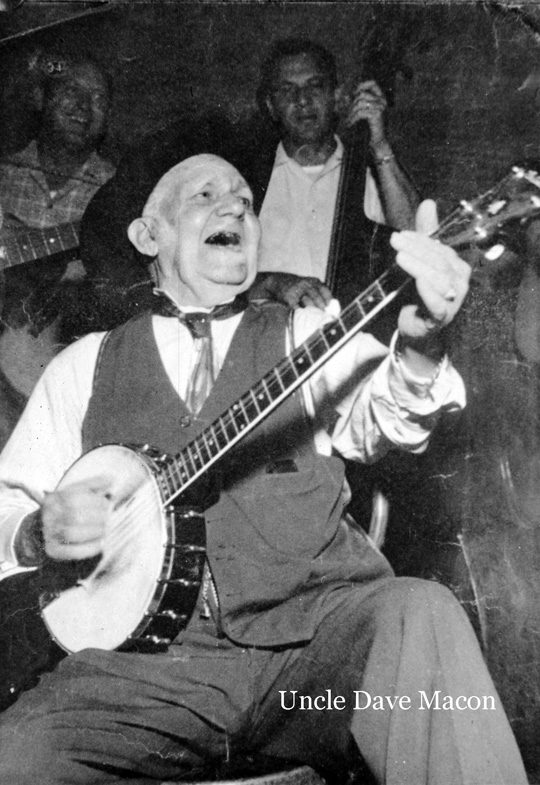
What Faier did not mention was that the "old folk song" was quite possibly composed solely by the legendary Uncle Dave Macon (1870-1952), the banjo-playing granddad of country and roots music in the U.S. - and a character whose approach to music had a lot more in common with that of the KT and other pop folk groups than it did with that of the dour-faced denizens of basement clubs in Greenwich Village. And what Faier also couldn't have known was how much this song provides us with an example of the connective tissue that links 19th century mountain music with 21st century pop.
You can read a solid if simple bio of Macon on Wikipedia HERE; note the emphasis on his connection to vaudeville and his emphasis on humor and banter as part of his shows. Macon understood that his later-in-life (age 51) career switch made him an entertainer, not the high priest of (at that time) a non-existent but soon to become sacrosanct tradition. The music was part of the show, as was the humor. (Macon may be the great unknown source of Trio song selection: in addition to "Skillet" becoming "Honey," he also popularized or wrote "Saro Jane" as noted in my Lou Gottlieb piece and "Buddy Won't You Roll Down The Line" - and possibly more.) Here is Uncle Dave's premier recording of "Keep My Skillet Good And Greasy" - Uncle Dave follows Stringbean and precedes Woody Guthrie in this extended video:
Most subsequent versions of the song include Macon's seventh-chord based accompaniment and that little hammer-on and wrinkle he is doing on "time, time, time" and elsewhere. Here for example is a clearer recording of the song by Woody Guthrie:
It appears that the legendary Sonny Terry and Cisco Houston are with Woody here, Terry on harmonica and Houston on (for him, a baritone) an unusual tenor harmony and fine guitar work. Guthrie is on mandolin.
Faier must have known of the Osborne Borthers' 1956 version, called "Ruby, Are You Mad?" that was the immediate antecedent of the KT "Honey Are You Mad At Your Man?":
Why this bluegrass adaptation did not strike Faier as "inappropriate" is a bit of a mystery, since the elements that he objects to in the KT version are present in prototype here.
The Kingston Trio, as Faier notes, added a chorus but preserve much of the original feeling of the song - with a unique banjo part by Stewart and that punchy, syncopated guitar strum by Shane:
What makes this recording significant and part of what I term above the connective tissue of popular music is this. While I may not have liked the song all that much - Lindsey Buckingham of Fleetwood Mac sure did. Buckingham was listed as producer for John Stewart's most financially successful solo album, 1979's Bombs Away Dream Babies with its Top Ten hit "Gold." But as Stewart relates in The Kingston Trio On Record, Buckingham was actually preoccupied with a FM project at the time, Tusk, I believe. So he told Stewart simply to crank the knobs on the mixing board until he liked what he heard - which Buckingham averred should be like "Seasons In The Sun" and "Honey" - simple, repetitive, and hypnotic, as Stewart said. Anyone who has listened to any significant amount of Fleetwood Mac recordings from the 70s and early 80s will recognize that formula for instrumentation immediately - take songs like "Rhiannon" or "Tusk". And like them or not, Fleetwood Mac gave much of 80s, 90s, and even 2000s rock a kind of template for instrumental accompaniment - derived from something Lindsey Buckingham heard in the Kingston Trio recordings, including "Honey."
The original "Skillet" version of the song has some fine performances available on YouTube. Three of the best, I think, are -
1) Lew Dite, a solo roots singer who has over 2 million views of his many roots recordings, most done like this one with great fidelity to the original:
2) The Mars Hillbillies, from Flagstaff AZ, just up the pike from Scottsdale - a really fun version of the song:
3) The Roe Family Singers from Minnesota, who have a clean traditional sound that sounds amazingly like Macon and Guthrie:
And a wonderful late addition in March 2012 - the fabulous Carolina Chocolate Drops:
I have the feeling that Uncle Dave would have liked all of these versions - they all make the song just weirdly fun - and repetitive and hypnotic to boot.
Friday, July 3, 2009
John Stewart + Marty Robbins + Roy Rogers + Frederic Remington + More - "Dogies Lament"
Another cowboy song, you think. Another fluffy bit of album filler, you say (and Allan Shaw et al. in The Kingston Trio On Record did). A forgettable Trio effort that pales in comparison to their best work, you opine.
And beyond the standard disclaimer of "each to his own" - not hardly, I would say. Not only is "Get Along, Little Dogies" (called "Dogies' Lament" by the Kingston Trio and others) a legitimate bit of classic Americana, worthy of notice by the many wonderful artists included here, but the KT's recording from one of its best albums, New Frontier, is itself a fine performance and a very interesting point in the long recording career of that group.
First, the song itself. I'd guess that many, perhaps most, of us knew this song before the abovementioned KT recording from late '62-early '63. It was certainly a staple of children's TV shows, recordings, and school music appreciation classes. I knew that I had heard it in several versions long before New Frontier. I'm sure my family had a 78rpm of Burl Ives doing it, I can remember Win Stracke (whom I've mentioned in these posts frequently) did it on his after-school show, and I'd bet that several other children's records in our family included it as well.
Not surprisingly, the song leaves cattle country and comes to America at large through the Lomaxes, father and son. John A. included a version in his 1910 collection of cowboy songs, and Alan had versions in the several different editions of his Folk Songs Of North America (1947). Both Roy Rogers and the Sons of the Pioneers can be credited with popularizing it in movies (as below), and both Burl Ives and Pete Seeger recorded it on vinyl in the late 1940s.
I never really cared to understand what a "dogie" was, but for my 11th birthday I received a copy of the '47 Lomax book above. Its explanation was that the term for a cow derives from "dough-guts," cowboy jargon for a yearling animal, often orphaned, whose distended belly resulted from eating grass prematurely and whose underside reminded the cowpokes of sourdough bread dough.
Whatever the term's origin - our earliest version today is from the 1940 film West Of The Badlands, starring the erstwhile Leonard Slye of Cincinnati, who of course had re-invented himself as (with Gene Autry) the personification of the Singing Cowboy - Roy Rogers:
I cannot adequately express my delight at finding this on YouTube. For me, as for millions of American children, Roy Rogers was my hero even before Davy Crockett. When my dad would ask me what I wanted to be when I grew up, I'd invariably reply "Roy Rogers." (My mother added that when I was told that there was only one RR and I'd have to pick some other line of work, she swore that I'd say "God.") This video is a reminder of what a beautiful voice Roy had - several of the background singers were at one time or another members of the group associated with Roy and from which he emerged as a solo star, the Sons of the Pioneers.
Now what is notable about the Kingston Trio's 1962 version is this. "Dogies' Lament" is a Dave Guard Trio song done by the Stewart Trio. By that I mean that it is absolutely, 100% a traditional song, and the KT had been moving steadily away from those after Guard's departure. What's more, the guys give this a respectful and generally straightforward reading that demonstrates a clear understanding of the song's roots. But with a Guard-type wrinkle, they change the accompaniment. Where Rogers and most of the others below (Seeger excepted) are doing a basic C-F-G7 chord progression, on the verses the Trio is using a C-Dm7-Em7 progression - for non-guitarists, a closely associated set of chords but which give just a hint through the minor sound of the "lament" that you hear most clearly in Pete's version:
John Stewart has the perfect baritone voice for this number, and the Trio's version may well be the most authentically traditional currently available (ironic point, of course). I threw together the video above with illustrative paintings from the great Frederic Remington, whose fervent attempts to record Western life before it disappeared (he died in 1909 at48) became the template from which virtually all of our modern images of the Old West come. When Hollywood started making Westerns, it was to Remington they went for the "look" of the movies.
Of later artists, who could do a cowboy song better than Marty Robbins? This version is from a short-lived TV series starring Robbins in 1965 called The Drifter:
That may be the smallest six string guitar I have ever seen.
One of my children's records above had a version similar to this one from Pete Seeger, with a distinctively "lamenting" minor key to begin the chorus:
After hearing this next version, I'm almost ashamed to say that I knew nothing of Elton Britt. With Rogers (and Jimmie Rodgers before that), Britt helped to popularize yodeling as a part of American folk tunes. He was an excellent singer, and I love this recording:
And a spare, straightforward rendition by one of my all-time favorite folksingers, Woody Guthrie's boon companion Cisco Houston:
By whatever name you call it, the "Dogies" song is an authentic link to our shared American past and the mythos that best expresses our image of ourselves - which makes it a fine choice for a Weekend Videos for our nation's birthday. A happy 4th of July to all!
Playback Note
YouTube has significantly upgraded its playback capabilities, but to save bandwidth it has made the low resolution 360p the default playback mode (on some videos, even - shudder - 240p). For best results on these and all YT videos, check in the lower right-hand corner of the video screen with the cursor to see if playback in 480p, 720p, or hi-definition is available. It will take a few seconds for the video to reload in the new resolution - but it will be well worth it.
And beyond the standard disclaimer of "each to his own" - not hardly, I would say. Not only is "Get Along, Little Dogies" (called "Dogies' Lament" by the Kingston Trio and others) a legitimate bit of classic Americana, worthy of notice by the many wonderful artists included here, but the KT's recording from one of its best albums, New Frontier, is itself a fine performance and a very interesting point in the long recording career of that group.
First, the song itself. I'd guess that many, perhaps most, of us knew this song before the abovementioned KT recording from late '62-early '63. It was certainly a staple of children's TV shows, recordings, and school music appreciation classes. I knew that I had heard it in several versions long before New Frontier. I'm sure my family had a 78rpm of Burl Ives doing it, I can remember Win Stracke (whom I've mentioned in these posts frequently) did it on his after-school show, and I'd bet that several other children's records in our family included it as well.
Not surprisingly, the song leaves cattle country and comes to America at large through the Lomaxes, father and son. John A. included a version in his 1910 collection of cowboy songs, and Alan had versions in the several different editions of his Folk Songs Of North America (1947). Both Roy Rogers and the Sons of the Pioneers can be credited with popularizing it in movies (as below), and both Burl Ives and Pete Seeger recorded it on vinyl in the late 1940s.
I never really cared to understand what a "dogie" was, but for my 11th birthday I received a copy of the '47 Lomax book above. Its explanation was that the term for a cow derives from "dough-guts," cowboy jargon for a yearling animal, often orphaned, whose distended belly resulted from eating grass prematurely and whose underside reminded the cowpokes of sourdough bread dough.
Whatever the term's origin - our earliest version today is from the 1940 film West Of The Badlands, starring the erstwhile Leonard Slye of Cincinnati, who of course had re-invented himself as (with Gene Autry) the personification of the Singing Cowboy - Roy Rogers:
I cannot adequately express my delight at finding this on YouTube. For me, as for millions of American children, Roy Rogers was my hero even before Davy Crockett. When my dad would ask me what I wanted to be when I grew up, I'd invariably reply "Roy Rogers." (My mother added that when I was told that there was only one RR and I'd have to pick some other line of work, she swore that I'd say "God.") This video is a reminder of what a beautiful voice Roy had - several of the background singers were at one time or another members of the group associated with Roy and from which he emerged as a solo star, the Sons of the Pioneers.
Now what is notable about the Kingston Trio's 1962 version is this. "Dogies' Lament" is a Dave Guard Trio song done by the Stewart Trio. By that I mean that it is absolutely, 100% a traditional song, and the KT had been moving steadily away from those after Guard's departure. What's more, the guys give this a respectful and generally straightforward reading that demonstrates a clear understanding of the song's roots. But with a Guard-type wrinkle, they change the accompaniment. Where Rogers and most of the others below (Seeger excepted) are doing a basic C-F-G7 chord progression, on the verses the Trio is using a C-Dm7-Em7 progression - for non-guitarists, a closely associated set of chords but which give just a hint through the minor sound of the "lament" that you hear most clearly in Pete's version:
John Stewart has the perfect baritone voice for this number, and the Trio's version may well be the most authentically traditional currently available (ironic point, of course). I threw together the video above with illustrative paintings from the great Frederic Remington, whose fervent attempts to record Western life before it disappeared (he died in 1909 at48) became the template from which virtually all of our modern images of the Old West come. When Hollywood started making Westerns, it was to Remington they went for the "look" of the movies.
Of later artists, who could do a cowboy song better than Marty Robbins? This version is from a short-lived TV series starring Robbins in 1965 called The Drifter:
That may be the smallest six string guitar I have ever seen.
One of my children's records above had a version similar to this one from Pete Seeger, with a distinctively "lamenting" minor key to begin the chorus:
After hearing this next version, I'm almost ashamed to say that I knew nothing of Elton Britt. With Rogers (and Jimmie Rodgers before that), Britt helped to popularize yodeling as a part of American folk tunes. He was an excellent singer, and I love this recording:
And a spare, straightforward rendition by one of my all-time favorite folksingers, Woody Guthrie's boon companion Cisco Houston:
By whatever name you call it, the "Dogies" song is an authentic link to our shared American past and the mythos that best expresses our image of ourselves - which makes it a fine choice for a Weekend Videos for our nation's birthday. A happy 4th of July to all!
Playback Note
YouTube has significantly upgraded its playback capabilities, but to save bandwidth it has made the low resolution 360p the default playback mode (on some videos, even - shudder - 240p). For best results on these and all YT videos, check in the lower right-hand corner of the video screen with the cursor to see if playback in 480p, 720p, or hi-definition is available. It will take a few seconds for the video to reload in the new resolution - but it will be well worth it.
Friday, April 24, 2009
Ewan MacColl's "The First Time Ever I Saw Your Face"
A few months back, I mentioned in one of these weekend videos posts that I didn't intend to do any really high profile songs by the Kingston Trio that became famous in subsequent versions because I thought there just wouldn't be enough variety in the performances to justify the time and effort - and I specifically mentioned "The First Time Ever I Saw Your Face" as an example of such a song.Well, doing these video reports has been an education for me, and I've found a wide variety of interpretations in songs that I would have guessed had really only one basic arrangement, even really common ones like Scotch and Soda or Greenback Dollar or Someday Soon.
So it was a revelation to me to find out just how many different ways that artists have found to present this classic love song, penned by the late great Ewan MacColl as a paean to his great love (but at the time, not his wife) Peggy Seeger (the couple pictured at left) and first brought to wide attention in the U.S. by the Kingston Trio, whose New Frontier album including the song sold several hundred thousand copies.
I had heard of MacColl several years before this because one of the treasures of my boyhood was the pair of Vanguard albums from the Newport Folk Festival of 1960, which featured MacColl as a solo (doing what many consider the definitive recorded version of the classic Scots traditional ballad "Lang A-Growing," though Liam Clancy's version is also highly regarded) and as a duo with Seeger, performing a topical song that was one of my favorites of the era and covered by many other folk artists, "The Springhill Mine Disaster" about an actual event in Nova Scotia in 1958.
MacColl had a fine, strong, masculine voice with a burr that you could cut with a knife (see appendix), and he projected the same kind of image through a tumultuous fifty year career as a radical labor organizer, street actor, folk song collector, performer, and composer of excellent traditional-sounding songs like "Springhill" and "Dirty Old Town" and "Freeborn Man" and my favorite, "The Shoals of Herring." He was in an unhappy second marriage when he met Peggy Seeger in Britain, and the two began an open affair that created a scandal at the time that even a subsequent marriage never quite completely erased. According to legend, Seeger phoned MacColl requesting that he write a love song for a play that she was to appear in; he wrote the song both for and about her in less than an hour, called her back, and taught it over the phone.
So the first public performance of "The First Time Ever I Saw Your Face" was actually by its inspiration, Peggy Seeger, who performs it here from about 1961:
and more recently in a live performance here:
Intrepid song sleuths Shane, Reynolds, and Stewart knew a good number when they heard it, but they also knew that the slightly PG rating of the third verse ("the first time ever I lay with you") probably wouldn't fly with their wholesome image, so they changed the wording to "ever I held you close" in addition to shifting the tempo and emphasis of the melody a bit. Combined with a stunningly effective guitar duet (and I'm betting on a John Stewart arrangement of that) and impeccably tasteful harmonies, "The First Time" is one of the prettiest numbers that the Kingston Trio ever recorded:
A wonderful version now from the other great folk trio of the era, Peter, Paul and Mary - here from a 1965 BBC show when the group was at the height of its popularity and prestige:
After the KT but before Roberta Flack ten years later, Johnny Cash recorded a version that some feel was among his most effective ballad recordings. This video is a personal montage of anniversary pictures set to Cash:
Later in his career - but before he lost his voice and became a caricature of himself - Elvis Presley came to the song and put his distinctive, soulful stamp on it. Like Bob Shane, Elvis had a marvelously rich, natural baritone with an instinctive vibrato - a truly gifted singer:
You can't talk about this song without acknowledging the truly inspired singing and fabulous, operatically-trained voice of Roberta Flack, with whom this song will ever be associated:
Sublime is the only word for this. Would you like a barometer of how far popular culture has sunk since 1972? Without the Kate Moss anorexic, Barbie-doll looks preferred today - how far would Flack get on American Idol? Let Celine Dionne and Lauryn Hill and the rest of them over-sing their over-produced versions - Flack's is the benchmark performance.
I want you to know that I searched thirty-plus pages into the YouTube results to find these next videos. Three instrumentals - first - acoustic guitar in an open tuning, derived from Bert Jansch by Chumblefish:
Jazz sax by CooolJazzz - really sweet:
Finally, slide guitar from "Shakey":
I have to say that I'd take any one of the least of these renditions over any of the aforementioned hyper-orchestrated mishmashes that come out of pop music today.
Appendix:
Here's what Ewan MacColl sounded like - nice radical union song,"My Old Man":
Thursday, July 31, 2008
"A Lovely Shade Of Red, But A Naughty Boy": Hoyt Axton And "Greenback Dollar"
Hoyt made a mere $800.00 from the song. "After I got ripped off as a writer on 'Greenback Dollar', I didn't go into a blue funk and walk around crying that everyone's crooked," Hoyt says of the experience. "I've always been an optimist, and I'm going to stay that way until I die. I think I get that from my mother, who could go up to the devil himself, and she'd say 'Hello, young man, you're a lovely shade of red, but you're a naughty boy'. With 'Greenback Dollar', I had a crooked publisher, and that was when I'd only been in the business a year, so I didn't know anything - I was just a kid with a guitar living in a car... How could I sue when the whole point of the song was how I didn't give a damn about a greenback dollar?"- Mark Weierman
Hoyt Axton was a character and a half. Voice, personality, physique, creative success - he was a sort of a larger than life latter-day Burl Ives on drugs. If Axton was never either quite the singer or actor that Ives was - and he wasn't, as Ives could range from "The Blue Tail Fly" to "Long Black Veil" as a singer and from melodrama to Faulkner and Miller as an actor -
Burl never wrote a succession of iconic songs as Hoyt did - "Joy To The World" (Three Dog Night), "Sweet Misery" (John Denver), "The Pusher" (Steppenwolf and the opening song in Easy Rider ), "Never Been To Spain" (Waylon Jennings and Three Dog Night) - and of course, "Greenback Dollar."
As most fans probably know, Axton was the son of "Heartbreak Hotel" co-writer Mae Boren Axton and came to the LA/San Francisco folk scene somewhat late in the game - around 1962, making GD a relatively quick if not quite golden financial success for a 24 year old singer/writer who was just about a year older than John Stewart.
Axton, however, was seduced by the music business drug culture that took off roughly simultaneously with Axton's career, and Hoyt's ongoing battles with addiction to alcohol and cocaine likely contributed to his premature death in 1999 at 61.
I saw him solo several times at the Troubadour and the Roxy in LA, and he gave no outward evidence of those problems. He was a large bear of a man with an engaging personality, ready wit, and utterly no pretension about him. He just didn't fit comfortably into any niche - too throaty and rough edged for the smoother 70s singer/songwriters like Simon, Taylor, Denver, and so on - but neither rocked out enough to appeal to the metalheads nor pseudo-country enough to appeal to the Flying Burrito-Poco-Eagles crowd. But he kept plugging away, a workman-like actor, performer, and songwriter who stayed on the job til the end.
Axton related somewhere I can't find that he met cowriter of GD Ken Ramsey in a laudromat, and that Ramsey had some of the words and part of a chorus for the song that became his first writing hit. Ramsey and Axton finished the song in an afternoon, did a demo, and sent it to the abovementioned publisher, who promptly bought their rights to the song for $800 each.
I'll bet it looked like a lot of money at the time........
You might think that the Kingston's version was all that there was to the song.............but not at all so. The enduring appeal of the KT version, though, is reflected on its continually self-renewing popularity, most recently as we know at the end of the film Thank You For Smoking - and in the fact that a weak video montage of the Trio that includes photos of many KT troupes (but not the one that sang the song!) would garner more than 370,000 views:
A YT video of Hoyt doing his own song was yanked for CopyVio - but another YouTube phenom - Fretkiller performs a version close to Axton's own. He did not permit his videos to be embedded - a stricture I evaded for nearly two years by using an international site that permitted embedding. The web cops caught up with that site though...and with Fretkillr, whom they banned for unspecified reasons (probably copyvio complaints from rights holders of some of the songs he covered). Some intrepdid YouTubers, however, managed to rescue some of FK's work from the dump - here is his excellent "Greenback Dollar":
Speaking of Mama Mia - here are Sweden's famous Hootenanny Singers with future ABBA star Bernie Ulvaeus - a real KT tribute:
For the just plain strange, how about surf guitar/singer/legend Dick Dale giving it a try - with the DelTones, sax, drums - but no Dick on guitar:
Finally - of all the straight-on rock versions on YouTube, the benchmark performance is probably 80s neo-folk group the Washington Squares:
Nostalgia moment: I still have stored somewhere a beautiful vinyl album with my favorite KT album cover - New Frontier. A red sticker is affixed to the upper right of the record - an ink drawing of a genie with a crystal ball and the legend "Preview Album! Hear 1963's Music Today!"
Of time and the river.............
2011 Addition
Johnny Rivers, who never gets enough credit for his pop-rock-folk-blues contributions, - live from 1965:
...and Barry McGuire of "Eve Of Destruction" fame - a good friend of both Axton and Ramsey and an uncredited co-writer of this song,
Subscribe to:
Posts (Atom)