Showing posts with label StringAlong. Show all posts

Thursday, April 4, 2013

The Folk Process And "Buddy Won't You Roll Down The Line"

A little over two years ago, I posted here some thoughts on The First Grammy For Folk And Why It Matters Today, which though mostly a discussion of the Kingston Trio's second studio album At Large enabled me to ruminate on a now long-forgotten controversy about what constituted authenticity in folk and roots music and how our sense of that has changed over the decades since 1959. Half of the population of the U.S. today was born after 1970, and for them, music like that which is purveyed by, say, the Avett Brothers or Mumford and Sons (worthy and talented musicians all) or on the soundtrack of Oh Brother, Where Art Thou? surely does sound "authentic," what with the banjos and Appalachian accents and all. Yet had the recordings of that soundtrack or those artists, any of them, appeared in 1955 or 1960, I guarantee that they would have been as excoriated with the same vehemence as "commercial" and "tawdry" and "tinselly" as were the similarly polished and professional recordings of the pop folk artists of the great revival era, spearheaded in terms of sales by but in no way limited to the LPs of the Kingston Trio. Just a few years ago, major urban traditionalist and banjo master extraordinaire Billy Faier revisited what he thought might have been a youthful prejudice against the KT and similar groups when he reviewed a Trio compilation disc. Faier's review was thoughtful and considered, but even 45 years after the heyday of pop folk music, Faier found little to like in what he heard. He sensed "very little respect for the folk genre here" and came to the overall conclusion that the KT's output (and by extension that of many other pop folk groups) consisted of "a mishmash of twisted arrangements that not only obscure the true beauty of the folk songs from which they derive, but give them a meaning they never had."

Faier was one of the most dedicated of the participants in the early 1950s spontaneous folk gatherings in Washington Square in New York City, and he has spent a lifetime performing and teaching traditional music and instrumental skills. Agree with it or not, his opinion matters; it carries with it the weight of an expertise in the folk field that very few others in the 20th century could match - the Lomaxes and Pete Seeger, Cecil Sharp, Jean Ritchie, Izzy Young, a few others perhaps. And it is not that his critique is without foundation - there are plenty of songs on the CD he was reviewing that demonstrate exactly what he says they do: a transformation, in some cases even a vulgarization, of tunes that began their existences somewhere in the hazy past of tradition and seemed to have been preserved intact through decades or even centuries of oral transmission.

What troubles me about the review, however, is not that Faier dislikes music that I like, but rather that anyone with as encyclopedic knowledge of traditional songs as he possesses must surely know that his phrasing  - again "that not only obscure the true beauty of the folk songs from which they derive, but give them a meaning they never had" - is a nearly perfect description of what has come to be known as the folk process, the way in which a single melody over time becomes adapted to a wide variety of uses, many of which bear no resemblance to the previous incarnation of the song whatsoever but somehow manage still to be regarded as authentic folk songs. These CompVid101 posts are full of examples of exactly that, even when there is no KT or other pop-folk version in the article. Take, for example, last year's musings on one of my favorite old songs, "Over The Hills And Far Away", which began as a Scots lullaby or children's song rather more than three hundred years ago, was turned into a musical comedy love song by one of England's great dramatists in the early 1700s, was purloined from thence to become a military recruiting song for more than a century, and today remains as a regimental march for several units in the UK's armed forces. Quite a journey for a single song, I would say, though I have yet to see a folk song scholar criticize any of the vastly different uses to which a simple ditty for children has been put.

Another example comes from the Roots Music and Beyond radio program that I co-host with the redoubtable Art Podell. For our St. Patrick's Day show a few weeks back, I paralleled songs from Ireland that had been transformed into quite different tunes when they reached our own sunny shores. A number of our listeners remarked that they had never noted that "The Old Orange Flute" from Ulster appears in the American west as "Sweet Betsy From Pike." Here is Tommy Makem with "Flute":


...and Roy Rogers and The Sons of the Pioneers with "Betsy":


The "Flute" song predates "Betsy" by a number of decades, and about the only point in common between the lyrics of the two is a certain mordant humor. Yet no one suggests that "Betsy" perverts "Flute" by giving it a "meaning it never had," nor would anyone seriously deny that both tunes are authentic folk songs. Thus with dozens of other tunes profiled on this blog over the last five years. Those very permutations and adaptations are, in fact,  why this blog exists and all - and what give folk music its unique character and enduring interest.

All of which takes us to Uncle Dave Macon's "Buddy Won't You Roll Down The Line." Macon's original (and he may well be the sole composer of the piece) is an entertaining but odd combination of a labor protest tune that brackets a more conventional prisoner's lament - as if "The Midnight Special" met "We Shall Overcome." The song grew out of the Coal Creek War in Tennessee in the early 1890s, when Macon was yet a young man.  The point of dispute was that two large coal companies, the Knoxville Iron Company and the Cumberland Coal Company, had decided to reduce their labor costs by contracting with the state of Tennessee to use convicts who had been sentenced to hard labor in the companies' mines, thus disemploying thousands and thousands of miners who had been working at near-starvation wages anyway. The miners organized and resisted, destroying company facilities and blocking convicts from entering mines; the companies retaliated by burning miners' homes and villages and organizing mass arrests and trials. There were a number of armed confrontations as well between the miners and company goons and later the state militia - in both cases, men were killed and wounded.

Macon opens his song with a summary of the situation:

Way back yonder in Tennessee, they leased the convicts out.
They worked 'em in the coal mines against free labor stout;
Free labor rebelled against it. To win it took some time.
But while the lease was in effect, they made 'em rise and shine


...but then shifts to the prisoners lament:

The beans they are half done, the bread is not so well.
The meat it is as burnt up and the coffee's black as heck.
But when you get your task done, you'll gladly come to call.
Anything you'd get to eat it taste good, done or raw.


...with the humorous avoidance of singing "hell," before returning to a political comment (and another slickly humorous avoidance of the same word):

The bank boss is a hard man, a man you all know well.
And if you don't get your task done, he's gonna give you hallelujah!
Carry you to the stockade, and it's on the floor you'll fall.
Very next time they call on you, you bet you'll have your coal.


The "Buddy won't you roll down the line" chorus seems to be akin to the "let the Midnight Special/Shine its ever-loving light on me" articulated hope for eventual freedom, the "line" being the tracks that will lead the singer away from captivity and into the arms of "my darlin," much as the singer in "Midnight Special" looks forward to the embrace of "Miss Rosie." Here is Macon on 5 string banjo, with Sam McGee backing him on something called a 6-string guitar/banjo as well as harmony on the chorus:


Here with a perfect replication of the instrumentation on Macon's recording, the very much lamented Mike Seeger taking Macon's part with Bruce Molsky doing McGee's accompaniment - on a 6-string guitar/banjo:


The video is from The Old Time Banjo Festival 2009 at The Birchmere in Virginia, a matter of weeks before Seeger's death from cancer at age 76. Like Billy Faier, Mike Seeger spent a productive life nurturing, performing, and teaching the trad music that he loved.

Around 1960, however, Texas songwriter Jane Bowers collaborated with Kingston Trio founder/arranger Dave Guard to create a very different song, one that changes the labor/prison tune into an apolitical wanderer/hobo/traveling number. In the past, I would have just created a simple video of the KT version, posted it to YouTube, and used it here - but of late, the good folks at Capitol/EMI have been looking askance at my efforts in that regard and blocking many of my videos from playing, so my days of creating such videos for this blog are at an end. You can, however, for a mere 89 cents purchase a copy of that track from Amazon here, and it would be well worth the pennies to do so, as it is one of the original Trio's best arrangements.

Update, June 2013: The change in Capitol's policy regarding the Kingston Trio videos, discussed in the margin note on the left, now allows me to post the original KT arrangement here:


We also have a creditable version of the KT arrangement to offer.

A new posting of the tune (as of summer 2014) comes from a KT tribute band called In-Folk-Us, doing a fine job with the harmonies and adding both a train whistle and Nick-Reynolds-style conga part not found on the Kingston recording:


Another recent upload comes from Gigatimes - a unique and completely successful brief re-thinking of the tiune as a jazz number, with John Renz on baritone sax and brother Ed on drums:


In the 1980s, singer-songwriter John Stewart, formerly Guard's replacement in the Kingston Trio, re-wrote "Buddy" yet again, this time as a kind of "life on the edge" number:


This is from Stewart's EP Revenge of the Budgie, the Budgie being Stewart's former Triomate Nick Reynolds, heard here on high harmony and on the second verse. Reynolds had sung on the Kingston Trio's original track (Stewart was not in the group at that time), and he tips his musical cap at the end of his verse with the "get on down the line" substitution. This is just a bit of folk-rockish tuneful fun. I recall a reviewer at the time making a point along that line, remarking that "Buddy" was the only song with KT roots that the two chose to do on that EP - which the reviewer also noted was reminiscent of the band A Flock of Seagulls but more melodic and interesting. Note, though, that in a kind of "full-circle" moment Stewart returns to Macon's original chorus.

As I noted in the first Grammy for folk piece, the whole controversy over what music and artists have a rightful claim to be termed "authentic" or "folk" has largely disappeared, except perhaps in a dwindling number of academic circles. I have worked quite a bit on a fair number of Wikipedia articles on folk music and folk artists and folk revivals and more, and the understanding of what the term means to the aforementioned half of the country that was not yet born when the disputes were raging (and which forms the bulk of Wikipedia editors) is very different from that of the urban traditionalists and commercial folksters who are now fading away and passing on. On the whole, that is probably a positive development, since pigeonholes are for, well, pigeons, and good music is always just that, whatever its source. I may myself mourn the passing of a certain respect for and understanding of tradition, though I would never have gone as far as Billy Faier did above. I suppose I can get used to Bruce Springsteen morphing into a "roots" performer and all the Celtic What-Have-Yous becoming the current face of Irish music, even as the mention of The New Lost City Ramblers or the Clancy Brothers will elicit nothing but a blank and uncomprehending stare from the younger generation. That's the way the world wags on. Folk process, you know.

Thursday, August 16, 2012

"The Tattooed Lady"

This odd little song is delightfully mysterious in its origin, at least as far as where it started its life. The when is easier to pin down, as we will see, because it is derived from a very familiar tune about which we know considerably more than we do about "The Tattooed Lady." I always thought that it was an English or French music hall tune, the former because the first version I heard was by the Kingston Trio in the late 1950s, and they sang it with the broadly satirical attempt at a British accent that they used on a number of their early recordings, and the latter because of the melody's affiliation with the most common musical setting for the can-can, that naughty Parisian theatrical dance with the lifted skirts and high kicks and all. And certainly there are variants of the tune throughout the English-speaking world, many of them positively obscene, ranging from Scotland to England to Australia and back. Complicating any search for information about the number is the fact that there are so many different songs with the same title, more or less, most especially "Lydia, The Tattoed Lady" by Yip Harburg ("Brother, Can You Spare A Dime?" and "Somewhere Over The Rainbow") popularized in a delightful performance by Groucho Marx in the 1930s.

But the likeliest point of origin for "The Tattooed Lady" may well be the Ozarks of Missouri - and that is strange because it doesn't sound much like a fiddle or banjo tune. Yet a multitude of different lyrics were collected in Arkansas and Mizzou in the 1940s, all using the basic frame of the verses but substituting local names and places for the more familiar ones we hear today. The tune also bears a strong resemblance to a very old country number called "My Home In Tennessee," the western portion of which state practically trips over the Ozark plateau.

And the root song is definitely of St. Louis origin. I'm pretty sure that I recognized right away that "The Tattooed Lady" uses a melody virtually identical to the chorus of "Ta Ra Ra Boom De Ay," but the connection didn't take hold in my mind because I usually heard the latter tune in brass band arrangements as a backing for circus acts or as a kind of ragtime piano number in B westerns that always seemed to feature a saloon scene with can-can dancers. But the origin of "Ta Ra Ra" is rather less savory and far more colorful than circuses or dance halls. The earliest copyright was filed by Henry Sayers in 1891, but Sayers was unusually frank in acknowledging that he had heard the ditty in all its suggestive glory in Babe Bonner's notorious St. Louis brothel, sung by local celebrity Mama Lou, a black songstress who did a slower, bluesier version than we hear today, which she punctuated with bumps, grinds, and pelvic thrusts (imagine "ta ra ra BOOM de ay" with a snare and bass drum accompaniment and the picture becomes clearer). Sayers cleaned up the lyrics and sped up the song, which didn't catch on in America until popular singer Lotte Collins took to England a further re-written version called "The Tuxedo Girl" that became a big hit and migrated to Paris, where the high-stepping young ladies of the musical revues adopted it for the can-can - and returned it to the U.S. complete with that scandalous dance, thank you.

Here is jazz age version of "The Tuxedo Girl" from 1943 by Mary Martin:


The lyrics about Dorsey and NBC are added of course, but the two principal verses about the naughty and nice girl are directly from Collins, and Martin is incorporating just a hint of Mama Lou's suggestiveness with a clear nod of the head (or shake of the butt, if you will) to the can-can girls of fifty years earlier. I'm not sure I'll ever be able to watch Martin's Peter Pan quite the same way ever again.

(Sadly and as you can see, Martin's performance has been yanked from YouTube, something that's becoming increasingly rare as I write this in September of 2015 as content creators have come to terms more and more frequently with video sites. I'm hoping for a return of Martin's "Tuxedo Girl" and will leave this section in for a while. Until then - we can enjoy a performance of "Ta Ra Ra" that closely mirrors the combination of innocence and suggestiveness of Martin's, this one from a couple of years ago by the marvelously stage-named Winnie-Woopsie Tapatit:


The raging notoriety of "Ta Ra Ra" throughout Europe, America, and Australia makes the transition of that song into "The Tattooed Lady" very murky indeed, with everyone from Australian rugby teams to Royal Navy sailors claiming credit for the standard lyrics we sing today. Even the academics are uncertain. I hooted with laughter when I saw, for example, that the Hill Collection at the University of Arizona listed the composer as "Jack Splittard," which was a pseudonym adopted by the members of the Kingston Trio when they wanted to copyright an arrangement of a public domain song and, well, split the jack. And though the song appears in Boy Scout hiking song collections from the '30s and in a 1943 B movie called (appropriately, perhaps) Hi Ya, Sailor! and elsewhere, it was the Trio's version from their 1960 Billboard #1 String Along album that restored the tune to national commercial prominence.


I'd bet on lead singer Nick Reynolds as the source for this as far as the KT was concerned. His father was a U.S. Navy captain who loved to play guitar, and sailors military and commercial from all points of the compass seem to have a very unsurprising affinity for the song.

The lone surviving member of the original Kingston Trio, Bob Shane, performs the number here in 2009 at the group's fantasy camp with the current group of (l-r) George Grove, Bill Zorn, and Rick Dougherty with Paul Gabrielson on bass:


The only other truly professional video of the tune that I could find comes from a somewhat unlikely source, at least in my opinion: angel-voiced Judith Durham of Australia's Seekers, here from a 1970 television show entitled Meet Judith Durham after she had left the group:


It's fun and fresh, but Durham looks just a little awkward and rushes the conclusion a bit, perhaps because of the "chest" reference that was at variance both with her wholesome Seekers persona and the primly pigtailed schoolgirl look that she is sporting. It is worth noting, though, that both before and after her tours with the Seekers, Durham was known as a powerful and sultry cabaret singer of jazz and blues.

From there it's on to the enthusiastic amateurs - first David Menefee, with broad and self-kidding humor:


David's sole video note reads "It is what it is" - I love that.

And for the truly strange, DJ Preo with a spoken version:


Well - it is what it is.

Of at least equal interest are some of the lyric variations that pop up here and there. Walt Robertson, a West Coast folkie from around Berkeley active in the 40s (and about whom I've read but have never heard) used as his opening verse

I paid a bob to see
A Scotch tattooed lad-ee
She was a sight to see
Tattooed from head to knee


and concludes with

But what I like best
Was right across her chest:
My home in Tennessee!


-one of many lyric versions that include a reference to Tennessee, including most of the aforementioned Ozark arrangements.

A Royal Navy version collected around 1960 is a bit more raw:

I went to gay par-ee'
And paid five francs to see
A bloody great French cherie
Tattooed from head to knee
And on her lower jaw
Was a British man-o-war
And across her back was a union jack
so I paid five francs more
to see her lilly white tits
And a map of the rising sun (up her bum)
And all along her spine
Were the andrew crew in line
And tattooed on her fanny
Was Al Jolson - singing mammy
But I love her
Yes I love her
That bloody great French cherie


There are dozens of other lyrical variations, including several which I won't post here. However, if you're not easily offended, you might glance at one of the British rugby team versions HERE - it's a .pdf, and the version is song 140 on p. 78. Along the way you'll find plenty of other bawdy numbers, often set to familiar tunes.

"The Tattooed Lady" as we know it is pleasant enough to be sung by scouts but suggestive enough, I would think, to raise a few eyebrows here and there even today. No matter. The era in which tattoos on ladies were scandalous seems almost as far in the past as the era in which the can-can was. I'm not sure whether that fact is a good or bad one, but - it is what it is.

Addendum

You didn't think I was going to post this without "The Howdy Doody Show Theme," did you?


Or Groucho's "Lydia, The Tattooed Lady" from At The Circus?


Thursday, August 18, 2011

"Who's Gonna Shoe Your Pretty Little Foot?"

"The fastest train I ever did ride,
Was a hundred coaches long,
And the only woman I ever did love,
Was on that train and gone."

"Who's Gonna Shoe Your Pretty Little Foot?" is a typical American lost love folk ballad, generally similar to and possibly derived from its sister songs, the rather older "I Never Will Marry" and "The Butcher Boy/In Tarrytown I Did Dwell," both of which boast pedigrees that go back to the British Isles. "Pretty Little Foot," though, is in its present form attributed to and copyrighted by Woody Guthrie, who typically and honestly notes in the copyright "Words and Music Adaptation by Woody Guthrie."

Both lyrics and melody indicate why Guthrie did so. The "who's gonna shoe your foot/hold your hand/be your man" sequence appears in several Appalachian ballads and reels; "the only girl/boy I ever loved is gone" on some train or other likewise keeps popping up, most prominently in the first verse of the closely-related "I Never Will Marry," whose melody has the same structure as Guthrie's. No one better to present that one than a very young Joan Baez, from early in her career when her repertoire consisted primarily of traditional songs:


Baez is still learning to play guitar at this stage, and she is having some difficulty making her modified Travis-style picking fit with the 3/4 time that "Marry" and "Shoe Your Foot" share. That's a "waltz" tempo, a 1-2-3 1-2-3 rhythm that is clearer and audible in Guthrie's own recording of "Shoe Your Foot":


Guthrie is likely drawing on the older "There's More Pretty Girls Than One," a 19th century song recorded early in the 20th by both the duos Alton Delmore and Fiddlin' Arthur Smith and Rutherford & Foster, whose version is here:


A more contemporary take on "Pretty Girls" by Lyle Lovett with Alison Krause:


Both "Marry" and "Shoe Your Foot" have evolved into gender-neutral songs, performed with slight lyric alterations by performers of both sexes - though if I were a betting man, I'd wager that the root song of "Foot" was from a masculine perspective and feminine for "Marry" even though early published versions of both were male-oriented.

The Browns had a number of folk-oriented hits in the 1950s, one of which is this combined m/f vocal:


Largely Guthrie's arrangement, with that clear 3/4 time.

The Weavers also combine the male/female voices to good effect, and the instrumental skills of Pete Seeger and Fred Hellerman are on display as well:


Great harmonies here, and note that the Weavers are combining "Pretty Girls" with Guthrie's "Shoe Your Foot" to come up with a new song - and a new copyright.

One good theft deserves another, which is pretty much what the Kingston Trio's Bob Shane and his friend and songwriting partner Tom Drake did to create "Who's Gonna Hold Her Hand?". The Kingstons always acknowledged the primary influence of the Weavers, and note that this KT number follows the Weavers tune almost exactly, significant because the latter group clearly made minor changes in the line length from the older songs:


Musically interesting for the seventh chord that the group adds to the end of the fourth line of each verse and chorus, the cut also represents what enraged traditionalists about KT adaptations. The new lyric explores pretty much the same emotional geography of the original songs, but the "oooh" background vocals violate traditional standards and identify this effort as the 1950s pop ballad that it really is.

Interestingly, pop vocal harmonizers extraordinaire Phil and Don Everly present a version much closer to the traditional, accompanied by a single guitar:


Of course, the Everly's alteration of the last line to "I'm gonna kiss your ruby red lips" takes the melancholy out of the song and stands it next to the KT in the 1950s ballad folder of the American musical archives.

One more pop version to close with - Guthrie's fellow Oklahoman and 50s superstar singer Patti Page:


This would seem to be the inspiration for the Everlys. The arrangement Page is using here combines a touch of the old-timey with the harmonica but otherwise goes for the full-on 50s pop orchestra and chorus - nice version nonetheless from 1965.

"Who's Gonna Shoe Your Pretty Little Foot?" and its associated songs represent much of what I like about folk music and explains why this blog just keeps going and going. The variations are all interesting musically entertaining, even the 50s pop versions. I could wish that more of today's acoustic songwriters would more frequently mine the rich and largely untouched veins of American folk gold for some of their melodies and themes.

Friday, October 15, 2010

Country, Folk, Harlan Howard, And "Everglades"

A long time ago, back in the early days when radio and records were getting their nearly simultaneous starts as mass media, marketing categories and their accompanying labels didn't really exist as we know them today. Basically, all music was divided into "serious" (what we today would call classical or orchestral) and "popular" (encompassing everything else).

Radio and records in the 1920s helped to create a national audience for popular music that initially had had viable markets only in fairly well-defined regional and racial communities. Ragtime had enjoyed a pre-radio burst of popularity in the very early 1900s thanks to sheet music, but it was not until the 1920s that originally regional music like Dixieland, other forms of jazz, pop Hawaiian, and "hillbilly music" began to reach gradually into the national consciousness.

That last category was the radio station and record company name for what later came to be called country, western, and folk music. In 1940, no great distinction was made among these, though with hindsight we can see the different origins of each - and recognize that the "western" music of, say, Bob Wills and the Texas Playboys was a different breed of cat than the "country" music of Bill Monroe and the Blue Grass Boys. Both may have had some points in common with Jimmie Rodgers and The Carter Family, but a lot of people today might find it odd that in 1950, Pete Seeger and the Weavers and Burl Ives were pigeonholed for marketing purposes into the selfsame category. A glance at old issues of Billboard from the late 1940s includes frequent references to both those artists as "hillbilly singers." It also explains why the National Association of Recording Arts conflated "country" with "western" music to award its first Grammy in that category to a group that would next year win the association's first award for "Best Ethnic Or Traditional Recording," the Kingston Trio.

Country music and folk music have always been somewhat like cousins who look alike but really don't get along. As much as the two related forms of music have cross-pollinated with each other over the decades, there has also been a fair amount of public antagonism between them. Some country artists were among the most scathing critics of the instrumental simplicity of the early pop folk groups, and I imagine most of us of a certain age remember country singer Charlie Rich burning the envelope on stage and on national television that awarded the 1975 Country Music Association's "Entertainer of the Year" trophy to folk-oriented John Denver.

And yet - given contemporary country music's nearly total abandonment of its roots (with exceptions like Ricky Skaggs) and the morphing of what record and Grammy people call folk into an unrecognizable hybrid or mishmash - is it any wonder that the now-wide umbrella of "roots music" should include artists like Johnny Cash (always more folk than country), the Carters, Pete Seeger, Willie Nelson, Woody Guthrie, and it seems nearly anyone else who ever played an acoustic guitar?

At the height of the folk revival, the artists borrowed frequently across genre lines. Jimmy Driftwood was country, but "The Battle of New Orleans" could have been done by any pop folk singer and his "Very Unfortunate Man" was, by both Burl Ives and the Chad Mitchell Trio. Billy Edd Wheeler and Danny Dill both wrote songs performed across those genre lines as well.

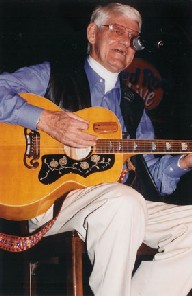
So it cannot be much of a surprise that one of Nashville's most prolific and successful country composers, Harlan Howard[pictured above] (1927-2002), contributed this week's chestnut, "Everglades," to the folk repertoire. Howard was just getting his start in Music City in 1960 when the Kingston Trio included this composition on String Along, their fifth consecutive studio album to hit #1 on the national charts and earn a gold record. Howard had already had two recorded hits, but in 1961, fifteen Howard-composed songs hit the country charts - eventually in his long career, more than 100 of his songs became hits, including such standards as "I Fall To Pieces" and "Busted." He is in the Country Music and Nashville Songwriters Halls of Fame - which he well could be simply for his pithy description of what songwriting should be - "Three chords and the truth."

The delightful "Everglades" has a couple more than three chords, and I'm not sure how much "truth" there is to it - but then again, it's an early Howard composition, just for fun, and not fraught with the heartbreak and hard times themes that characterized his best-known songs and helped to shape country music writing ever since. So our first version ought by rights to be from a country singer, and I know of none better than Waylon Jennings, who recorded an entire album called Waylon Sings Ol' Harlan:


This would seem to be the way Howard conceived of the song; he played along with Jennings on the recording. But he couldn't have been unhappy when the Kingstons sold about three quarter of a million albums with his song on it, however they adapted it to their own style. He would have made well into the six figures in today's dollars in royalties for this version:


A minor note on the recording: trio member Dave Guard is playing a jumbo Gibson 12 string guitar here, perhaps for the first time on a KT recording, a special order of his inspired by seeing the jumbo Gibsons played by the Everly Brothers (see below) referenced in the joking last line of the song.

Roots music pioneer Willis David Hoover gave the song a go (I think I have to thank Dave Long or Curt Dalton for posting this one - gentlemen?) late in his career. He seems to mock the KT a bit in the intro but without any genuine malice, and he does point out Howard's good-natured joshing at the end of the song:


We also have one delightful non-pro version inspired by the KT. John Dennis Dickey is a YouTube friend of mine who is a long-time trio fan, a member of the his own South Coast Trio, and creator of a goodly number of solo multi-track recordings. I'm happy to be able to include his take on the song:


My own upload of the KT version of the song presented above has generated more nostalgic and positive comments than any other single song of theirs of the 70 or so I've uploaded for this series. The general tenor of the comments is - "I'd forgotten this gem and why don't they make music like this any more?" Amen to that.

Appendix

Here is Howard himself performing the song in an upload appearing a few years after this article first appeared:


Further....Howard's "I Fall To Pieces" that became a monster hit for Patsy Cline:


Finally, the Everlys with their jumbo Gibsons and "Bird Dog," whose guitar riff figures in the KT and Hoover videos above:


And Howard's official website and bio are certainly worth a look here:

Harlan Howard's Official Website

Thursday, September 2, 2010

"The Escape Of Old John Webb"

I believe it was my friend Max Schwartz who has related several times in different posts that one of the things he loved about folk music was its ability to transport us to different times and places like no other kind of music can. That resonated with me, because when I was a boy that was exactly what I felt about traditional songs from time periods I loved, like the era of Yankee whaling or the time of the mountain men or the Civil War - or as here, colonial America.

I loved "The Escape of Old John Webb" the first time I heard it. The lyric provides just enough detail for the listener to fill in the blank spaces and create his or her own personal imaginative drama. My John Webb is a short old man, bald except for a Ben Franklin-esque fringe of shoulder-length white hair. He is dressed in eighteenth century knee-length leather britches, with tattered white stockings and dirtied black leather shoes with tarnished brass buckles. His weskit, or long vest, is dark blue, tattered, and missing buttons as he sits in a dank, straw-floored subterranean cell, clamped to the wall with huge and heavy chains. Bill Tenor is a powerful young man in his 20s in a plain homespun shirt and yellow weskit with the massive shoulders of a defensive tackle, his brown hair tied back in a neat and oiled queue as he tears the jail apart to rescue his friend... I still see these images and get a chill every time I hear the song.

I had always assumed that, with the British being the bad guys, the song was of Revolutionary War vintage. Then about 20 years ago, while I was paging through the voluminous Folk Songs of North America by Alan Lomax, I found that a version of the song had been there all the time (I got the book around 1962) under the title of "Billy Broke Locks." Lomax tells a complicated and metaphorical version of the truth underlying the song, very different from the one told by Burl Ives in his song book. Other books tell yet other versions. From all the obscurity of centuries and folklore, four basic facts emerge:

1) There was a real John Webb (possibly Webber but likely the former), the mintmaster of Salem Mass. in the 1730s.

2) Sometime mid-decade, he fell afoul of the British authorities and was accused of counterfeiting.

3) He was jailed.

4) He got out of jail.

The truth of anything past that is speculative, possibly because the actual song is derived from an older Scots ballad called "Archie o' Cawfield" in which two brothers rescue a third who is doomed to hang and imprisoned in a cell with 40 weight of good Spanish iron and so on.

Ives tells the straightforward version. Webb is printing his own money in this version because royal currency cannot be trusted and Webb's notes are preferred by his neighbors. The Brits arrest him for counterfeiting, and JW's young friend Bill Tenor stages the jailbreak after having escaped from the selfsame jail.

Lomax suggests that it's all a metaphor - the original lyric has "one to let Old Tenor out" - old Tenor being a nickname for Webb, who preferred an older version of the country's currency (called "tenors") to a newer and in the colonies mistrusted and hence valueless version. Lomax further suggests that the lyric should read "billie broke locks" instead of "Billy" - a billie being a bit of Scots terminology for a lead pin, something like a belaying pin on ships and the ancestor of the billie club of nineteenth century police.

Makes sense, and folk songs can surely be that symbolic and indirect. Trouble is - fragmentary tax records show that in 1735 there was in the township of Salem a certain farmer, one William Tenner. And it was the Salem jail that John Webb walked out of - though we will never know if as some suggest he was freed due to lack of evidence (and the rising tide of colonial resentment against overseas British authority) or whether his friends broke him out with redcoat cavalry in hot pursuit.

But we do not have to know. The song stands as it is, one of the best of the American broadside ballads, which were songs printed on a single large sheet, about the size of an old sheet of newsprint.

Given that background, our first version of the song is in broadside ballad form, sequenced by folk expert Lesley Nelson-Burns of The Contemplator website:


Nelson-Burns' site, from which I downloaded this MIDI, is as I've mentioned before one of my go-to sites for information on songs to help me fill in gaps. The overall site is here:

The Contemplator Site

and the Webb-specific page is here:

Old John Webb

John Roberts gives us an authentic-sounding version, accompanying himself only with a concertina  - here from the 2010 Chicago Maritime Festival. Roberts sings the expanded lyric with a couple of verses clearly taken from "Archie o' Cawfield":


Roberts gives the song the kind of swing that makes it sound like a tavern singalong. You can almost smell the ale.

The Kingston Trio's version is the one I've loved for fifty years:


This is such a beautiful arrangement - the quietly urgent vocals that the original Trio did so well, the soft, bare-fingered banjo work by Guard, the way the desperation of the flight is communicated by Guard's "The British were coming..." riding right on the tail of Reynolds' verse - absolutely masterful.

John Stewart was like many of us a fan of the original KT before he joined the group after Guard left. Decades later, after reinventing himself several times in different singer-songwriter modes, Stewart began to return to his KT roots in the 1980s, first with a wonderful short album with former Triomate Nick Reynolds, and then slowly integrating new versions of old KT songs into his shows and later his albums. Here is his take on "John Webb":


I like Stewart's Lindsey-Buckingham-styled folk-rock take on the song - except for that damned whiny Ovation guitar John was playing at the time. Cool fact: Dave Guard and Nick Reynolds are singing on the chorus here.

E.L. Kurtz of Rochester IL is a younger performer who revels in all things Revolutionary. He has been a Revolutionary War battle re-enacter, and his 2007 CD A Soldier's Journey takes eighteen traditional songs and weaves them together into the narrative of a colonist's life as Kurtz imagines it. Here is his "Old John Webb":


Kurtz's dramatic reading has a kind of gusto that just feels right for the heroic tone of the song.

Poor Richard's Penny is a highly talented and thoroughly professional duo that specializes in early American music:


This delightful performance has been posted to YouTube for more than four years now and deserves a much wider audience than it has garnered to this point.

Finally, from the 1962 Ted Mack's Original Amateur Hour - Groveton High School's Wayfarer Trio creates an interesting riff on the Kingston version and adds a Limeliter-styled twist at the end:


Fine version - though it is sobering thought to realize that these three fresh-faced boys are all eligible for Social Security today.

If, as former DJ and producer Tomm Rivers suggests, folk is as dead as radio formats in general, then we are all obviously the poorer for it. But the people you really have to feel sorry for are the generations born after people could hear music like this over the air or buy it in a music store. Those younger ones will never have a chance to create their own John Webbs and Bill Tenors in their own sadly under-developed imaginations. Pity.

Thursday, April 22, 2010

Bob Gibson And "To Morrow"

Over the years of these posts, I've tried at times to present song profiles by artists who have been even more neglected than has the Kingston Trio - artists like Ed McCurdy and Ewan MacColl and John Stewart. Tonight is especially melancholy for me in that regard, because I have a few words to say about the granddaddy of all the forgotten heroes of my childhood and youth - a figure little known among even the younger generation of Trio fans who read here (meaning those under 70) - the late and great and genuinely gifted Bob Gibson.

[Parenthesis: Imagine being a celebrated folk singer who hit the skids in the 60s carrying that name while a Hall of Fame pitcher with the same name is making his mark in America - not unlike the recognition problem that John Stewart had when comedian Jon came along, or CMT baritone Joe Frazier did after the boxer of the same name gained fame.]

Gibson was the bridge between the solo pop folk artists of the 1940s and early 1950s (really, just Burl Ives and Terry Gilkyson, though Glenn Yarborough had the beginnings of a nice career going as well) and the Dylans and Paxtons and Ochs and Patrick Skyes and others who followed in the 60s. He may well have been the most influential soloist of his generation, after only Pete Seeger. A passel of 12-string guitar players, including Leo Kottke and Gordon Lightfoot, acknowledged an admiration for and influence from the way Bob handled that instrument.

It was Gibson who gave the 18-year-old Joan Baez national exposure, and he was instrumental in helping the young Judy Collins along as well - for both of which lovers of folk music owe him an enormous debt. Though he flamed brightly across the pop folk sky for only about seven years, between about 1957 and 1964 before being undone by his own mad addictive personality, Gibson left behind some of the best polished and commercial folk music of the era in four albums especially - his 1957 Carnegie Concert, the 1961 Yes I See, the 1964 Where I'm Bound - and most especially, the album on which what little remains of his memory rests, Gibson and Camp at the Gate of Horn (1961). (pictured above) Gibson was also the first to record "Day-O/Banana Boat Song," which Alan Arkin and Erik Darling heard him play with his banjo in Washington Square one summer - they formed the Tarriers with Bob Carey, recorded Gibson's arrangement, and had a minor hit with it - a hit heard and recorded by Harry Belafonte, who had a blockbuster hit with it.

The Camp is Bob, who later resumed his birth name of Hamilton and made a career as a comedian and actor. Gibson had introduced Camp at the 1960 Newport Folk Festival, and they co-wrote a number of what became standard folk group numbers (including "You Can Tell The World" and "Well, Well, Well") before the legendary gig at Chicago's first and arguably greatest folk club, owned by Albert Grossman, who later assembled and managed PP&M as well as co-founding the Newport Folk Festival and guiding the careers of Odetta and Ian and Sylvia and Gordon Lightfoot. The Gate of Horn album is regarded by many as the musical high point of the pop folk era.

Though Gibson had been born in Brooklyn, he will forever be associated with the Chicago folk scene that also produced Steve Goodman and John Prine and Frank Hamilton and Bernie Krause (Seeger's last replacements in The Weavers) and all Gibson admirers - and of course Jim McGuinn, who came to folk music because Gibson played a solo banjo gig at McG's high school. The eventual founder of the Byrds and folk rock came to this kind of music because of Bob Gibson - who I hope I've shown was about the most important figure in folk music that nearly no one remembers. He was big and doing Carnegie Hall while Dave Guard was still in grad school.

Oddly, for a performer who wrote and arranged some splendid folk music ("Foghorn," "Yes I See," the spirituals mentioned above,"Blues Around My Head"), the one song that the Kingstons chose to do by Gibson was one that he copyrighted but freely admitted he didn't write (shades of "Scotch and Soda"). Gibson learned "To Morrow" from a Bob Black of Indiana University, but the basic tune and words were copyrighted in 1898 by humorist Lew Sully with music by Geoffery O'Hara. According to a Dayton, Ohio newspaper, not far from the very real Morrow, OH:

The railroad also provided humorist Lew Sully with the material he needed to compose the famous poem "I Want To Go To Morrow." According to legend, Mr. Sully overheard a conversation between a Kentucky farmer and a Cincinnati railroad ticket agent. The agent decided to have some fun at the farmer's expense, and thus the basis for the poem was born.

The earliest known recording of the song - and one of the oldest surviving recordings in the world - is by Dan W. Quinn, recorded July 11, 1902:


This recording is from the Library of Congress National Jukebox.

Gibson re-worked the words and came up with this in 1991: (unfortunately removed for copyright and will be added again if it becomes available)


The Kingston Trio put Capitol Studio B and Dave Guard's still-new Vega Pete Seeger long neck banjo (the legend is that Gibson had bought the first production model of that instrument) to excellent use in their delightful version, with Bob Shane doing his jaunty bit and Guard almost visible in the imagination as a bespectacled railroad agent:


The number is clearly better suited to two voices in counter point, but the influence of Gibson on this, especially Dave's instrumental, is clear.

And now, some more fun versions of a fun song. First, one good re-write deserves another, and Scots folksinger Iain Mackintosh rewrote both the words and the melody in this early 1950s radio broadcast:


Just a few weeks back in February, the Slomski Brothers of Virginia go for the full-on comedy version. Their self-evident youth is somehow encouraging:


Let's close, however, with some real folk music pros - the Muppets, with these puppets created as images of the real (l-r) Jim Henson, Frank Oz, and Jerry Nelson, who reportedly are actually playing the instruments:


Bob Gibson died in 1996 at the age of 64 of supranuclear palsy, a week after a farewell concert performed for him in Chicago by many of those artists listed above and many more as well, including Tom Paxton. I hope he's out there some place smiling at even this little memorial to one of my all-time favorite performers.

Friday, September 18, 2009

Carl Sandburg: "This Mornin', This Evenin' So Soon" ("Tell Old Bill")

Talk about getting not nearly enough respect for a career of splendid achievement. Carl Sandburg (left, with Jean Ritchie), regarded during his lifetime as a major American poet second only to his contemporary Robert Frost, is now neglected to the point of being all but forgotten. I suppose one possible reason for this is that he is sandwiched in terms of time between two other great free verse poets, his own role model Walt Whitman and his more flamboyant successor Allen Ginsberg.

But Sandburg is much more dimensional than either of those two, and in his cultural importance - and in his importance to those of us who love folk music - he beats out nearly every other writer and folkie in American history in one critical regard. Sandburg is the link, the connection, between the high culture of published poetry and the people's culture (of folk music, actually) in a way that Whitman dreamed of but never quite succeeded at and that Ginsberg attempted but never realized (Ginsberg's success at being the iconic voice of the outsider).

Sandburg took the Whitman-esque style of long lines of apparently rambling free verse and infused it with a more pointed political perspective than Whitman ever quite managed to do. About the most political that Whitman ever got was to endorse the Union cause in the Civil War and fall in love with the idea of Abraham Lincoln. Sandburg, on the other hand, channeled his eighth grade education and early life of manual labor into a poetry that transcended Whitman's dreamy paeans to the common man into a harder edged, more real imagery that nonetheless celebrated the wisdom and virtue of the masses. Does anyone still remember "Chicago"?

Hog Butcher for the World,
Tool Maker, Stacker of Wheat,
Player with Railroads and the Nation's Freight Handler;
Stormy, husky, brawling,
City of the Big Shoulders:

They tell me you are wicked and I believe them, for I
have seen your painted women under the gas lamps
luring the farm boys.
And they tell me you are crooked and I answer: Yes, it
is true I have seen the gunman kill and go free to
kill again.
And they tell me you are brutal and my reply is: On the
faces of women and children I have seen the marks
of wanton hunger.
And having answered so I turn once more to those who
sneer at this my city, and I give them back the sneer
and say to them:
Come and show me another city with lifted head singing
so proud to be alive and coarse and strong and cunning.
Flinging magnetic curses amid the toil of piling job on
job, here is a tall bold slugger set vivid against the
little soft cities....

A lifelong socialist activist, Sandburg had the same faith in the People that we today associate with a Whitman or a Woody Guthrie or a Pete Seeger. But Sandburg was also an early contributor to and editor of the august Poetry magazine, popular among the intellectual elites of two continents, and his work was in fashion in salons from New York to London and Paris.

At the same time, though, Sandburg was out collecting folk songs, inspired in part by the Lomaxes and other early collectors, but also by his own belief that folk music was the art of the common people, with a power in and of itself (without resorting to writing new political songs) to transform and redeem America.

The result of his work was the classic American Song Bag of 1927, my own personal favorite right behind the Lomax books. It was apparently one of the Kingston Trio's favorite books as well, because they took maybe half a dozen songs from it that they list as copyrighted by Sandburg, including landmarks "Sloop John B," "The Colorado Trail," - and "This Morning, This Evening So Soon."

Often called "Tell Old Bill" and copyrighted by Sandburg as "Dis Mornin' An' Dis Evenin' So Soon," the song is clearly an African-American country blues number that may have originated from an older song in Georgia in the mid-nineteenth century. Sandburg told of hearing it in St. Louis in 1922 from a Nancy Barnhart, and it was roughly her arrangement he published. Sometime in the 30s, the recently-deceased Sam Hinton heard another version in Texas and recorded it. Sandburg's later editions of Song Bag reflect some of the elements of Hinton's song, and it is through that latter arrangement that most of us have come to know the number, courtesy of Sandburg's fellow Chicagoan Bob Gibson.

The Kingston Trio's version on their 1960 album String Along follows the basic chord pattern from Sandburg's book but with some extra minor chords thrown in and a bluesy guitar opening that sounds a bit like the Guard trio's opening for "Don't You Weep, Mary":


The vocals on this cut are IMHO just outstanding - one of my all time KT favorites.

And for outstanding vocals - how about Chad Mitchell on lead, from the CMT Reflecting album from 1964:


Next, a version from the great Dave Van Ronk, Greenwich Village's "Mayor of MacDougal Street" who was a powerful influence on the young Bob Dylan and one of the most effective of white singers who interpreted African-American blues:


More recently, Eric Bibb, son of art folk performer Leon Bibb, with Brian Kramer in a version that may be the closest to what the song that Sandburg first heard sounded like:


There is one very significant Kingston Trio connection to Sandburg, one I think not widely known. At my first fantasy camp in 2003, John Stewart and Nick Reynolds duetted on "Sloop John B" in a rough, unrehearsed version that I've posted on YouTube(link below). Even before the thunderous applause subsided, Nick had grabbed the vocal mic and with an asperity in his voice that I found arresting said, "When we were first starting out, there were a lot of people calling us 'phony folksingers' and such. One man who stood up for us - one of the really righteous men - was the poet Carl Sandburg, who collected that song. He sent us all a really nice letter with autographed copies of his works The Lincoln Years*. We never forgot that."

Amen, Nick Reynolds. And God bless you, Carl Sandburg.

Addendum - March, 2012

Thanks to Alex Edouard, whose comment appears below, we can also enjoy Nathan Salsburg & Will Oldham doing their version in 2007 - Oldham is better known by his stage name of Bonnie Prince Billy:


*Nick was referring to Sandburg's Pulitzer Prize-winning biography in two volumes, Abraham Lincoln: The Prairie Years and The War Years.

Appendix

Link to Nick and John, Sloop John B:

Reynolds/Stewart Sloop John B

Amateur Time - Nice home recording - Leo Keating:


Courtesy of Bo - Fred Grittner, me, Neal Spivey, Mr Banjo, and Art Yow a few weeks ago:


Addendum, 2/6/10

At the risk of sending Carl Sandburg spinning in his grave - Merle Haggard is a major performing artist whose singing and song selection I usually enjoy. Here, though, Merle got a hold of the number and turned it into something quite different:


Well, I guess that's one use you can put Public Domain material to....

Friday, May 15, 2009

"The Colorado Trail"

"The Colorado Trail" is one of those folk songs in the American tradition that appears as a genuine surprise, like maybe "Shenandoah" and "The Streets Of Laredo" and "Coffee Grows On White Oak Trees." American frontier culture has given rise to rough-hewn ballads like "Jesse James" and fiddle and dance tunes like "Old Joe Clark" and "Turkey In The Straw" and topical/historical pieces like the hundreds of Civil War songs and railroad songs and sea chanteys. We're not generally known, though, for the lyrical beauty of the Celtic songs of Ireland, Scotland, and Brittainy or the stately and often melancholy classics of England (think "Greensleeves" or "Barbara Allen").

Every so often, though, some anonymous American worker came up with a melody and some words of genuinely aching beauty, real polished diamonds set sparkling against the rough and grainy backdrop of American folk tunes. Such a song is the very real cowboy ballad, "The Colorado Trail."

We owe our knowledge of this obscure ballad to classic American poet Carl Sandburg and Weaver Lee Hays, the same pair who gave us "The Wreck of the John B" and dozens of other traditional songs that found their ways into public consciousness through the books of Alan Lomax and the records of Burl Ives and The Weavers. The story goes that Sandburg "collected" (as they say in the folk music biz) the song in 1927 (about the same time as "John B") from Dr. T.L. Chapman, an old surgeon in Duluth, Minnesota who maintained that some decades earlier he had treated an anonymous cowboy for "bones of both upper and lower legs broken, fractures of the collar bone on both sides, numerous fractures of both arms and wrists, and many scars from lacerations." According to Chapman (from Sandburg), the cowboy spent several weeks convalescing, singing "The Colorado Trail" several times daily to other patients who just couldn't get enough of it.

And no wonder. The song is pure (if a bit schmaltzy) genius and includes one especially fine technical point - the rise in the melody of the chorus where the meaning of the words rises - "wail, winds, wail" - with the subsequent gradual stepping down of the melody as the words return to earth - "all along, along, along - The Colorado trail." [Lomax's published musical setting gives you the option to sing the word "wail" at either the high end of an octave as the Kingstons do below or the lower as with the Bar D Wranglers - Ives did the high octave.] You generally don't hear that kind of sophisticated gambit in any kind of music outside of the really serious pop and classical stuff. That ol' cowpoke knew what he was doing.

I first heard it on what may have been the earliest commercial recording by Ives, who put out literally hundreds of 45rpms and 78rpms before the mid-Fifties debut of LPs. The Weavers may also have waxed it in the Gordon Jenkins sessions with Decca, though I can't say for sure or find direct evidence of it.*

It's safe to say, though, that the awesome commercial punch of the Kingston Trio in 1960 brought the song its widest attention to date, appearing as it did on their album String Along, the fifth consecutive (and final) album of the original trio's to go to #1 on the Billboard charts, where it stayed according to The Kingston Trio On Record for an impressive ten weeks. The Trio's reading stands after nearly fifty years as one of the loveliest cuts that they ever recorded:


Given the single source for the song from Sandburg, there are still major variations in the lyrics because a)Lee Hays added two verses of his own to Sandburg's find, including the last verse that the KT sings, and b) most of the other artists who have recorded it (Johnny Cash, Don Williams, Tex Ritter, and more) have felt free to write their own verses as well.

We have some fine performances of the song from amateurs and professionals alike. For a pure and simple folk arrangement featuring only vocal, guitar and recorder, I would like to start with one of my favorite singers of all time, Cisco Houston, who died at 42 years old in 1961 just as his career was taking off in the folk boom. Houston had the best baritone voice in roots music, one that some traditionalists felt was "too good" for the simple tunes he sang. I disagree most emphatically:


Rick Devin is a multi-faceted and thoroughgoing professional who has had different incarnations as a rock, folk, and blues performer. Since 1985, though, he has focused on cowboy songs, teaming up with Michael Martin Murphey, among others. This video is a bit of a commercial but still a fine performance:


Marshal Bailey and The Silver Bullets put a definite and very melodic country spin to the song - this was recorded last June at the Colorado Bluegrass Festival:


Mike Iverson gives a genuine and authentic-sounding reading at last year's Western music Alliance meeting in Albuquerque, New Mexico - the mouth harp makes you nearly smell the campfire smoke:


A lovely, understated melody, melancholy tone, haunting lost love theme - "The Colorado Trail" includes for me just about everything there is to love about traditional music.

*4/21/12

Well, here's some pretty direct evidence - The Weavers with Lee Hays on lead. Seeger is playing the recorder, but the brush drums and strings are the work of Gordon Jenkins, so this is indeed from the 1949-52 Decca era of the group.


Updates, April 2013

In the nearly four years since this post first appeared, the number of videos of all kinds posted to YouTube has more than tripled, and despite the occasionally problematic actions by record companies to enforce copyright restrictions (as has happened with the Kingston Trio video above), this has been good news for music lovers of all stripes. In May of 2009 when I wrote this, I had a hard time coming up with YT renditions of "The Colorado Trail" that I liked enough to include in an article such as this. The ones in the original posting above are of genuine excellence - but they were all that I could find. Recently, though, especially in the last year, a substantial number of outstanding versions of the song have been uploaded to YouTube. Here are several of the best of those, all by major artists whose work was not available in video form four years ago.

Don Edwards


Connie Dover


The Norman Luboff Choir - 1955


Noël Wan, Harp - 2007