Showing posts with label OUAT. Show all posts

Friday, May 24, 2013

Bob Dylan's "Mama, You've Been On My Mind"

Bob Dylan turns 72 today, a fairly unremarkable fact, certainly not on the order of wonderment of, say, the notoriously self-abusive Keith Richards looking forward to birthday #70 in a few months following yet another extensive and strenuous Rolling Stones concert tour, or Pete Seeger's continuing vitality in his twin roles of musician and activist at the age of 94 - and as the godfather of American folk and roots music through most of the 20th century. Dylan remains simply Dylan, soldiering on doing his Dylan things, writing, touring, and performing, and now reaping accolade after accolade and award after award as cultural institutions around the world trip over each other in a mad rush to acknowledge his genius while he is still around. To any real Dylan fan, and I would guess to Bob himself, the recognition is fine, but it belabors the obvious - that in the words of the special 2008 Pulitzer citation he has had a "profound impact on popular music and American culture, marked by lyrical compositions of extraordinary poetic power." Time Magazine included Dylan in its controversial and typically idiosyncratic list of the most important people of the 20th century, and there is an international coalition of college professors who have organized and mounted a campaign to have Dylan named as a Nobel Laureate in literature.

That last may be a bit of a stretch - or not, depending on what you think literature and poetry are, just as one's reaction to the "singer" part of Dylan's role as a singer-songwriter depends very much on what one values in singing. A polished pop vocalist like Frank Sinatra (a towering figure in 20th century popular music, every bit as significant as BD in overall impact) he is not, but it is beyond serious question that his evolving vocal styles have shaped the sound of rock music throughout the world, and a recording in that genre that does not demonstrate Dylan's influence is as rare a bird as a pop vocal that does not have Sinatra's fingerprints all over it.

I have almost from the start enjoyed Dylan's vocals - almost, since on his first album he was affecting a kind of Woody-Guthrie-reheated singing style that just didn't come close to matching the easy, homespun sincerity of Guthrie's own. Traces of that remained in some of the performances on the second album pictured above, but the fact that The Freewheelin' featured mostly original compositions, including several that became folk/rock standards like "Blowin' In The Wind" and "A Hard Rain's A-Gonna Fall," overshadowed the actual renditions themselves as the quality of the lyrics essentially proclaimed the arrival of a new and very accomplished writer of folk-styled music. Still, the vocals here are merely a foreshadowing of the explosively original approach that Dylan seemed to perfect in the landmark 1965 recordings for Highway 61 Revisited, especially "Like A Rollin' Stone."

Of course, not everyone is as enamored of Dylan's vocals as most folks seem to be of his writing. Alec Macpherson, for example - a younger music reviewer for Britain's The Guardian - took a sledgehammer to the icon's singing in his review of Dylan's 2012 album The Tempest (a recording I thoroughly enjoyed, by the way). Macpherson commented that

For all the reverence Bob Dylan attracts in certain circles, it's been surprisingly easy to live life, as first an obsessive music fan and then a professional music critic, thoroughly untroubled by him. A sole ill-fated attempt to get into him....ended two-and-a-half songs into a best-of compilation with me flinging the CD out of the window, outraged that anyone could have the temerity to sing like that and call it art.

And further -

Dylan's lyrics don't come to life because he doesn't bring them to life. His voice is famously divisive – but, as horrible a rasp as it is, the problem is more about what he fails to do with it. He colours between the lines performatively, almost wilfully avoiding any element of spontaneity or surprise....lyrics in pop, rock and rap are not poetry: they're performance. The best exist not in a dry textual vacuum but are inextricably connected to the nuanced vocal inflections, the rush of notes, the tempo shift. A line that appears banal on paper can be – not seem, be – profound in the mouth of a talented vocalist. Words that look like nonsense can sound intensely meaningful if delivered as though there's something important at stake. And music can breathe vitality into cliches...

...which Macpherson maintains that Dylan never quite achieves, even when the words demonstrate the sublime lyricism for which Dylan has become so celebrated.

While I salute Macpherson's apt and usually-overlooked distinction between poetry and song lyrics, I can't quite go along with so total a diss on Mr. Zimmerman's melodizing, and my Exhibit #1 for the defense is Dylan's work on one of his best love songs, 1964's "Mama, You've Been On My Mind," a studio recording that inexplicably was never released as an official Columbia track until 1991, though bootlegs of it and of live performances had been circulating almost since it was written. The song is said to be about the break-up of Dylan's relationship with the late Suze Rotolo (the young woman pictured above, of course), and the June 9, 1964 recording is a classic of the kind of folk simplicity that Dylan was soon to abandon.


At his best in his early years, Dylan's singing could express both rage (as in many of the political songs) and pain, as here. "Spontaneity and surprise"? Maybe not - but both or either would be utterly out of keeping with the nature of the lyrics, and the fact that Dylan avoids them is a credit both to the performance and to his understanding of the nuances of his own verses.

Joan Baez provided Dylan with the biggest early boost to his career (along with Peter, Paul and Mary) - Baez was already a folk superstar and the subject of a Time Magazine cover story before Dylan even arrived in New York City. Her formal studio recording (as "Daddy, You've Been On My Mind" to make the lyric gender-appropriate) appeared in 1965, almost a year after she began performing the song live, often with Dylan in tow as an opening act who would join her on this number.


The purity of the young Baez's soprano and the more conventionally-understood excellence of her singing puts a different spin on the tune - and makes it rather more commercially palatable than BD's rendition above.

Johnny Cash's signature rockabilly-influenced sound also lent itself to an interestingly different take on the song:


Note that in deference to censors and the standards of the more conservative country radio stations which at first gave Cash his greatest airplay, he tames the lyric a bit in the third verse from the original "I don't even mind who you'll be waking with tomorrow" to "It don't matter to me where you'll be waking up tomorrow..." Cash, of course, helped to bring Dylan's writing to country audiences as much as Baez did to the folkies.

Beatle George Harrison also loved Dylan's whole musical approach - the band's 1967 Sgt. Pepper's Lonely Hearts Club Band was directly influenced by BD, and Harrison covered a number of Dylan's songs in live performance. This is a studio recording from Harrison's Living In The Material World album from 1973:


I find it interesting that on this track Harrison is affecting a Dylanesque tenor to his singing, unusual because in most of his solo work George H. had a quite distinctive and pleasing vocal style all his own, one that sounded nothing like this. Think "My Sweet Lord" or "Give Me Love."

The Kingston Trio came a bit late to the Dylan party, likely because their chief competitors at the top of the pop-folk heap were Peter, Paul and Mary, who had scored two top 15 singles hits with Dylan tunes before the Trio had recorded even one and who seemed to have a lock on the reputation as interpreters of BD. The KT had been used to setting trends in folk, not following them, though the group eventually recorded a number of BD songs toward the end of its first cycle. This rendition (as "Babe, You've Been On My Mind") was not released until 1969, two years after the group broke up and a bit before KT's Bob Shane re-formed the band with different partners as The New Kingston Trio.


The lead vocal and 12-string guitar work here are by John Stewart, who was shortly to embark on his own career as a singer-songwriter. Stewart's voice has the perfect tinge of loneliness and longing appropriate to the lyric, though it's worth noting as well the as-always supremely tasteful and understated harmonies provided by Nick Reynolds on the latter verses.

There have been scores of covers of the song over the decades, and it has continued to find its way into the repertoires of younger artists to this day. One of the better recent versions is from the Swedish duo Mando Diao, here from a live performance from 2005:


Sounds to me as if the guys had been listening to Johnny Cash and Simon&Garfunkel and fused their styles into this track.

Lastly, Jack Johnson has been a favorite of my high school and college students for over a decade now, and he has a distinctive approach to the songs he covers - here, slowing the tune to a more reflective pace:


Johnson uses a range of musical tools here, including bringing in more instruments as the recording builds to its climax. Good stuff.

Not surprisingly for a blog about folk music such as this one is, Bob Dylan's name crops up scores of times in the more than 180 articles here. How could it not? Though I have issues with the mawkish adoration and hagiography that have become attached to a very real person and artist, and though a realistic and balanced understanding of both the extent of his achievement and its very nature is likely decades and perhaps generations away, I do like a remark made by critic J. Hoberman in The Village Voice a few years back because it gets at the essence of Dylan at the same time that it expresses the problematic nature of his relationship with folk music. Hoberman says "Elvis might never have been born, but someone else would surely have brought the world rock 'n' roll. No such logic accounts for Bob Dylan. No iron law of history demanded that a would-be Elvis from Hibbing, Minnesota, would swerve through the Greenwich Village folk revival to become the world's first and greatest rock 'n' roll beatnik bard and then — having achieved fame and adoration beyond reckoning — vanish into a folk tradition of his own making." It can't be summarized better than that.

So a happy birthday to Robert Zimmerman, wherever you may be. Long may you run.

Addendum

I can't believe that this version did not appear in my YouTube search - or rather, I do believe it, since the YT search protocols reek and are a disgrace to its corporate master Google. In any event, Linda Ronstadt was one of the great singers of the era, and this version - ferreted out of YT obscurity by my longtime friend from back in the day Mike Peterson, to whom I tip my cap and pull my forelock - has the distinct folk rock sound she helped popularize, with more than a bit of the Stone Poneys[sic] sound, the band she had just left to record the solo album this is from.

Tuesday, March 27, 2012

"The Roving Gambler"

I first heard "The Roving Gambler" about 1961 on the third album of The Brothers Four, an estimable pop folk group that had started out as fraternity brothers at the University of Washington in the mid-1950s singing vocal group standards in addition to traditional songs. The group's facility with folk-styled music dovetailed chronologically with the boom in mainstream popularity of the genre and spurred them to national prominence - in what some remember as the Folk Revival and the more cynical as The Great Folk Scare, referencing a now nearly forgotten (except for the disdain, that is) controversy about the "authenticity" of performers like the B4 who freely adapted, arranged, and harmonized songs that had previously existed in somewhat simpler amateur and professional recordings. The quartet became one of the most popular and successful acts of the era, selling millions of albums but unlike many of their folk-oriented counterparts also scoring a significant number of Top 40 singles as well. They were solid professionals - really fine singers who worked hard on their arrangements and harmonies and presented an energetic and entertaining live show. The Brothers Four still perform today with founding member Bob Flick at the helm and three long-term group members with him. They are the only band from the late 50s that has existed as a performing entity for an unbroken stretch of 55 years.

Yet the Brothers Four, like many of the other acts that rose to popularity at the same time, are rather less remembered today than they should be. One explanation for why is offered by the excellent music critic Bruce Eder, who specializes in folk and folk-rock on the internet's Allmusic site. In reflecting on the career of the B4, Eder notes -

Most accounts of the post-WWII folk music boom focus on the political and issue-oriented branch of the music, embodied by Woody Guthrie and Bob Dylan, at the expense of the softer, more entertainment-oriented branch, embodied by the likes of the Kingston Trio, the Chad Mitchell Trio, and the Brothers Four. Those acts and the music they made -- though it sold well and, indeed, for many years defined what most Americans visualized when the phrase "folk music" was mentioned -- are scarcely mentioned in most histories; the Brothers Four aren't even listed in the Guinness Who's Who of Folk Music.

Eder calls it the "issue-oriented branch," but it was really just another head of the Authenticity Hydra, a monster created in a postwar suburban America in which millions who had joyfully escaped their hardscrabble roots in poverty urban or rural suddenly found their children wanting to adapt their own musical tastes to someone else's current hardscrabble misery - and so attempt to establish their own sense of personal authenticity by grafting themselves on to roots that were not their own. Thus did the issue-oriented branch justify its disregard for groups like the B4, though in the wildest irony imaginable, the issues and roots lovers rather quickly abandoned traditional music altogether, and what today is called "folk" or "roots" is an hilariously misnamed amalgam of electric rock, rhythm and blues, and country without a real folk song any where on the horizon. The upshot is that the very groups derided in the '50s and '60s as faux folk - groups like the Brothers Four, the Kingston Trio, and others - have created with all their professionalism and smooth harmonies an approach to folk and trad music that is much more - you guessed it - authentic than what is marketed as such today.

You can see this in play when you have a really good, really old, and really interesting song to work with like "The Roving Gambler," a tune that according to most scholars began its life in England as "The Roving Irishman" or "The Roving Journeyman," probably more than 300 years ago. According to the great poet and accomplished folklorist Carl Sandburg, the earliest British versions did not include a deck of cards or any games of chance at all - because the story was about an itinerant bad boy known as a roving gamboler, or a hopping and skipping playboy, a despoiler of innocent girls. Some of that remained in the lyric as the gamboler morphed into a gambler, a card sharp who courts a proper young lady and steals her away from her mother.

We know of the song today thanks in no small part to its popularization by John Jacob Niles, a Kentuckian by birth but a highly-educated musical sophisticate and a true citizen of the world. Niles performed the song in the strange, high-voiced inflections that he had heard from his rural forbears (you can hear a sampling of Niles' style on the website created to honor him HERE) - but he created a classical-sounding vocal arrangement for the song that hearkens back to the tune's English roots and that is still widely performed today, here by Alexander Carlos Pikarsky in recital:


There is an almost English Renaissance sound to that, and though Niles writes that " 'The Roving Gambler' is one of my early childhood recollections. It must have come into our family from the Ohio and Mississippi River steamboats" - his chorus of "With a click clack oh and a high johnny ho" sounds a lot more like Oxfordshire than it does like Louisville or Memphis.

After World War I, when Niles was gamboling (couldn't resist) about France and the U.S. studying music, a number of very early recording stars were putting "Roving Gambler" to wax in the 1920s, including Kelly Harrell with perhaps the earliest version in 1925. Vernon Dalhart (a stage name for Texan Marion Try Slaughter) had been recording pop and classical songs for Edison records since 1916, having been auditioned by old Thomas Alva himself, but in 1924 he turned to folk and country. Dalhart's "Gambler" was recorded in 1927:


Dalhart's tune is the template from which the rest of our versions are drawn. It is one of a dozen or so versions from the 1920s and 1930s released by a number of performers, enough so that it was a familiar song by the time Elton Britt recorded it in 1952 (with the Beaver Valley Sweethearts) as a kind of western swing:


Both Dalhart and Britt preserve the image of the gambler as a seductive wanderer, a kind of American Gypsy Rover, who works his way into the affections of an otherwise decent girl.

In 1958, the Everly Brothers released a fascinating album called Songs Our Daddy Taught Us that mixed straight folk with country and flavored it with their inimitable two-part harmony:


The single guitar accompaniment is unusual for the Everlys - except on this album, which shows more fidelity to the original songs and - dare I say - more authenticity than albums more widely regarded as folk.

And that brings us to 1961 and the Brothers Four. They were at the height of their popularity when the B.M.O.C. (Best Music On/Off Campus) album including "Gambler" came out:


The Brothers performed with a kind of controlled verve on display here, a kind of early 60s collegiate cool. It's a deceptively simple-sounding cut, but a close listen demonstrates just how tight that harmony is.

A year before his death in a plane crash in 1964 at the age of 39, country star Jim Reeves went to South Africa to play the lead in a movie called Kimberly Jim, and Reeves had a country hit with his version, changing the city names to Capetown and Kimberly to give the tune a South African ambiance:


A year or two before the first iteration of the Kingston Trio disbanded, they added "Gambler" to their concert repertoire. The shirts and hair in this video are a dead giveaway that it's from the mid-60s. Gone are the late 50s crew cuts and 3/4 length striped shirts. What remains, though, is the almost-manic high speed energy of their uptempo performances:


The medley with "This Train," a completely unrelated song, works well here, and in some fashion as the Trio approached what appeared at first to be the end of its existence it was getting back to its own roots. Both songs are traditional - and it had been quite some time since the KT had introduced new trad numbers into their playlist.

There are at least two or three dozen recorded versions of "Roving Gambler" in the 40+ years since the Kingstons' rendition. One of the most recent and best is by emerging country/roots superstar Dierks Bentley, here with the veteran Del McCoury Band:


Bentley's blazing take on the song is very much what we expect from a contemporary bluegrass artist - but note how much more it has in common with the Kingston Trio than it does with Vernon Dalhart or Elton Britt.

The variations in these versions tend to be rather more in the music than in the lyrics, which except for Bentley's character turning murderous are fairly uniform. The story has legs, as they say on Broadway, not least because of that darkest of mysteries to many a teenage boy and young man. Why is it that the good girls go for the bad boys? I don't know and you may not - but the Gambler apparently does.

Addendum

I couldn't sneak this into the article because it just wouldn't fit thematically, but I wanted to include it. I had forgotten that the late actor Robert Mitchum had an active music career as well - I remember as a boy enjoying his singing of the theme song in the western River of No Return. Mitchum released two albums in his life, but several tracks were released only after his death, including his "Roving Gambler." Mitchum does a pop/jazz/blues take on the song - what I find surprising is the high pitch he uses here. Recall that his speaking voice (and his voice on many of his other recordings) was a robust baritone:

Thursday, April 1, 2010

Dylan's "One Too Many Mornings"

Bob Dylan will turn sixty-nine in May of this year, not a significant milestone like a decade birthday - except, perhaps, to those of us who remember the scruffy look and baby face of the cover photo on his first record album on Columbia in 1962, closing in on fifty years ago. It's just as hard imagining the enfant terrible of the Greenwich Village folk sub-culture as a senior citizen as it is finding oneself knock knock knocking on the same door. It's also sobering to realize that Robert Zimmerman, Little Richard wannabe, began his personal reinvention and by many accounts self-iconization as Bob Dylan, folksong poet and reluctant prophet, nearly half a century ago.

He has over the course of the decades developed a core following of rabid Dylanistas, fans from several generations who believe him to be the greatest (fill in the blank with your favorite category) of the 20th century. Uttering a word of criticism of Bobby Z. will draw the ire of maddened legions of those fans, which makes a proper assessment of what he actually has accomplished difficult.

But time will eventually take care of that, and may well have done so already. I'm reminded of a comment made by Irish actor Peter O'Toole on the Charlie Rose Show a few years back, I believe around the time of his last Academy Award nomination. O'Toole has been a frequent and often prickly guest on Rose's program, so I winced a bit when Charlie waded right in with his first provocative question - which was to the effect, "You know, Peter, when they finally publish your obituary - you know what the lead is going to be - it'll be Lawrence of Arabia. How does that strike you?" To his everlasting credit, O'Toole replied without so much as a blink and with consummate graciousness, "That will be just fine with me. I was lucky once in a lifetime to have such a role."

Rose's point, of course, was that Lawrence was very early in O'Toole's career, and all of his subsequent work has been measured by and in the shadow of that great performance in what many regard as one of the best films ever made. Thus may it be with Dylan. He continues to write and perform songs of what the Pulitzer Committee described in its citation of his work (again, not an actual Pulitzer Prize) as "lyrical compositions of extraordinary poetic power." But when they finally publish Bob's obit, you know what the lead is going to be - it'll be "Blowin' In The Wind," or "folk poet of the 1960s."

And why not? Despite the revisionist critics who would have us believe otherwise, those early albums and songs retain a sublime relevance and impact. Dylan's best political songs, like "In The Wind" and "The Times They Are A-Changin'," are not specific to a single time or cause but are universal - and that is a hallmark of legitimate art, art that transcends simple and temporary pop culture, which is what much of Dylan's output has been since the 60s. And Dylan is rivaled only by the early Paul Simon as the folk songwriter of urban alienation - songs like "Positively 4th Street" and "Like A Rolling Stone" and what may be the song whose lyrics give him the best shot at being regarded by serious critics as a real poet, "Desolation Row."

"One Too Many Mornings" from his The Times They Are A-Changin' album is Dylan at his urbanly alienated best, and a song that he himself has reinterpreted in countless ways over the years. The first version from that 1963 album is quiet and reflective, with a nice finger-style guitar accompanimen. Changes in YouTube's stance vis-a-vis copyrighted material  have recently allowed previously-blocked versions of literally millions of popular tracks to appear with permission of the rightsholders, as is the case with this original recording:


Those Dylanistas sometimes forget that Bob got tremendous career boosts from musical stars much bigger than he was at the time, Peter, Paul and Mary at the head of the list. But superstar Johnny Cash took an especial interest in Dylan, as here in a duet from February 1969:


Dylan shows a fine rockabilly sensibility here, and a spot-on-pitch singing style. No question though in this video as to who the superstar is, and it ain't Bob, babe.

The Kingston Trio caught the Dylan train a bit late, recording a number of his songs very well after an initial misfire with a tepid "Blowin' In The Wind." But their version here of "Mornings", like their version of Tyson's "Someday Soon," demonstrates their innovative ability to adapt a song to their own style - and they had a corner on powerful, uptempo banjo-based songs:


Those of us who saw the Trio on their 1966 farewell tour well remember this as the second half opener - a thrilling moment and a great performance in my memory.

The other superstar who lifted Dylan out of smoky coffee house obscurity was Joan Baez, the deity of urban folksingers, queen of Greenwich Village, Time Magazine covergirl - and thrilling performer:


A countrified version from Johnny Cash and Waylon Jennings - 'nuff said:


And just for fun - teen idol Bobby Sherman (remember him?) and actor Rex Harrison's son Noel, who had a brief career as a cabaret-style singer in the 60s.


I hope that Bob Dylan's obit won't be published for decades yet. But I also hope that he could respond to a question about it with O'Toole's grace - that if in fact he is best remembered for something he achieved when very young - that he too will be able to respond, "That will be just fine with me."

Friday, December 4, 2009

"Dancing Cliffed Shattered Sills" - Eric Andersen's "Thirsty Boots"

John Stewart almost certainly snags the award for Most Under-Appreciated Songwriter/Artist of the last half century - but he's not alone in that regard. There is a cluster of other singer-songwriters whose bodies of work go neglected in the odoriferous cesspool that American mass popular culture has become. Steve Goodman always comes to my mind first - had he written only "The City of New Orleans" he would still be a minor deity of the art, but the whole of his work is so much more than that one song. Jim Croce is largely forgotten, and Phil Ochs wrote some of the loveliest tunes of the 60s with lyrics that could be trenchant, satirical, or powerfully emotional. Even Leonard Cohen is a name unknown to most folks under thirty, whose only contact with the musical artists of our youth seems to be with the prodigiously talented Bob Dylan - a rare artist indeed, but not the only one, and I'm not even sure the best one.

Had Eric Andersen written only "Violets of Dawn" and "Thirsty Boots," he would be accounted a fine songsmith. But Andersen has released dozens of albums since his Greenwich Village debut in the early 1960s, and like Stewart, Andersen has produced dozens of really outstanding songs on those albums that have been heard sadly only by the few thousand fans who have stayed faithful to him and continued to buy his recordings. The list of artists who have played with him on those albums is as much of a Who's Who of folk royalty as is the list of artists who have recorded his songs. The latest crapola contestant on American Idol becomes universally if temporarily recognizable by millions while a genuine artist like Andersen labors in the shadows of small venues. At age 66, he's still on the job.

"Thirsty Boots" is a song that I believe will long outlive Andersen just because it is so damned beautiful. Its roots, of course, are in the civil rights protests and demonstrations of the 60s, and Andersen himself has said that he wrote the song for a friend of his who had actually gone down to Mississippi while Andersen had stayed in the relative safety of New York City. But whatever flood of guilt or bright moment of epiphany prompted Andersen to write the song - what he came up with is a song for the ages, one that celebrates all youthful sacrifice and idealism - and he did so with a lyrical beauty that for my money even Dylan never bested.

This first version from the Kingston Trio is not the more polished version released in 2008 on Twice Upon A Time. Rather, this is the bootleg tape from a 1966 concert that I've downloaded from Rick Daly's FolkUSA that for many years was the only recording available of one of the Trio's best performances from late in their initial run:


Here is a clearer and more recent upload of the KT doing the tune, from their final concert at San Francisco's Hungry i in 1967:


Hearing the original artist do his own work is always revealing, and here we have a wonderfully clear video of Andersen performing his masterpiece in New York in 2012.


The closest anyone ever got to a hit with the song was probably Judy Collins, with whom the number is most identified. In 2002, Collins sponsored the Wildflowers Festival (named after what's likely her best-known album) and is joined on the song by (left to right) Tom Rush, Arlo Guthrie, and Andersen, who takes the second verse. This version is masterful:


Unless you happen to be a major John Denver fan - and there are many of us on this board who are- you may not have known that on his first three or four RCA albums, Denver did largely covers of other writers' work, almost always to wonderful effect. Listening to this recording is yet another pull of nostalgia for me - I miss Denver's voice, his writing, his concerts.


Finally - the recording that with Nick Reynolds 70th birthday prompted me finally to go to Fantasy Camp 4 in 2003. I had talked to Paul Rybolt on the phone about signing up, and Paul was good enough to send me the DVD from the 2002 camp - loads of fun with a great amount of talent among the campers. But it was this number by my now friends Pete Bentley, Michelle Stevens, and Bob Kozma (who sings the lead) that really really made me want to go. It was a life-altering decision in every possible good way:


A sublime treatment of one of the great songs of the era.

Thursday, March 12, 2009

Lead Belly's "Goodnight, Irene"


It could be reasonably argued that the commercial boom in American folk music really began not with the Kingston Trio's 1958 hit "Tom Dooley" but rather nearly a decade earlier in 1949 when the Weavers topped the Billboard charts with "Goodnight, Irene," which was #1 for three weeks and on the list for 25. As most know, the politics of the era did the Weavers in (after two more #1s, "Tzena, Tzena" and "On Top Of Old Smoky," both in 1950), and the Kingstons had a more sustained commercial career and a significantly greater effect on popular music in America. Also as we'll see, the KT came out of the gate with a more authentic fake folk sound :) than did the Weavers.

But throughout their long and honored career, members of the Kingston Trio always acknowledged the Weavers as the greatest of American folk groups. Founding member Bob Shane has said this repeatedly, as did the recently departed Nick Reynolds, and Shane acknowledges in his introduction to "Goodnight, Irene" on the Once Upon A Time album that the group started doing out "everything" by the Weavers - a fact that any fan of the latter group already knew from the selections on the KT's first two albums.

It was a personal delight for me to find a Kingston Trio performance of this Huddie Ledbetter classic on OUAT because it had always been one of my favorite Weavers songs (and Ken Kesey's, I'd guess, since he took his novel's title Sometimes A Great Notion from the lyric here), and I'd bet that the original Trio noodled around with it years before they waxed it on that last album.

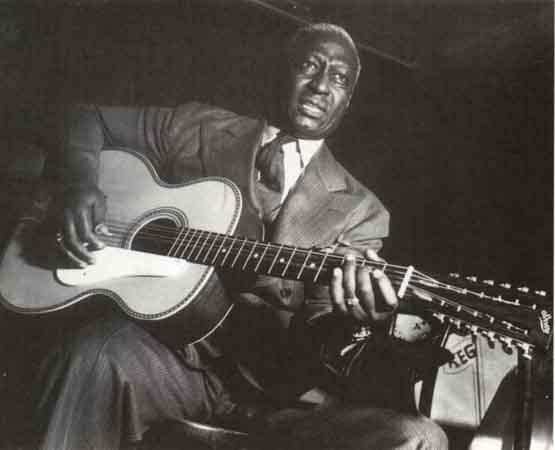
Huddie Ledbetter, who styled himself Lead Belly, was a complex and fascinating figure. Born the son of slaves in 1888 in Louisiana, he became a virtuoso musician on the twelve string guitar and the accordion and reportedly could acquit himself well on the tenor banjo as well. A man of volatile temperament, he served at least three significant hitches in penitentiaries in Texas, once for theft, once for attempted murder, and once for manslaughter after he killed a cousin in a knife fight over a woman.

It was while in prison that Lead Belly learned and refined many of the songs associated with him (like "The Midnight Special" and "Pick A Bale Of Cotton" and "Cane On The Brazos") and where folk song archivist John A. Lomax discovered and began to record him, boosting Ledbetter into a musical career which kept him on the straight and narrow after his release unit his death in 1949 (after the Weavers' hit) at age 61 from Lou Gehrig's disease.

Lead Belly never claimed to have written "Goodnight, Irene," saying that he learned it from an uncle, who may have learned it from his own grandmother. Whatever its origins, it is from Lead Belly and his friendship with Lomax (and Lomax's connection to Pete Seeger) that we know the song today. Here's The Man Himself doing the song:


Amazingly good audio quality for a 1944 recording.

Now here is the Weavers' million seller - the Gordon Jenkins string version - hence my comment about the original Weavers recordings not sounding very folky - give it fifteen seconds or so:


As an antidote - here's how they really sounded - we can overlook the suits, no? It's 50s television, after all:

>

I think you'll find fidelity to both the Weavers and Lead Belly in the Kingston Trio's version, clearly an homage to Seeger, Hellerman, Hays, and Gilbert. They give it more of a rousing treatment than the earlier group, but as with many a rousing number, it works perfectly for the Trio:


Now for some latter day versions. I hope everyone knows Ry Cooder, folk instrumentalist extraordinaire. I've always thought that one of Cooder's strongest assets (beyond amazing ability on a variety of mostly stringed instruments) is the thoughtfulness of his arrangements. Here is Cooder from the 80s with a group called the Moula Banda Rhythm Aces, which includes among others Van Dyke Parks:


Who better to close with than Willie Nelson, whose county-bluesy voice is perfect for this song:


This video occasionally gets yanked from YouTube. Let's enjoy it while we can....

Thursday, January 29, 2009

Bob Dylan's "Tomorrow Is A Long Time"

Say what you will about Bob Dylan, two points are practically and incontrovertibly beyond dispute. First, he has been an absolutely protean musician, changing musical styles and voices and directions constantly throughout the years, from angry young man to rock star to recluse to born again zealot to obnoxious head case on stage to...fill in the blank... and second, he has written some stunning and wonderful songs.

I'd add one more accolade - he's absolutely sui generis, - completely unique, often imitated but never duplicated. Sure, musicians cover his songs in the thousands, but like most genuine artists, his own work is fundamentally inimitable. I may prefer, for example, the musicality of Peter, Paul and Mary's versions of his earliest songs like "The Times They Are A-Changin'" (for my money, PP&M's single best cut ever) or "Don't Think Twice, It's All Right" or "Blowin' In The Wind" - but I have to admit even at that that they don't capture the peculiar edge that Dylan brings to his own work. Like any great artist from Van Gogh or Jackson Pollock or Aescyhlus or Mozart - no one does it quite like the master himself. I have never heard anyone cover nor can I even imagine anyone trying to cover the most "Dylanesque" of his songs, such as "A Hard Rain's Gonna Fall" or "Like A Rollin' Stone."

But please don't count me among the hardest core Dylan fanatics and hagiographers. He's not a poet really - not to most people like me who have a far-ranging and lifelong love of poetry. His words lie flat on the page without the melodies that amplify, uplift, and ennoble them - and even more, the performance voices that bring the words and melodies to life.

That's no rap on Bobby D though - the really greatest poets in English of the last century - Eliot, Yeats, Auden, Frost, Williams, Sandburg, Plath, Stevens, to name a very few - couldn't do a thing with music, and collectively they never reached an audience as wide, as far-ranging, or as diverse as Dylan has.

Bob's not much of a musician either, unless three chords and a cloud of dust is someone's idea of great music. John Coltrane or Tommy Dorsey or Aaron Copland or Richard Rodgers or Stephen Sondheim or Leonard Bernstein might have a word or two to say on that score (no pun intended) - even as much as some of them like Bernstein and Sondheim genuinely appreciated Dylan's genius....


...which is as a songwriter, an artist whose gifts combine the poetic with the musical and create an entirely different art. Dylan bears comparison to Stephen Foster or Cole Porter or Johnny Mercer. It's an art unto itself, one that Dylan crafted and dramatically re-shaped in the last half of the last century (and for which, my friends, the erstwhile Robert Zimmerman won a "special citation" - NOT a "prize" - from the Pulitzer committee - the wording of that citation was for "profound impact on popular music and American culture, marked by lyrical compositions of extraordinary poetic power" - but not for poetry or musical composition, both categories awarding genuine prizes that same year).

One of Dylan's most widely covered songs, "Tomorrow Is A Long Time," existed for nearly a decade only in a bootleg concert tape and a discarded studio cut from 1963 that made it only onto a Dylan album in 1971 on his Greatest Hits, Vol.II. Why this is so is a bit of a mystery, since so many other artists had covered it by then (a greatest hit in that sense) and because Dylan himself does such a fine job on this simple, very folky song -

- but both the recording companies and Dylan's own people have been aggressive about keeping his own performances off of YouTube, which is too bad because no one does Bob like Bob. So we start with the highest profile recording of this song, by Judy Collins:


Several other groups and soloists recorded the song before the Kingston Trio added it to their repertoire. I first heard them do it (and their uptempo take on "One Too Many Mornings") on the farewell tour in late 1966. The polish of ten years of professional work shows in this lovely arrangement - you'll have to click on the "Watch On YouTube" link on the video to get a couple minutes of the song, but it's well worth it:


Or alternatively - from the very last performance by the original group at San Francisco's Hungry i in June of 1967:


I sometimes wonder if the Trio got the idea for the song from Bud and Travis, who recorded it here in '64 or '65. Bob and Nick and John all showed great affection and reverence for Travis, who lives in Scottsdale and comes to fantasy camp every year - best to Travis in his current health troubles! If anyone has forgotten just how fine a singer Travis is or how good this duo sounded together, listen here:


Nick Drake, a kind of Gram Parsons figure from the UK who flamed out and died at 26 in the 60s, left behind a lovely version of the song:


I may have heard this first from Canada's greatest folk duo (maybe just its greatest folk act of any description), Ian and Sylvia:


Harry Belafonte, one of the greatest vocalists of his generation, gives a full-on pop rendition:


There are scores more versions on YouTube,many quite good done by amateurs in their living rooms and professionals on stages. But the best (or at least my favorite) rendition from the younger generation comes from the San Diego-based Americana band Nickel Creek:


I remember being very disappointed that the Nick, Bob and John Kingston trio's last album Children Of The Morning didn't include this song - it would have fit in well with the tone and tenor of that album and is (arguably) a better composition than some of the songs that made it onto the record. But then - like I'm sure many of us did - I walked into a record store in 1969 and almost had a seizure when I saw a double LP:

Photobucket

I still think that this number is the best performance on the album, which for lots of reasons is not in my top fifteen of enjoyable KT records. But back then as now - I'd have bought it for this cut alone and felt I'd spent my money well.