Showing posts with label Flashback. Show all posts

Friday, September 24, 2010

Rod McKuen's "Doesn't Anybody Know My Name?"

I never really thought of Rod McKuen as having anything directly to do with folk music, and I kind of doubt that he did either. That is no kind of criticism at all - he is what he is, and that is a fine pop songwriter who writes rather more in the French cabaret tradition of pop music than in the American Kern-Gershwin-Berlin-Cahn-Bacharach/David tradition. And though pop folk groups like the Kingston Trio and the Limeliters had a lot to do with propelling McKuen's earliest songwriting efforts into the national consciousness, his staying power as a songwriter has come from the large number of pop vocalists who have recorded his tunes. Frank Sinatra's 1969 album A Man Alone is comprised entirely of songs by McKuen, the only time in Sinatra's long and legendary career that Ol' Blue Eyes paid any songwriter (and he worked with all the great ones) that kind of compliment.

I discussed McKuen's controversial career as a poet a year and a half ago when I wrote about his freehand rendering of Jacques Brel's song "Le Moribond" as "Seasons In The Sun: - but some of the exact points at which he is vulnerable to (often savage) critiques as a poet are precisely the points that stand him in good stead as a lyricist. His words are often simple, transparent, and emotional verging on the sentimental. This may or may not make for good poetry, depending on your tastes, but these qualities make for often very effective lyrics when set to the kind of reflective, often Brel-sounding melodies to which McKuen sets them. Now 77 years old, he still writes and performs, singing in that peculiarly affecting throaty baritone of his.

I always thought that McKuen the composer was at his best when, as with French writers like Brel, his lyrics and melodies were tinged with a kind of fin de siecle melancholy, a sadness as gentle as an autumn mist. Think, for instance, of the lyric derived from William Butler Yeats in McKuen's "Isle in the Water" - the subtle changes he makes to Yeats' poem and his original lines make even this love song quietly wistful. "Love's Been Good To Me" is one of the 60s best reflective ballads, and "Rusting in the Rain" is surely one of the loveliest of all laments for the passing of time and the inevitable changes that it brings.

McKuen's "Doesn't Anybody Know My Name?," also known as "Two-Ten, Six-Eighteen," falls right into line with the songs cited above. Like "Rusting in the Rain," a large part of the emotional impact of the song comes from an individual returning to a familiar place and finding that it has become most unfamiliar due to the changes wrought by the inexorable passage of time. That fact that the returnee is an American soldier coming home from an unnamed foreign war to a people who have forgotten him and his sacrifices on their behalf makes this tune about as close to a "protest" song as McKuen would write.

McKuen composed "Doesn't Anybody Know My Name?" in the 1960s, which could lead easily to a misinterpretation of it that would both undermine its universality and do it a great injustice. It is not about the Viet Nam war, though it is eerie how clearly McKuen's lyric anticipated what would become the experience of many a returning VN vet in the decade following its 1962 composition. Given McKuen's age, if there IS any specific conflict motivating him, it is far likelier the Korean War that was fought largely by men his age. In 1962, the U.S. had a smallish military presence in Southeast Asia - perhaps 25,000 soldiers then compared to the 600,000 at the height of the war - and U.S. participation in the growing conflict still at that point enjoyed fairly widespread popular support.

Part of the song's effectiveness is that it takes no political side about any war. It relates the experience of the return home through the eyes of the soldier. In his mind, he has "nearly died/To keep us free" - and perception in this case is the equivalent of reality. McKuen's comment that no returning veteran should be nameless and shunned is one that could and does apply to any war, any where, any time.

Our first version of the song is from McKuen himself, here from about 1970:


This is McKuen's original lyric, one that the Kingston Trio shortened by an entire line in each verse in their version. Once again, I'm using the 1963 concert version of the song from the 2009 CD Flashback because I think that Bob Shane's vocal is greatly superior to the studio version from the album Sunny Side:


Johnny Cash was gifted with a voice whose timbre lent itself most naturally to songs of melancholy and loneliness, and though the Man In Black was most often characterized in his lifetime as "country," he is more properly appreciated as what today is called "roots," which means with a healthy pure folk influence as well - which you can hear in this version remarkable a capella version of McKuen's composition by Cash:


No genre-identification problem with the next two artists. Return with me now to those thrilling days of yesteryear when country music really was country music, first with one of the genre's all time greatest artists, Waylon Jennings:


and Hank Williams, Jr. from 1963:


Both of these last two are solid, professional efforts. I think that Jennings does the greatest justice to the song of all the versions presented here.

A final thought. The peroration or grand conclusion of Abraham Lincoln's second inaugural address, arguably the greatest speech ever written by an American, looks past the awful cataclysm that any war is and urges the nation of his time - and really all nations in all times - "to bind up the nation's wounds, to care for him who shall have borne the battle and for his widow and his orphan, to do all which may achieve and cherish a just and lasting peace among ourselves and with all nations."

All you can say to that is "Amen."

Thursday, June 3, 2010

Let Us Now Praise Famous Songs: Dylan's "Blowin' In The Wind"

"Blowin' In The Wind" may well not be Bob Dylan's best song, but it is incontrovertibly his best known song, the one that has already attained the Stephen Foster-type status of a composed song by a known author that has moved into the oral folk tradition. As with Woody Guthrie's "This Land Is Your Land," people all over the world sing "In The Wind" in English and/or in their own languages, often without knowing who wrote it - because like "This Land," its ideas, hopes, and longings are expressed in an idiom that is all but universal. Like Guthrie's composition as well, "Blowin' In The Wind" has most all of the virtues of a real, traditional folk song - a simple melody line, repetitive structure, easy chorus, and a simple trope (the rhetorical question here) employed in every verse.

But more than that, and again like "This Land," "Wind" resonates with a simply but superbly evocative poeticism in the verses. Where Guthrie writes of "the sparkling sands of her diamond deserts" - and has anyone else ever expressed that vision better? - Dylan demands,"How many ears must one man have/Before he can hear people cry?" - and again, the combination of anger at injustice and hope for remediation never finds better expression than in that and many other lines in Dylan's straightforward but passionate lyric.

"Blowin' In The Wind" has a melody derived from a spiritual, as the first video below describes, and lyrically it represents a quantum leap beyond Dylan's earlier topical songs, not least because of the aforementioned universality. Born as it was of the civil rights era, it has easily transmuted itself to every decade since - and could have done so as well earlier, at least as far back as there were cannon balls that could be banned. For this reason alone, it has my vote for the one song by Bobby D. that someone will definitely be singing - and marching to - in the next century.

National Public Radio did a piece a couple of years ago on the song's composition, and NPR does a better job that I could of detailing its origins:


And without further ado - a very young Bob on TV doin' it the way it was written:


Now NPR got one part of the story wrong, or at least they skipped a significant element. They do point out that Dylan was not a household name at the time of this song - his albums sold in the thousands of copies only. But Milt Okun, former solo folk singer, collaborator with Belafonte, and musical director for several folk groups, brought the song first to - his proteges the Chad Mitchell Trio. That Trio (already famous for its satirical political songs) was eager to record the number, release it as a single, and title what would be their third album after it. An old school producer at the group's Kapp Records label vetoed the ideas, however, maintaining that "no song with death in the lyrics was ever a hit," and the album was released as The Chad Mitchell Trio In Action.

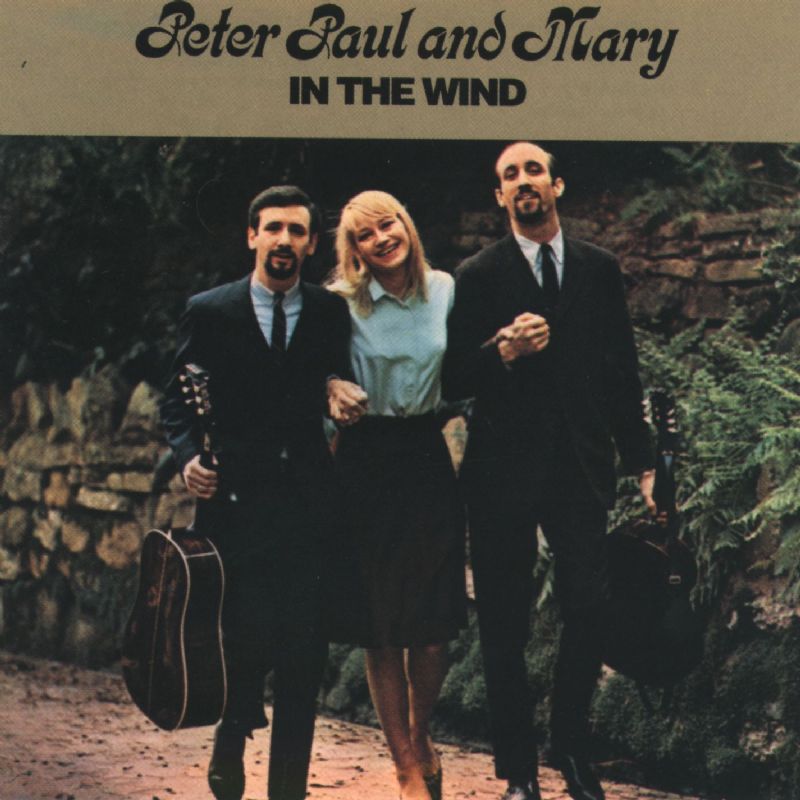
Okun, however, was also the musical director and arranger for another young and eager folk trio called Peter, Paul, and Mary, and he brought the song to them. PP&M did everything that the CMT had wanted to do with the song. They titled an album In The Wind, released the song as a single (it sold a million copies and hit #2 on the Billboard charts) and performed the number before ML King's "I have a dream " speech during the August, 1963 civil rights March On Washington. The success of the song made both Dylan and PP&M household names in the U.S.

So next - the stirring version by the CMT that was almost the first time most Americans would hear the song:


And a fine and feeling version it is to this day. But the vagaries of fate being what they are, here is the first that most Americans ever heard of Bob Dylan - Peter, Paul and Mary performing on the BBC what had been one of the great recordings of the era:


If you weren't around in '63 and didn't hear this on the radio for the first time - you have no idea of the electric thrill that went through millions who listened. And children - this was #2 on Top 40 charts. It signaled a new era in songwriting and popular music.

Almost immediately, other artists in droves began to cover the song, one of the earliest and best being the sublime Judy Collins, here live at the Newport Folk Festival:


Interesting variation on the melody, chord structure, and rhythm.

The Kingston Trio included a rather perfunctory cover of the song on their mid-1963 Sunny Side album, but that studio version paled in comparison to those by the artists above. In 2009, however, Folk Era Records released a CD of a 1963 concert in Kentucky by the group with a version of the song that rivals the CMT and PP&M for its power:


Of the thousands of other covers, hundreds of which are on the web, here are some of the best:

Dolly Parton:


Dylan's old friends Liam Clancy and Odetta, who died within months of each other:


Bruce Springsteen, 1985:


Glen Campbell and Stevie Wonder:


Joan Baez & Bobby D:


Punk Version From Cover Artists Me First and the Gimme Gimmes:


Poet W.H. Auden once wrote that poetry makes nothing happen; he was being slightly ironic, of course, because without poetry and the visions that it creates, nothing ever happens. Cannon balls may still fly and too many people still die - but if misery ever lessens or ceases, it will be because people will question why it has to happen. And they'll be singing "Blowin' In The Wind" when they do.

Friday, August 14, 2009

"They Call The Wind Maria"

Every time I think I'm coming to the end of this series and can envision only four or five more songs to profile, something comes up and I find myself seeing ten or fifteen beyond that number - and delaying one week's selection for something more immediate.

When I did the KT Wikipedia a month ago, I came upon and used a quotation from Bob Shane from the 1997 book Martin Guitars in which Bob descried the folksinger label attached to the group, saying that they did "folk-oriented material amid all kinds of other stuff." The first song that popped into my head for "other stuff" was "They Call The Wind Maria," a Broadway Lerner&Loewe chestnut that stood out from the folkier selections on the ...from the Hungry i album but remained a highlight of that record because of the sheer power and excellence of the performance. And as with songs previously profiled here like "Scarlet Ribbons" and "Try To Remember", it has been folkies and country singers who have contributed at least as much to the song's popularity as the musical comedy community.

The Trio has long introduced the song as one swiped from a failed Broadway musical, but that's not quite so, unless you prefer to think relatively. Paint Your Wagon played on Broadway for 289 performances between late 1951 and mid 1952 - at seven shows a week, that's about 40 weeks - not enough to retire on but what should have been well past the break-even point for shows of that era. Production problems created cost overruns that ate up the modest profits. Now that's not a flop - unless of course you remember that Lerner and Loewe were almost co-equal with Rodgers and Hammerstein as the dominant composers on postwar Broadway and unless you compare Wagon with genuine L&L hits that ran for years like My Fair Lady and Camelot.

Still, Wagon would likely be dismissed to the dustbin of history were it not for this song and another great tune, "I Was Born Under A Wanderin' Star." "Maria" was sung in the original cast by Rufus Smith, the least-known but fully equal member of that group of stunningly talented Broadway baritones of the era that included Gordon MacRae, John Raitt, Richard Kiley, Robert Goulet and more - and the recently-deceased Harve Presnell (d. 6/30/09), whose version here is from the 1969 movie and is as Lerner and Loewe conceived it:


The Kingston Trio gives us the next three versions - first, the one that many of us fell in love with from Hungry i, a fabulous version in a nightclub without orchestra or chorus (forgive the fanzine images of Mariah Carey, whose parents did in fact name her after this version of the song but got the spelling wrong):


Now, I never fully embraced John Stewart doing Dave Guard-era Trio songs - until the Flashback album. That version here is a superior performance - five years down the line Shane is in even better voice, Stewart's lead guitar and background vocals are haunting, and Stewart and then Shane just blow away the rhythm guitar part at the end - and John Triofan Lee's mastering brings Nick Reynolds' bongos up to a proper level - just magnificent:


And an excellent piece of evidence showing why Bill Zorn is the only singer in folkdom with the vocal power to take Shane's place in the group - here's the current KT in an equally wonderful rendition:


And another Big Voice from the days of yore - I hope some here remember Vaughn Monroe:


Frankie Laine, from 1998, late in his career:


It would have been a treat to hear Laine do this in his prime.

Carlie Slaven presents a delightfully unique and original bluegrass version:


Finally, our surprise selection of the week - actor Pernell Roberts of Bonanza and Trapper John MD set against videos of the former show in its glory days:


Contrary to some people's suppositions, I do not actually live at the computer, and next week's Weekend Videos may well go the way of last week's - into the dark cavern of lost good intentions. I'll be in Manitou Springs CO rehearsing like crazy for our show there - hope to have a WV anyway but no promises. Then again - no one seemed to miss one last week....:)