This is a song about which I knew relatively little except for the facts that a) a lot of folk revival singers covered it, and b) it was at least vaguely related to the folk/blues/country/rock "C.C. Rider." But when I Googled the song and was directed to the Wikipedia article, I discovered that I had the book in which a published version of the song first appeared, John A. and Alan Lomax's American Ballads and Folk Songs, published in the 1930s. Father John A. had collected part of the song from a young woman prison inmate and had fleshed out the rest of the lyric with standard blues tropes that appear in many other songs (like "the sun's gonna shine" line). He named it "Woman Blues" or "Woman Blue," the title under which Joan Baez and some others recorded it. (James Taylor recorded a version that he named "Circle Round The Sun" - I have no idea why.)
That the song is originally a plaint from a lady is clear from the suggestive terminology in the words. I remember that my mother objected to the title of the 1969 counterculture classic film Easy Rider because of the implication of the title, an "easy rider" as she knew from jazz songs referring to a man who pimps out his wife or girlfriend so he won't have to work. "Rider" itself was synonymous with the 1960s police slang "john" for a hooker's customer - for what I'm going to guess are reasons obvious to anyone who reads here.
But the "you're gonna miss me" tag line has proven just too appealing to be restricted to one sex - recall that Charlie Poole's song of that title is derived from "Frankie and Johnie," in which Frankie takes the initiative and tells Johnnie that he's a-gonna pay. Both "Rider" and its cousin "C.C. Rider" have been interpreted by singers of both sexes, to very different effect - much as listening to the song the Kingston Trio called "Pullin' Away" from the masculine point of view puts a completely different slant on the words than in the original song, a lament by a young woman named "The Wagoner's Lad."
Our first version from 1986 is a fairly trad-sounding country blues version from Jorma Kaukonen and Jack Casady (Hot Tuna) joined by David Bromberg, whom I used to see around Chicago:
This trio has a really traditional acoustic blues sound, rather like Mississippi John Hurt and Robert Johnson - down to Bromberg eschewing electrified slide guitar in favor of acoustic bottlenecking, the original blues sound (anyone else remember trying that from Jerry Silverman's Folksinger's Guitar Guide?)
Next, the folk-rockers - the Byrds from 1965 -
This group seems to refer back to the blues roots of the song a bit more than the Kingston Trio.....
..whose high-octane banjo-based arrangement actually seems almost to anticipate the eventual transformation of the song into a bluegrass number - here as done in 1979 by the legendary Seldom Scene:
Easy to see here why this group is so highly regarded. And apropos of an earlier discussion on the John Stewart message board - "Rider" is one of the songs that provided Stewart and John Phillips with part of the lyrics for "Chilly Winds."
Far and away the most famous version of "Rider" post-1960 belongs to Jerry Garcia and the Grateful Dead, here from 1972:
Garcia always listed the Kingston Trio among his influences - he was such a protean musician that he could (and did) borrow from multiple sources and come up with something completely his own.
The multiplicity of different approaches to "Rider" here demonstrates why I love the traditional music so much - as John Duffey notes in the intro to the Seldom Scene version - it's a folk song, so you can "steal" it and do whatever you want with it, just like everybody else has.
"Come All You Fair And Tender Ladies," whose cautionary words to young women about young men is a standard folk motif, seems to be one of those fairly rare American Appalachian originals - I say rare because so many other ballads from the southern mountains have clear antecedents in Britain or Ireland. "Ladies" may as well, and some experts think so, but no clear bloodline exists to any one song from the British Isles, or even from one family of songs. My usual sources for consultation - mainly John A. Lomax and Lesley Nelson-Burns (from The Contemplator site) both identify the song as American, as does British expert on Appalachian songs Cecil Sharp. That should be good enough for anyone - though in some of the lyrics there are distant echoes of UK songs like "The Water Is Wide," among others.
But Lomax has more to say pertinent here in his 1947 Folk Songs of North America. In fact, he uses a musical setting for "Ladies" in his introduction as an example of how folk music should not be arranged - with sixth and augmented chords of the kind that we hear in several of the pop folk versions below but not in the traditional ones. He especially disliked "chromatic upholstery, overrichness of harmonic texture, [and] modulations." Whew.
First, a couple of almost-traditional versions. Maybelle Carter of the legendary original Carter family (and as a guitarist, the inventor of the "Carter lick" that most of us use in some form) performs our first version:
The autoharp adds a nice touch, I suppose - but it's not a traditional mountain instrument, having been patented in the 1880s in Germany and in the 1920s in the U.S. What is authentic here, though, is a simple accompaniment of major chords with an occasional minor thrown in.
The Abbott Family also hails from the mountains - the Coast Ranges of Santa Cruz, CA. But they have been born again into mountain music, and though using the Carter Family melody, they go fuller-on trad in their instrumentation:
Now for the versions that John Lomax wouldn't like - first, the Kingston Trio:
Very smooth, soft, and thoughtful - but the syncopated rhythm of the guitar line and occasional sixth note in the harmony makes this version anathema to purists. Pleasant listening, though, if you don't mind a bit of sophistication in your folk music...
...which you can also hear in this version from Ireland's Lumiere, consisting of Eilis Kennedy and Pauline Scanlon:
The guitar part sounds as if it had been arranged by Paul Simon in his heyday. Really lovely.
Gene Clark of the Byrds (with Carla Olson) in his last recording before his death in the 1980s gives the song a signature folk-rock setting:
Jackson Browne from 1975 shows his folkie-country roots here:
(Ed. Note: Jackson B. is down for Copyright - so here is the stunning soprano of the early Joan Baez recording.)
And finally, the classically-trained and oriented Ishtar from Belgium with a lovely take on the song:
Not surprisingly, I find this last and the Lumiere versions to be the most affecting, likely in part to the plaintive feminine voices in these videos. They are also (with the Kingstons) the most musically complex. The debates about what constitutes folk music are long past - it seems to be today whatever you want to make it. While I truly enjoy Mother Maybelle and the Abbotts, I also feel that a good song like this one benefits from creative license. A good part of the ultimate value of the Folk Revival, I think, will prove to be that it both rediscovered and popularized traditional music but at the same time made it available for thoughtful re-creation.
The Red Scare demolished the Weavers as a commercial entity in 1952 following a two year period in which the group sold over four million records - records of folk songs like "Irene, Goodnight" and "Tzena, Tzena" and "On Top Of Old Smokey" and "Wimoweh," albeit in heavily over-orchestrated versions by producer/arranger/A&R man Gordon Jenkins. And when for political reasons the Weavers became persona non grata to the record companies, the concert promoters, and the radio station programmers, they seemed to take "folk" as a branch of popular music with them into almost complete oblivion until six years later with the sudden and explosive re-emergence of the form with the Kingston Trio's multi-million selling single "Tom Dooley."
Almost complete oblivion, but not quite. Harry Belafonte, who became the dominant male vocalist in the country in terms of record sales for a couple of years mid-decade, had his roots in American folk music - to which he returned after the calypso craze he started died out. The period between the Weavers and the Kingston Trio also saw the beginning of the career of Bob Gibson, the Gateway Singers (including Travis Edmonson), and two groups who had calypso-flavored "folk" hits - Terry Gilkyson (who wrote "Fast Freight") and the Easy Riders with "Marianne" and the Tarriers with "Day-O" and "Everybody Loves Saturday Night."
The Tarriers may be the hardest luck group in U.S. entertainment history. In addition to this song, they were the first group to record what were arguably the two biggest hit songs that whetted the American public's appetite for folk music - "Day-O," which they had learned from Bob Gibson, and "Tom Dooley," which they had picked up in Greenwich Village from Roger Sprung, the banjo star who added the little hitch in the chorus ("Hang down your head Tom...Dooley") that is not in the original song and that the KT employed. The Tarriers had a respectable career, but nothing on the order of Belafonte's or the Kingston Trio's success.
The original group included Alan Arkin (who went on to great fame as a character actor in NY and Hollywood), Erik Darling (master banjoist and folksinger who later joined the Weavers and started the Rooftop Singers), and Bob Carey (who became a successful record producer). Carey was African-American, and the Tarriers became the first racially integrated vocal group in America.
The "Saturday Night" song originated in Nigeria, and a number of stories have grown up around it - that it was a Weavers song (it wasn't, though Pete Seeger included it in one of his solo songbooks) and that it was composed as a protest against military government-imposed curfews (lifted on Saturday night only) in Lagos in either the 1950s or 1970s, depending on the source of your rumor. While I'm sure that folks everywhere have sung the song with gusto on all sorts of occasions, it existed well before the 1950s and 70s curfews that urban/internet legends suggest created the song. The original Nigerian song apparently was only a fragment of a forgotten older piece. It was Trinidadian calypso singer Aldwyn Roberts "Lord Kitchener" who popularized it in Britain in the late 1940s by repeating the song's one line over and over in different languages - hence the association of this African song with Caribbean rhythms and styles.
So first, we have the Tarriers with the original U.S. recording from 1957 on their self-titled album:
It's interesting to me how muted Darling's parts are here - he emerged from the group as the most accomplished musician, with a distinctive high tenor voice (barely discernible here) and as one of the best and most versatile folk banjoists of the whole revival - here he's just strumming.
Another version of the song appeared in a fascinating and odd 1958 film called Windjammer: The Voyage of the Christian Radich, a documentary made in Norway about a group of teenaged recruits to the Norwegian navy and their training cruise aboard the vessel. When they stop in the Caribbean, they have to of course sing a calypso or two, so...
I'm not sure who is performing it, though IMDB gives credit for this and most of the (familiar) songs in the movie to the aforementioned Terry Gilkyson - doesn't sound like him, though - he had a rich, round, musical-comedy style baritone.
Bud and Travis also did an outstanding version of "Saturday Night," with that frenetic high-speed Spanish guitar strumming for which they were famous, but there is no video available of it at the moment. Travis (who died in May a year ago) was described by both Bob Shane and John Stewart of the Kingston Trio as a hero to them - he was an established local star in San Francisco when Shane and the original group started, and Stewart was effusive to the end of his life in the gratitude he expressed for Travis's many kindnesses shown him when Stewart was starting out in his pre-Trio days. Travis was a regular guest performer at Stewart's Trio Fantasy Camp in Arizona every year, and in 2004 he was joined for a rendition of the song by his old friend Bob Shane (recently retired due to a heart condition) and the KT of George Grove, Bill Zorn, and Bob Haworth:
The numerically impressive New Christy Minstrels and Serendipity Singers both took a stab at the song, with the Christys having some radio airplay success with it. I always enjoyed their version, but this studio recording is a bit more cluttered than their live performances of it:
I originally misidentified this cut as the Serendipities, which is why their album cover appears in the video. Both groups in any event branched out from the simple acoustic folk sound that they had started with, and this cut demonstrates the distinctively "pop" direction record companies wanted folk to take - one of the reasons why the whole popular folk era is so disregarded critically and lampooned a la A Mighty Wind.
So it's not a great leap from the Serendipitys to a full-on, mainstream pop version by Percy Faith and his orchestra:
The song has also been a staple of jazz groups as well, especially as popularized by Denmark's Papa Bue and his Viking Jazz band in Dixieland style. No Papa on YouTube*, but the Carlings are doing something close to his arrangement:
And that, my friends, is as far off the reservation as I'm going in this series. I love pop, I love love Dixieland - but I love folk music most of all. I feel the need next week for a real Anglo or Irish ballad to write about (hint)....
*Addendum, 9/1/11
Whilst trolling around YouTube, looking (successfully) for an alternate version of the Percy Faith version that had been removed, I found that Papa Bue's Viking Jazz Band performance has been uploaded in the 1967 studio version:
When I was younger, there were certain poems and novels and songs and plays and films that I just knew I would love forever and would return to frequently. I've still never seen a better film than Lawrence of Arabia or found a poet more in tune with the subtle vibrations of experience than Robert Frost or W.H. Auden. Hemingway's For Whom The Bell Tolls still affects me deeply, and I still think that O'Neill's Long Day's Journey Into Night is the pre-eminent masterpiece of the American theater.
What I could not quite foresee, though, in my youth and callowness was that the ways these and countless other creative pieces would resonate for me through the decades would change, as change they have dramatically. To me as a sixty year old, David Lean's Lawrence is less heroic and more pitiable, and my sympathies in the O'Neill play now extend far beyond the helplessly drug-addicted Mary Tyrone to embrace as well her disillusioned, alcoholic husband and sons. Years and experience change us all and the ways in which we understand ourselves and our lives.
So has it been for me with this week's song, Tom Paxton's "I Can't Help But Wonder Where I'm Bound" - and so as I think we'll see has it also been for many of the myriad of other artists who have covered the tune. I have written before about the sheer and absolute "folkiness" of Paxton's best work in articles about his "The Last Thing On My Mind" and "My Ramblin' Boy", and "Bound" is the equal of these as a song that will long outlive any of us. All three songs seem simple and direct in both music and lyrics - deceptively so, I would suggest. For though they mean what they say, each song has the same quality that an abstract expressionist painting or an imagist poem does - we bring ourselves and our own life experiences into understanding the work, and thus each means more than the simple literal reading of the lyric.
One of the first things that any lit student learns to appreciate is the power of metaphor, and at least since the time of Homer three thousand years ago just about everyone recognizes the symbolic value of the journey as a metaphor for life itself. Paxton's lyric in this song may have been intended only as a reflection of his sense of his own and his generation's rootlessness and yearning for meaning in life, but in the hands of the musical artists who have interpreted this song below, we'll see that each infuses the verses with his or her own personal sense of quest.
First, Paxton himself lays down the template for the song. When this performance was taped in Israel in 1994 (with Shay Tochner, one of that country's leading folk artists), "Where I'm Bound" was already thirty years old and Tom himself was well into his fifties:
I like the confidence that emanates from TP here - he knows that the audience knows his song, and it's clear that he knows he's written a damn fine one at that.
The first version that I actually heard was from the Chad Mitchell Trio (known when they recorded this as The Mitchell Trio) from their wonderful Reflecting album. The CMT was probably more responsible than any other single artist for taking Paxton's work and giving it a national audience, much as Peter, Paul and Mary did for Bob Dylan and the Kingston Trio did for Rod McKuen:
I always liked the two-guitar accompaniment of this (Paul Prestopino and Jacob Ander), and in the context of the CMT's often overtly political stance in many of their albums, I have always believed that this version was a 1964 query about the direction of the country as a whole. Vocal lead is by Joe Frazier, now an Episcopal priest in Big Bear, CA.
The Kingston Trio also did a fine job with Paxton's compositions, and their studio recording of "Bound" on their Stay Awhile album is one of the highlights of their years on Decca Records. I've chosen for this piece, though, their live performance from July of 1966 at Lake Tahoe as they kicked off their farewell tour before disbanding (temporarily, as it turned out) in June of the following year:
However much the upcoming dissolution of the group may have seemed the right thing to do at the time, there had to be an attendant uncertainty about the future that I think this rendition expresses. As a side note - this Trio changes the lyric in the third verse from "I hear he's out by 'Frisco Bay" to "Monterey" - because as a Bay Area group they knew what Paxton did not - that longtime residents up there despised the abbreviation and just never but never said "Frisco" for anything related to their beloved city.
Johnny Cash's American Recordings were spare, stripped down arrangements recorded in the last years of this great artist's life. "Bound" appeared on an album released earlier this year, American VI: Ain't No Grave:
I love the craginess of the voice and the tentativeness of a man who knew he was facing his last long and mysterious journey.
Nanci Griffith collected an all-star line-up of musicians and songwriters for her Other Voices, Other Rooms album in the early 90s - an entire recording of other people's songs, often as here with the composer performing with her:
The song clearly lends itself to Griffith's uptempo, good time country reading.
We forget, perhaps, that Paul Simon and Art Garfunkel actually started out as a folk duo. Here is Simon in solo performance at Queen's College in 1964:
We conclude with two fairly recent, non-pro performances that I like. First, Riverbend - well, they're pros but have only recently come together as a group. Ron Wilburne, formerly of the New Christy Minstrels, is the lead in the center with David Meitz on mandolin and Art Morgan on guitar:
I haven't been able to find out much about Oliver Mulholland, who performs here. I believe he's up in the Puget Sound area: this video was originally posted by a high school classmate of his with whom I briefly corresponded, and I think this performance is from a reunion in the 90s:
All successful singing groups develop their identities from the vocal synergy that evolves among the members, and often the most memorable moments in the group's careers are moments of brilliant and stunning harmony. At the same time, though, most of the great vocal groups (including the pop folk groups) were anchored in the bedrock of the group's best voice. It's hard, for example, to imagine the Weavers without Pete Seeger at the top of the blend, even though both Ronnie Gilbert and Lee Hays had more trained voices (and great as Seeger's replacement Erik Darling was - just not the same). Glenn Yarborough gave the Limeliters their unique sound, and for my money Peter and Mary would have gone nowhere without the warm, round baritone and dynamics of (Noel) Paul Stookey.
In the Kingston Trio, the greatest of the pop folk groups, the best voice by common acknowledgment by the other performers, the critics, and the public at large, and the one that stood at the center of the group's sound for forty seven years, was that of Robert Castle Schoen, better known for half a century by his stage name of Bob Shane.
I have always believed that this group had no single indispensable member because all three of the originals were utterly necessary for the burst of success that put the KT into the music history books. You just couldn't remove any one component - Dave Guard's arrangements and patter, Nick Reynolds' harmonies and exuberance, Shane's vocal skills and stage presence - and have ended up with the phenomenon that started fifty three years ago. Lou Gottlieb of the Limes noted this as he watched them develop, and Dr. Lou recounted to historian Ronald Cohen decades later that the three had "something really special...it was hard to describe it unless you heard and saw them."
Having said that, however, from the very beginnings of the group, it was clear the the voice at once most powerful and most refined belonged to Shane. An article in Time Magazine at the point of Guard's departure in '61 noted that of the original three, only Shane had the vocal chops to make it as a soloist. And Nick Reynolds, Shane's best friend for half a century, said in an interview a couple of years before his 2008 death that in retrospect he wished that the group had given even more vocal leads to Shane than they did.
In the post-Sanford Mesiner method acting era in performing arts, it has become customary to refer to a performer's physical attributes as his or her "instrument," and Shane's voice was precisely that - an instrument the use of which he honed and refined throughout his career. It has often been referred to as a "whiskey baritone," but I have never thought that quite accurate (possibly an unconscious reference to his most famous solo "Scotch and Soda"). But there was something more in that voice than drinks and smokes, and the best description I have seen of it comes from Time's Richard Corliss, who in a 2003 retrospective on pop folk referred to it as "dusky, knowing." That's it - dark shadings and the suggestion of having been around the block a few times.
Those qualities and Shane's excellent timbre were both on display from the start - his solo on the group's first album and almost everyone's favorite, the anonymous bar ballad "Scotch and Soda":
The combination of power and control and intuitive Sinatra-esque phrasing here makes this performance so exceptional that I believe that it obscures the middling quality of the song itself. Johnny Mercer, Harold Arlen, Cole Porter - those guys wrote really great bar songs. Shane's skills fool us into thinking that this song bears comparison to the work of those composers. It doesn't - but Shane's performance can stand shoulder to shoulder with any similar song that Sinatra ever waxed.
When you're talking about Shane as soloist, you have to start with "S&S", but for fifty years my favorite solo of his has been Stan Wilson's "A Rollin' Stone." Wilson, who was a local Bay area celebrity and night club star while the guys were still in college, helped to shape both the repertoire of the group and Shane's own approach to singing and song selection. (Jerry Kergan's "Liner Notes" has a lot more on Wilson HERE.) His "Stone" is classic:
The song is a lot closer to folk than some of the other selections here, and Wilson's jaunty, devil-may-care composition seemed ideally suited to the voice, talents, and jaunty, devil-may-care onstage attitude of Shane.
And speaking of genuine folk songs, Shane was an outstanding interpreter of these as well, as evidenced here in "Blow The Candle Out":
Though Shane has copyright for the lyrics, he freely acknowledged that he learned the song from Stan Wilson's performance of it. And in reference to the synergy described above - a good deal of the effect of this cut comes from Dave Guard's brilliant instrumental arrangement (with Reynolds supplying the guitar line) in support of Shane's vocal.
Shane co-wrote the lyrics (with his good friend Tom Drake) for "The White Snows of Winter," whose melody is based on a passage from Brahms' First Symphony. That knowing, smokey baritone never sounded better than it does on this Christmas-themed song:
Here in "Snows," Shane once again (as he so often did) strikes a perfect balance between an almost erotic longing and pure romanticism. Brilliant.
I've chosen the 2009 Flashback 1963 album version of "Maria" over the original Hungry i recording (1958) because I think that the five year interval demonstrates brilliantly my contention that Bob continually refined and improved his technical and interpretive abilities. The versions of these songs presented here are arguably the two best ever recorded of these pop standards.
We close this retrospective with a song that for me was always special and is now especially poignant, Trio member John Stewart's lovely pop ballad from 1961, "When My Love Was Here":
Stewart wrote this when he was 21, and for my money this is absolutely the most mature and fully realized of all the songs that he wrote that were recorded by the Kingston Trio. Though Stewart seldom again ventured into pop balladry, "When My Love" is the one early composition of his that prefigures the prodigious songwriting talent that evolved during his forty year solo career - and he entrusted this gem to Bob Shane.
Occasionally during the two years and 90 posts of Weekend Videos/CompVid101 I've alluded to the fact that I think we who love folk type music are blessed to live at the same time as some truly sublime artists - I've mentioned Ian Tyson, Emmylou Harris, and Marty Robbins, among others. With these - and it goes without saying but hence needs even more to be said - Bob Shane stands at the head of the class. For more than fifty years he has entertained us, made us laugh, treated us as an audience with respect - and thrilled us with the marvelous use of that great, dusky, knowing voice. Blessed we are indeed.
Addendum - August, 2014
In the four plus years since this was posted, a significant number of other classic Shane solos have appeared on YouTube. Two of the best, both essential to understanding Shane's brilliance as a performer, are below: the original studio track from 1962 of "Try To Remember" with brilliant but uncredited guitar work from John Stauber and one of Shane's earliest solos, Irving Burgie's lovely pop ballad "The Seine" from the 1959 album At Large.
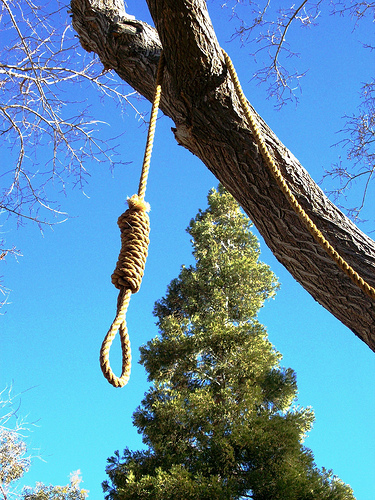
This week's song goes under many names: the oldest is "The Maid Freed From The Gallows," though it has also been known as "The Gallows Tree" and "Gallows Pole" and simply as "Hangman, Hangman." It is a song with a rich and varied history and all the things that I love about real folk songs - a good tune and story, origins lost in the mists of time, major variations in tune, tone, and tenor, and that tantalizing single motif that unites all the versions and indicates a common source. Someone is about to be hanged and his/her family proves indifferent to the fact. Things are looking bad for our prisoner until his/her beloved (usually the fiance/fiancee) shows up with enough gold to bribe the hangman and save the day. Significantly - and unlike other folk songs like, say, the family of songs that eventually morph into "The Gypsy Rover" that have radically differing endings - our prisoner always escapes the noose due to the good offices of the beloved.
The versions of the song that we know come from England, where it was known in its oldest forms as "The Briarly Bush" or "The Prickly Bush," but the actual origins of the song are from the continent. Virtually every country in Northern Europe (and many in the south) have some variant of it, and the great folk scholar Francis James Child (1825-1896), the American who did landmark work in tracing both the origins and permutations of about three hundred ballads from the British Isles, believes the song to be German or Hungarian originally.
In UK and European versions, the prisoner is almost always a maid, often one kidnapped and held for ransom by pirates; in America's southern Appalachians and in the Texas-Louisiana area where the song is also known, the condemned is usually a man. Regardless, the motif of purchasing one's freedom from the gallows (or a hostage situation) does in fact have its roots in history. Though then as now capital punishment was a deterrent, an act of vengeance, and a kind of terrorism inflicted by the ruling class on the lower classes to keep them in line - it differs from the procedure-laden, appeals-rich and legally intricate method of today. In 17th century England and before, for example, those accused of capital crimes were not permitted a solicitor and had to mount their own defense. And if reprieve could not have been purchased all that frequently at the point of execution - some gold given to the right jurist prior to then could work wonders. And there were reported cases (in Scotland, not surprisingly) of executions forestalled by the payment of a ransom.
Our first version of the song is fittingly a pub performance from the UK, by an 84 year old woman simply known as Bella.:
Bella is apparently from central Europe but lived most of her nine decades in the north of England. She sings in the authentic a capella style that most ballads were performed in traditionally. I'm intrigued by how the younger-skewing audience (fueled by ale, no doubt) finds the parents' refusal to help amusing. Whatever dark humor permeates a lot of folk songs - there isn't much here in this one. Rather, it is an implicit commentary on how the bonds of romantic love transcend those of birth family - and the laughter shows what happens when folks get cut off from their folk roots. No wonder American Idol and its ilk are popular.
The two classic American folk performances of the song probably belong to Leadbelly, who claimed to have learned it in prison (he spent a lot of years there for various offenses including manslaughter) and Odetta. Leadbelly throws in a really bluesy tinge to the melody (which I bet influenced the Kingston Trio's Nick Reynolds) and in a comment on YouTube absolutely shreds the twelve string guitar here - if you ever wondered why people regard ol' Huddie Ledbetter with reverence, listen to him play here:
Odetta on the other hand approaches the song with the almost operatic seriousness that characterized most folk singing before the commercial/pop folk era began big time in 1958:
The commercial popularizing groups also took a couple of good whacks at the piece. The Kingston Trio included it - fittingly, I'd say - on their early 1961 so-called "dark" album Make Way, so called because of the generally quiet tone of most of the song selections (and the dark dust jacket, the illustration in the video):
The first generation of the Trio here is doing what it often did and is seldom credited for doing - using a fairly close reading of the original song with some interesting wrinkles. Note how close this version is lyrically to Bella's above and the aforementioned Leadbelly-esque bluesy tone of the vocals. I'm also wondering idly here if I am hearing Dave Guard on his fairly new Gibson twelve string and Bob Shane on plectrum banjo....
Peter, Paul and Mary also do a fine job with a melody a bit more reminiscent of the oldest British version that can be heard here - "The Briery Bush". From a 1965 BBC television show:
Led Zeppelin riffed off Leadbelly's version in 1970, as Robert Plant explains in his intro to this 1998 live performance with Jimmy Page:
There's a bit of Steppenwolf's cover of Hoyt Axton's "The Pusher" in the intro too, I think.
Two final versions - first, another opera-serious almost a capella rendition from Kentucky's master dulcimerist and folkorist, John Jacob Niles:
And I'm sure you've been waiting for this one - the Smothers Brothers unforgettable - ah, abbreviated version:
Roots and branches, roots and branches....the very nature of real folk music.
Comparative Video 101 is a resource for performance videos of some of the classic popular folk songs of the last several decades with personal commentary on them by Jim Moran, a teacher of literature for nearly forty years and a folk musician and writer for a decade longer. He was also co-host of the "Roots Music And Beyond" radio program on KPFK-FM in Los Angeles. Some of these posts appeared originally on the Kingston Crossroads message board, and many of the profiled songs were performed by the classic pop folk group the Kingston Trio. The page will be updated once or more per month. Your comments are welcome.
Use the Google Search Bar above as you would use the Google web search. Enter the name of a song or artist, press "search," and the results will appear showing every mention of your search term in the 150+ articles on this blog. An alphabetical index of song titles is coming soon; until then, the Google Search This Blog will substitute for it.
Since Blogspot/Google has recently begun including readership statistics as part of its service to bloggers like me, I have become aware that the readership for these pages is far more extensive and international than I had ever dreamed, usually approaching 1,000 visitors per week from literally all around the world. I am profoundly appreciative of the interest in these posts and glad that folk music fans find enjoyment and value in them.
There are currently more than two hundred articles here, and nearly all of the twelve hundred posted videos in those articles are from YouTube. Most readers will already know that because YouTube is another subsidiary of Google, the latter company is being sued for copyright infringement by a significant number of content providers like Sony-BMG and Warner's Music Group. YouTube/Google's normal response to infringement claims is to remove the disputed videos or ban them from certain countries in which the claims have been filed.
This, of course, has a profound effect on the content of posts like the ones in this blog. Videos that I have selected for any given article can be and often have been removed at any time without warning. I try where possible to replace deleted videos with other versions of the same performance or with similar renditions of the songs, though this is not always possible.
Policing the hundred plus posts to be sure that there are interesting and representative video performances is itself a major undertaking, one that involves a significant commitment of time. I hope that those of you good enough to stop by this blog will have a bit of patience. I review as many of the older articles as I can every week with the goal of maintaining the integrity of each, and sometimes this enables me to find newer, better, and more exciting performances of the songs profiled here.