Thursday, August 26, 2010

**CompVid101 Post #100 - My Top Ten**

The genesis of this blog was in several posts I made well over two years ago to Kingston Crossroads, a message board which, like CompVid101, focuses initially on the vast and diverse repertoire of the Kingston Trio but goes into a whole lot of different directions from there. Though my lifelong love of folk music started in my childhood even before the KT hit the scene, for me as for millions of other Americans there was something special about the group and its music. The one hundredth post in this series gives me a special opportunity to look back fifty years at why that was so for me. Here's hoping for a hundred more posts on folk music of all kinds!

When I was in Scottsdale, AZ a few weeks back for the Kingston Trio Fantasy Camp, I mentioned to a friend that we were coming up on post #100 for CompVid101. She asked if I had a special song that I was planning to profile for what surely is a landmark of some sort or other. I had to reply that I actually hadn't - that the only future post the content of which I know for sure will be the last one, if there ever is one such.

But over the course of two years and two months on an almost weekly basis, I've already written about and presented nearly all of my favorite folk songs that I had first heard from the KT (nearly, but as we shall see shortly, not all). Some time over the last two weeks, it came to me that this might be an opportunity for me to join in briefly to one of America's favorite armchair pastimes - creating a ranked list of some sort. While I would never presume to try to say what the Kingston Trio's best songs have been - that would be a fool's errand and completely subjective in any case - over the course of writing these posts I've often reflected on which songs of theirs I have enjoyed most and that have meant the most to me over the last fifty plus years. I was surprised by how easy it was for me to come up with the list below. These are the songs that have just stood out for me over the decades, the ones that I continue to return to again and again.

I'm proud of what this series represents, not the least of which is a lot of very enjoyable hard work. I have been delighted by the re-discovery of older songs that I had all but forgotten about, and I have been thrilled to find some genuinely outstanding versions of the songs by other artists. Most of all, I have been profoundly impressed by the fact that I could come up with this many songs that were recorded by a single artist that do in fact have a multitude of other interpretations. Look at Folk Alley's list of the "100 Most Essential Folk Songs" and you'll find that the Kingston Trio at one time or another recorded 21 of them. The next nearest artist has five.

While it's true that I can and will continue to profile KT songs here, the finite number of usable songs from the Trio and my own much wider folk interests are impelling me to expand the blog (Comparative Video 101) to include a wider range of songs to discuss (I could do 50 posts blindfolded on the Clancys and probably as many on the Chad Mitchell Trio), and that suggests a change in direction soon. So I've included a poll at the end of this post to ask whether or not folks here at Xroads would like to see future articles on non-KT songs.

And that leads me to my last note before the music. When these posts go out onto the larger web on the blog, the readership can number from a few score to a few thousand people. But on Kingston Crossroads, as Ken Laing's view counters indicate, I can depend on the fact that every week, 200 or more Xroaders will look in on my efforts. I cannot express to you all how profoundly moved I am by that, and how profoundly grateful I am that good people who share my love for this music think it worth their while to stop by.

So thanks to Ken for sponsoring the board and giving me and all of us this forum - and thanks to all my fellow Xroaders for the weekly visits that have encouraged me to keep going.

And now - on to the show!

Jim Moran's Favorite Kingston Trio Songs

10. "The Colorado Trail"
For my money, one of the three or four prettiest songs that the KT ever did, and one with the added attraction for me of being a pretty straightforward take on the traditional number. In the blog piece linked above, I point out how the arrangement reflects the lyrics - the "wail, winds, wail" line being sung an octave high by Nick Reynolds and the tune resolving itself lower as the words return from the sky to the earth - "along, along, along...the Colorado trail." I'm proud of the fact that this is one of four or five posts that has been picked up by and permanently posted to other websites, in this case a Colorado Trail preservation organization.


9. "Zombie Jamboree"
Still after five decades my favorite KT novelty/humorous tune, and maybe my favorite overall live cut from the group. Dave Guard's mock-erudite patter (and look at the article to see why Dave misidentifies the composer as "Lord Invader") wears well through the years and still makes me smile.


8. "One More Town"
When I profiled Bob Shane as soloist last June, I remarked that I thought that "When My Love Was Here" was the young John Stewart's most fully-realized early composition. I still think so - but I love this one more. The lyrics have a timeless quality - when I was a boy, they expressed my longing to go out and see the great world; as a man in late middle age, they remind me of where I have gone and how I have lived.


7. "I'm Goin' Home"
You cannot go to far into the KT catalog without coming up with a banjo blaster, and this cut from seven years into the group's career showed that they still had the chops to blow the roof off like no other folk group ever could.


6. "Across The Wide Missouri"
The last verse ("I'm pushing off..") is as breathtaking a moment of harmony as the folk era produced, and the rendition gives us the best of what the Trio could do with a brilliantly re-interpreted traditional song and outstanding recording by Voyle Gilmore. This video was produced by my friend Tom Salter of Niagara, ONT, one of his first in a brilliant career of making folk videos.


5. "The Gypsy Rover"
While I am a steadfast Clancy Brothers fan and think that Tommy Makem's solo rendition of this at the 1960 Newport Folk Festival may be the best version out there, this would be version 1A - and there are plenty of comments on my YouTube upload from Ireland that really love what Nick Reynolds does with this song.


4."Chilly Winds"
One more really fine songwriting effort from a very young John Stewart. I love what Tom Salter did with this - he ran the KT's 1962 version right into John Stewart's 1973 solo version (which I had emailed him), both of which I love equally. Tom did this as a kind of private gift for me, which is why the second half features pictures of my group. I'm sure he won't mind me sharing. And what's not to love about having your own picture come up right at the point of your favorite line?


3."The Escape of Old John Webb"
I have found to my delight this morning that in fact there are enough alternate versions of this for me to a full article on it, so I'm going to limit myself here. A goodly number of professional banjo players have said that the banjo break on "MTA" first got them interested in playing the instrument. For me, it was what Dave Guard did with exquisitely quiet good taste here that really made me wake up and take note of the instrument.


2. "The Sinking Of The Reuben James"
Banjo master Billy Faier cited this cut as an example that the Trio was "all climax and no build-up" - but Billy must have been listening to some other KT rendition, because this one has plenty of build and drama. For my money, the Kingstons' best banjo number and one of the most stirring pieces of Americana ever recorded.


1. "Bay of Mexico"
I can remember being a boy of nine, sitting between the speakers of our living room console stereo and being utterly transfixed by this song - the guitar, the banjo, the key shifts, the harmonies. My friend Tom Lamb pointed out a few weeks back on another post how perfect the final mixdown of the first two Trio monaural albums was, and no song's sound proves his point better than this one. The calypso rhythm, the jaunty and slightly blue sailor's lyric, the overwhelming in-your-face-confidence of three very young guys plus their bass player challenging the world to match what they could do musically - all that I love about folk music was born when I first heard this cut.


So there we have it - my favorite ten, and I invite everyone else to post their own. Here's to one hundred posts in the book, and to the hope of one hundred more!

Friday, August 20, 2010

Orthodox And Heterodox: "Jamaica Farewell"

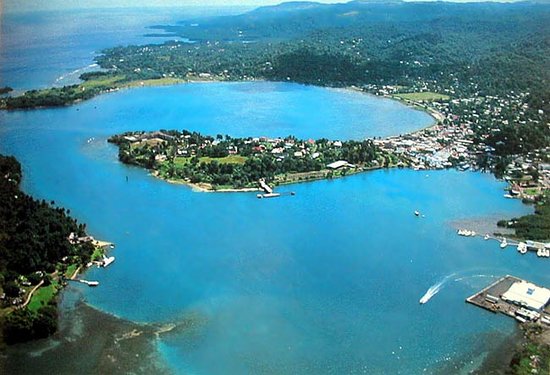
Kingston Harbor, Jamaica
Over the decades, the shallow pop culture has evolved a kind of orthodoxy (which as we all know originally meant simply "right" or "correct" thinking) about folk music that goes something like this:

In the beginning were the workers, of The People, and they were noble - on the farm and on the ocean and in the army and in love and in work and in war. And yea, the workers begat spontaneously the Folk Song, a pure virgin unsullied by filthy lucre.

And it came to pass that the Folk Song begat in conception without sin its priests Child and Sharp and Lomax, and it begat its holy twins Guthrie and Seeger.

And Guthrie and Seeger begat the Almanac Singers, and the Almanac Singers begat the Weavers, who died for your sins. And Guthrie and Seeger begat also Greenwich Village, which begat a bastard offspring PeterPaulandMary. And PeterPaulandMary midwifed the Holy Incarnation Of All That Is Good, the Son of Folk Song, Bob Dylan.

Utter nonsense, of course - but like the Flat Earth Theory and the Moon Landing denial, it is nonsense that has gained traction with a truly unconscionable number of people. The why of this is hard to say. A good stab at explaining it comes from Bruce Eder, who with Richie Unterberger and a few others on the web has made a genuine effort on the AllMusic Guide to give a fair shake to the missing elements in our little fable above. In his article on The Brothers Four on AllMusic, Eder writes:

The Brothers Four were also part of a largely forgotten chapter in the history of folk music in America...Most accounts of the post-WWII folk music boom focus on the political and issue-oriented branch of the music, embodied by Woody Guthrie and Bob Dylan, at the expense of the softer, more entertainment-oriented branch, embodied by the likes of the Kingston Trio, the Chad Mitchell Trio, and the Brothers Four. Those acts and the music they made -- though it sold well and, indeed, for many years defined what most Americans visualized when the phrase "folk music" was mentioned -- are scarcely mentioned in most histories...It can be argued that Dylan's approach to folk music, and particularly his rough-hewn, Woody Guthrie-influenced persona, were every bit as artificial and romanticized as that of the Brothers Four...if [post 1964 young people] did listen to folk music, they wanted what was perceived as a more authentic brand of singing, preferably with some serious political involvement somewhere in the mix.

The real story, the heterodox story - the one you won't read in most histories because it includes the ever-present quest for the aforementioned filthy lucre - goes like this.

The very genuine obscure origins of folk songs and ballads and protest songs became a source of big-time profits for mass media companies early in the 20th century. Radio begat Jimmie Rodgers and AP Carter; they begat the Grand Ole Opry and the WLS Barn Dance; the success of this so-called "hillbilly music" created the market that the Weavers exploited (correct word, by the way); the Weavers made straight the way for Harry Belafonte, who prepped the record world for the Kingston Trio, who if they didn't beget everyone else (and the Limeliters and Brothers Four were performing together before the Kingstons) at least opened up the commercial record market for all who followed, including Dylan and his very brief flirtation with folk music before he abandoned it for the filthy lucre of the rock world. Yes I said that. And I meant it.

The essential links between the earliest folk records and the popular folk revival are the Weavers (always acknowledged) and Harry Belafonte (usually ignored). Belafonte's Calypso! album is certifiably the first in any genre to have sold one million units, and that record featured songs of an umimpeachable ethnic integrity, even if they were popped-up versions of older songs. The evil genius who corrupted those earlier rough songs into genuinely listenable pop balladry was Irving Burgie, composer of eight of the eleven songs on that Harry B. record, including "Jamaica Farewell."

"Jamaica Farewell" includes most of what I have termed in other posts here to be the essential elements of the modern folk-type song - a simple chord accompaniment, usually with an acoustic guitar, basic and repetitive lyrics and chorus, and a ballad-like story. That doesn't make it a "folk song" in any academic sense - but it makes for a delightful pop song written with a conscious nod toward the folk traditions. Burgie does this often on the 1956 Calypso! album and on even more so on what is arguably an even better album (though without those monstrous sales figures) Belafonte Sings of the Caribbean, ten of whose eleven cuts are attributed to Burgie under his real name or under his nom de plume, Lord Burgess. While "Day-O" may be Burgie's best-known cut from these records, "Jamaica Farewell" is in many ways more typical of his many, many mildly melancholic parting songs.

Since Burgie assembled the song from earlier traditional fragments for Harry Belafonte, it is his version that leads us off:


This is from his landmark 1959 live album, Belafonte At Carnegie Hall, and it reminds us of what an absolutely sublime singer he was. One good Harry deserves another - so here he is from a live TV show the same year -


- because it reminds us that Belafonte was a real groundbreaker - the first genuine African-American male sex symbol. The first of these videos has 228,00 views; the one above has 436,000. Nice to know that someone out there still appreciates tastefully executed pop music.

From the same era - after Harry's hit album and hit single with the song but before Carnegie Hall - the Lennon Sisters from Lawrence Welk - you just don't get more mainstream than that:


Now, you'd think that a group that got its start doing calypso numbers at frat parties and whose very name was derived in part (but not exclusively - remember the "ivy league" connection) from the city named in the song would have done an early cover of the hit, but no. There is to my knowledge no recorded Kingston Trio performance of it at all until the 70s or 80s, and our video here is of the current incarnation of the group from 2006:


While the Weavers have to be credited with originating the radical idea of using a banjo for calypso numbers (Pete Seeger, of course, who played banjo on everything) with the recording from their Carnegie Hall concert of "Sloop John B," it was the Kingston group that pushed this to the limit with songs like "Bimini" and "Bay of Mexico." The Dave Guard idea of using the banjo as a syncopating rhythm instrument is taken to the next degree higher here by George Grove, whose playing makes you forget that you are not hearing any pure percussion except what he is providing. The vocal lead is by Bill Zorn.

And now, in rough chronological order - The Brothers Four, who always excelled at mild and romantic songs, from 1963:


Marty Robbins, from about 1965:


Ryman Auditorium legend Hank Snow countrifies it brilliantly:


And finally, if there were ever a song tailor-made for Jimmy Buffett's sandy, boozy, party style of updated beach music, "Jamaica Farewell" is it:


This version is from 1990, with calypso's Caribbean successor in pop music reggae becoming the essential rhythm Buffet is employing here.

I probably wouldn't suggest that "Jamaica Farewell" is a "real" folk song - it's just damned good pop music with distinctively folk roots. And as such, ironically, it's a helluva lot more folk than about 90% of what is categorized as such by the record companies and the pop media today. So much for orthodoxy. Long live the heterodox.


Thursday, August 12, 2010

A CompVid101 Special Edition: A Trio Fantasy Camp Retrospective, 2002-2010

Between the years 2000 and 2007, former Kingston Trio members Nick Reynolds and John Stewart conducted an annual event that they named "Trio Fantasy Camp" in Scottsdale, AZ. Following the rough outline of the many sports fantasy camps, TFC "campers" were able to spend several days in joyful conclave with those folk music legends - conversing, going to songwriting and Q&A meetings, and spending quite a bit of time just playing Trio songs and jamming.

The highlight event for the campers, however, was the chance to join Reynolds and Stewart on stage during the shows presented each evening, picking a favorite KT number and performing it with the two professionals, living out the fantasy for about three minutes of being a member of the Kingston Trio. And just as sports fantasy campers are issued authentic uniforms from their favorite teams - each Trio fantasy camper was issued an authentic, regulation three-quarter length sleeved striped shirt, the Kingston trademark from its heyday fifty years ago.

Despite the untimely deaths of Stewart and Reynolds a few months apart in 2008, sole remaining original Kingston Trio founder Bob Shane has continued the camp, whose momentum as a celebration not only of Kingston music but of folk and acoustic music in general has become almost self-sustaining. The 2008, 2009, and 2010 editions of the camp were resounding successes.

As I understand it (and correction is welcome), the idea for the camp originated with Michelle Stevens, a charter member of the "Bloodliners," an internet mailing list/message board/fan group (the name derived from Stewart's most famous album, California Bloodlines)for the late singer-songwriter Stewart, who had a distinguished forty year solo career following the temporary dissolution of the Kingston Trio in 1967 after a decade of unprecedented success.

As honored and respected as Stewart was, times were hard in the 1990s for most acoustic folk musicians, Stewart included. A complicated series of legal and family medical issues were dogging Stewart, and Stevens suggested that there might well be substantial interest from the Kingston Trio's now-mature fan base in joining Stewart and Reynolds (recently retired at the time from his second stint with the Trio) for a weekend of music and performances for a fee that in comparison to the hefty price tags of the sports fantasy camps (often $10,000 a week and more) was truly modest.

By all accounts, Stewart was initially reluctant to pursue the idea, not least because he had spent several decades creating a separate and very different identity for himself as a performer, and he reportedly felt at times that his tenure with the Kingstons was a kind of proverbial 800 pound gorilla at his shows, as even into the first decade of this century an occasional patron at a concert would request a long-forgotten KT song.

But the financial success and good will generated by the first camp in 2000 at the Fairmont Princess Resort in Scottsdale, AZ (a wonderful photographic record of which by Stewart's friend, the brilliant independent photographer Howard "California Roadman" Bruensteiner is HERE) prompted Stewart to continue the project, and the camps in 2001, 2002, and 2003 sold out the available camper spaces and the evening shows put on by the campers.

The transformational moment in the camp's history, however, occurred in 2004 from a convergence of two otherwise-unrelated events. In March of that year, Kingston Trio founding member Bob Shane (a Phoenix-area resident) was forced into retirement from touring after 47 years with the group, following a serious heart attack. At the same time, a Wisconsin teenager named Nikki Sherwin, who had (unusual for her generation) developed an abiding love for Kingston music and for original Trio member Reynolds, won permission from her parents to attend the annual gathering.

A reporter from the local Arizona Republic newspaper was sent to cover this unusual human interest story, generating a front page article in the paper's Saturday edition that profiled Sherwin but also noted that at the Friday night show, a remarkably hale-looking Shane had taken the stage for the first time in the camp's five year history (he had apparently lurked in the audience once or twice in previous years) to perform his signature solo "Scotch and Soda."

That night, the number of patrons seeking admission to the show jumped from the accustomed 100-150 to an astounding 400; they were lined up the equivalent of a block from the doors of the venue. Those lucky enough to get in - some had to be turned away due to fire regulations - were rewarded with a number of memorable performances by the campers, by Stewart's invited guests Travis Edmonson and the current KT with Shane's replacement Bill Zorn, by Shane once again - and by a spontaneous reunion onstage of the 1961-67 KT with Stewart, Reynolds, and Shane. The camp has developed, expanded, and changed since then - but the original vision conceived by Michelle Stevens and quickly embraced whole-heartedly by Stewart has persisted. The event remains a celebration of the Kingston Trio's 53 year history and of the acoustic folk music generated by the group and by the revival it helped to create.

This is a personal retrospective on the event, by no means encyclopedic or complete. I participated as a camper in 2003 and 2004 and have attended every year since. Except for the performances presented here from 2002, I've seen all of the songs in the videos. Though I haven't shot any of these videos, I have edited many of them (those with the fade-in/fade-out effects and title overlays) and borrowed the rest from intrepid videographers like Bo Wennstam (whose remarkable collection of 324 videos of FC from 2007-2009 is available HERE), Paul Rybolt, Tom Ivey and his wife Janet, and more.

I'm organizing these by year. They represent some of my best memories of this remarkable event.

2002

This is the first year for which I have any video, and these are courtesy of Paul Rybolt, who in his enthusiasm for the camp sent me a video of the '02 shows after I had already signed up for FC4 in 2003.


Stewart usually opened the camp shows with a brief solo set that included both songs he had recently written, or as here, with older favorites from his vast library.


This camper trio includes the aforementioned Michelle Stevens plus two men who have become good friends of mine, Pete Bentley on the left (a camp staffer for several years now) and Bob Kozma, a camper as well with me the following year and several more times subsequently. While it's customary for camp staff and audience to make the annual observation that "the music at camp is better this year than ever" - it was never better than this, folks.

2003


Unfortunately, technical glitches prevented the official camp video from 2003 from including any quality video of complete songs from campers. This performance of "Sloop John B" by Reynolds and Stewart (with the second verse sung from the audience by Travis Edmonson)shot from the audience is one I find especially affecting. Reynolds had been slowed by arthritis and mini-strokes - but the tempo of the song here is much closer to the original Kingston version than the group has performed it since. The quiet, plaintive vocals and the audience's response are just perfect.

2004


The transformational year. This is Travis at his best in his later years, and Shane's clowning with his old buddy is an absolute delight.


Nikki's big moment. Her spontaneous turn toward Nick at the end was precious and necessary to see in order to catch Steve Cottrell's hilarious send-up of it here:


On a not-unrelated note, my dedication of this number to my late father was in memory of the fact that he brought the At Large album home and started me off on the journey that has led me to this post.


It was an especial joy to sing this with Nick right there on stage and without any secondary accompanying musicians, who didn't appear on the camp scene until 2005 or 2006. Solos like mine and Tom's and Nikki's - and group performances as below - were just and only what's in the video.


What a joy it was to sing John Stewart's composition for him while he was sitting just off-camera right. He told us after a rehearsal that it gave him chills. 'Nuff said.
BTW - this was the first Chilly Winds video ever posted - by Rick Daly on FolkUSA before there was a YouTube. It's still there, I'm proud to say.

2007

Talk about a special moment. Age and illness had afflicted both Reynolds and Stewart in the three years since the last video above, and this was to be the last camp for both. So gentleman and gentle soul Peter Overly's rendition of "The Mountains of Mourne" with Nick Reynolds right there (and the song was one of Nick's signature solos) has acquired an even greater emotional depth even than it had at the moment.


Jam sessions are always a big part of the camp experience, and of Bo Wennstam's dozens of videos of them this one is especially nice because it is in response to a request from John Stewart's wife Buffy, who can be seen about a minute into it singing along.


2008

As sad as the first camp following Stewart's death was, it had some great moments dedicated to his memory. Here, the "Kingston Army" does his "California Bloodlines."


2009-2010 - Special Guests

3/4 of the original Modern Folk Quartet, all Stewart friends, perform a NBD song that Stewart reportedly loved performing with the NBJ trio.


Josh White, Sr. was one of the seminal performers in folk history, performing both blues and other ballads from the folk traditions of both black and white America. White took a young soloist in Hawaii named Bob Shane under his wing (in 1957 after Shane had finished college and before the formal incorporation of the Kingston Trio). White told Shane that the younger singer needed a real guitar to support his already powerful vocals, and on White's last day after a three-week gig in Waikiki, he took young Shane to a music store and got him his first Martin D28.

White's son Josh, Jr. was thus a logical invitee to the first camp in 2009 that Shane ran. The younger White has evolved quite a different style from his father, and he electrified the camp in both '09 and '10 with these performances - first, '09's "Streets of London":


This year's "Tupelo Honey"


The last word, though, should belong to a camper and to the current group that is continuing the tradition of both the camp and of the Trio itself - and of acoustic folk music in general. And who better to do so than Trio devotee Mikey Burns with George Grove and Rick Dougherty to do so?


This camp has become, as I noted on FaceBook, one of the great folk celebrations in the U.S. "It's all about the music - those great, great songs," John Stewart used to say. And as Bob Shane wrote in his announcement of the new CD of the earliest rehearsal tapes of the KT, Above The Purple Onion, "Those were the days, but then, these are the days ..." - and this music has been at the center of it all. Right you are, Bob. Truly so.


Friday, July 30, 2010

The Byrds + Hot Tuna + The Dead + More - "I Know You Rider"

This is a song about which I knew relatively little except for the facts that a) a lot of folk revival singers covered it, and b) it was at least vaguely related to the folk/blues/country/rock "C.C. Rider." But when I Googled the song and was directed to the Wikipedia article, I discovered that I had the book in which a published version of the song first appeared, John A. and Alan Lomax's American Ballads and Folk Songs, published in the 1930s. Father John A. had collected part of the song from a young woman prison inmate and had fleshed out the rest of the lyric with standard blues tropes that appear in many other songs (like "the sun's gonna shine" line). He named it "Woman Blues" or "Woman Blue," the title under which Joan Baez and some others recorded it. (James Taylor recorded a version that he named "Circle Round The Sun" - I have no idea why.)

That the song is originally a plaint from a lady is clear from the suggestive terminology in the words. I remember that my mother objected to the title of the 1969 counterculture classic film Easy Rider because of the implication of the title, an "easy rider" as she knew from jazz songs referring to a man who pimps out his wife or girlfriend so he won't have to work. "Rider" itself was synonymous with the 1960s police slang "john" for a hooker's customer - for what I'm going to guess are reasons obvious to anyone who reads here.

But the "you're gonna miss me" tag line has proven just too appealing to be restricted to one sex - recall that Charlie Poole's song of that title is derived from "Frankie and Johnie," in which Frankie takes the initiative and tells Johnnie that he's a-gonna pay. Both "Rider" and its cousin "C.C. Rider" have been interpreted by singers of both sexes, to very different effect - much as listening to the song the Kingston Trio called "Pullin' Away" from the masculine point of view puts a completely different slant on the words than in the original song, a lament by a young woman named "The Wagoner's Lad."

Our first version from 1986 is a fairly trad-sounding country blues version from Jorma Kaukonen and Jack Casady (Hot Tuna) joined by David Bromberg, whom I used to see around Chicago:


This trio has a really traditional acoustic blues sound, rather like Mississippi John Hurt and Robert Johnson - down to Bromberg eschewing electrified slide guitar in favor of acoustic bottlenecking, the original blues sound (anyone else remember trying that from Jerry Silverman's Folksinger's Guitar Guide?)

Next, the folk-rockers - the Byrds from 1965 -


This group seems to refer back to the blues roots of the song a bit more than the Kingston Trio.....


..whose high-octane banjo-based arrangement actually seems almost to anticipate the eventual transformation of the song into a bluegrass number - here as done in 1979 by the legendary Seldom Scene:


Easy to see here why this group is so highly regarded. And apropos of an earlier discussion on the John Stewart message board - "Rider" is one of the songs that provided Stewart and John Phillips with part of the lyrics for "Chilly Winds."

Far and away the most famous version of "Rider" post-1960 belongs to Jerry Garcia and the Grateful Dead, here from 1972:


Garcia always listed the Kingston Trio among his influences - he was such a protean musician that he could (and did) borrow from multiple sources and come up with something completely his own.

The multiplicity of different approaches to "Rider" here demonstrates why I love the traditional music so much - as John Duffey notes in the intro to the Seldom Scene version - it's a folk song, so you can "steal" it and do whatever you want with it, just like everybody else has.

Friday, July 23, 2010

"Come All You Fair And Tender Ladies"

"Come All You Fair And Tender Ladies," whose cautionary words to young women about young men is a standard folk motif, seems to be one of those fairly rare American Appalachian originals - I say rare because so many other ballads from the southern mountains have clear antecedents in Britain or Ireland. "Ladies" may as well, and some experts think so, but no clear bloodline exists to any one song from the British Isles, or even from one family of songs. My usual sources for consultation - mainly John A. Lomax and Lesley Nelson-Burns (from The Contemplator site) both identify the song as American, as does British expert on Appalachian songs Cecil Sharp. That should be good enough for anyone - though in some of the lyrics there are distant echoes of UK songs like "The Water Is Wide," among others.

But Lomax has more to say pertinent here in his 1947 Folk Songs of North America. In fact, he uses a musical setting for "Ladies" in his introduction as an example of how folk music should not be arranged - with sixth and augmented chords of the kind that we hear in several of the pop folk versions below but not in the traditional ones. He especially disliked "chromatic upholstery, overrichness of harmonic texture, [and] modulations." Whew.

First, a couple of almost-traditional versions. Maybelle Carter of the legendary original Carter family (and as a guitarist, the inventor of the "Carter lick" that most of us use in some form) performs our first version:


The autoharp adds a nice touch, I suppose - but it's not a traditional mountain instrument, having been patented in the 1880s in Germany and in the 1920s in the U.S. What is authentic here, though, is a simple accompaniment of major chords with an occasional minor thrown in.

The Abbott Family also hails from the mountains - the Coast Ranges of Santa Cruz, CA. But they have been born again into mountain music, and though using the Carter Family melody, they go fuller-on trad in their instrumentation:


Now for the versions that John Lomax wouldn't like - first, the Kingston Trio:


Very smooth, soft, and thoughtful - but the syncopated rhythm of the guitar line and occasional sixth note in the harmony makes this version anathema to purists. Pleasant listening, though, if you don't mind a bit of sophistication in your folk music...

...which you can also hear in this version from Ireland's Lumiere, consisting of Eilis Kennedy and Pauline Scanlon:


The guitar part sounds as if it had been arranged by Paul Simon in his heyday. Really lovely.

Gene Clark of the Byrds (with Carla Olson) in his last recording before his death in the 1980s gives the song a signature folk-rock setting:


Jackson Browne from 1975 shows his folkie-country roots here:
(Ed. Note: Jackson B. is down for Copyright - so here is the stunning soprano of the early Joan Baez recording.)


And finally, the classically-trained and oriented Ishtar from Belgium with a lovely take on the song:


Not surprisingly, I find this last and the Lumiere versions to be the most affecting, likely in part to the plaintive feminine voices in these videos. They are also (with the Kingstons) the most musically complex. The debates about what constitutes folk music are long past - it seems to be today whatever you want to make it. While I truly enjoy Mother Maybelle and the Abbotts, I also feel that a good song like this one benefits from creative license. A good part of the ultimate value of the Folk Revival, I think, will prove to be that it both rediscovered and popularized traditional music but at the same time made it available for thoughtful re-creation.


Thursday, July 8, 2010

"Everybody Loves Saturday Night"

The Red Scare demolished the Weavers as a commercial entity in 1952 following a two year period in which the group sold over four million records - records of folk songs like "Irene, Goodnight" and "Tzena, Tzena" and "On Top Of Old Smokey" and "Wimoweh," albeit in heavily over-orchestrated versions by producer/arranger/A&R man Gordon Jenkins. And when for political reasons the Weavers became persona non grata to the record companies, the concert promoters, and the radio station programmers, they seemed to take "folk" as a branch of popular music with them into almost complete oblivion until six years later with the sudden and explosive re-emergence of the form with the Kingston Trio's multi-million selling single "Tom Dooley."

Almost complete oblivion, but not quite. Harry Belafonte, who became the dominant male vocalist in the country in terms of record sales for a couple of years mid-decade, had his roots in American folk music - to which he returned after the calypso craze he started died out. The period between the Weavers and the Kingston Trio also saw the beginning of the career of Bob Gibson, the Gateway Singers (including Travis Edmonson), and two groups who had calypso-flavored "folk" hits - Terry Gilkyson (who wrote "Fast Freight") and the Easy Riders with "Marianne" and the Tarriers with "Day-O" and "Everybody Loves Saturday Night."

The Tarriers may be the hardest luck group in U.S. entertainment history. In addition to this song, they were the first group to record what were arguably the two biggest hit songs that whetted the American public's appetite for folk music - "Day-O," which they had learned from Bob Gibson, and "Tom Dooley," which they had picked up in Greenwich Village from Roger Sprung, the banjo star who added the little hitch in the chorus ("Hang down your head Tom...Dooley") that is not in the original song and that the KT employed. The Tarriers had a respectable career, but nothing on the order of Belafonte's or the Kingston Trio's success.

The original group included Alan Arkin (who went on to great fame as a character actor in NY and Hollywood), Erik Darling (master banjoist and folksinger who later joined the Weavers and started the Rooftop Singers), and Bob Carey (who became a successful record producer). Carey was African-American, and the Tarriers became the first racially integrated vocal group in America.

The "Saturday Night" song originated in Nigeria, and a number of stories have grown up around it - that it was a Weavers song (it wasn't, though Pete Seeger included it in one of his solo songbooks) and that it was composed as a protest against military government-imposed curfews (lifted on Saturday night only) in Lagos in either the 1950s or 1970s, depending on the source of your rumor. While I'm sure that folks everywhere have sung the song with gusto on all sorts of occasions, it existed well before the 1950s and 70s curfews that urban/internet legends suggest created the song. The original Nigerian song apparently was only a fragment of a forgotten older piece. It was Trinidadian calypso singer Aldwyn Roberts "Lord Kitchener" who popularized it in Britain in the late 1940s by repeating the song's one line over and over in different languages - hence the association of this African song with Caribbean rhythms and styles.

So first, we have the Tarriers with the original U.S. recording from 1957 on their self-titled album:


It's interesting to me how muted Darling's parts are here - he emerged from the group as the most accomplished musician, with a distinctive high tenor voice (barely discernible here) and as one of the best and most versatile folk banjoists of the whole revival - here he's just strumming.

Another version of the song appeared in a fascinating and odd 1958 film called Windjammer: The Voyage of the Christian Radich, a documentary made in Norway about a group of teenaged recruits to the Norwegian navy and their training cruise aboard the vessel. When they stop in the Caribbean, they have to of course sing a calypso or two, so...


I'm not sure who is performing it, though IMDB gives credit for this and most of the (familiar) songs in the movie to the aforementioned Terry Gilkyson - doesn't sound like him, though - he had a rich, round, musical-comedy style baritone.

Bud and Travis also did an outstanding version of "Saturday Night," with that frenetic high-speed Spanish guitar strumming for which they were famous, but there is no video available of it at the moment. Travis (who died in May a year ago) was described by both Bob Shane and John Stewart of the Kingston Trio as a hero to them - he was an established local star in San Francisco when Shane and the original group started, and Stewart was effusive to the end of his life in the gratitude he expressed for Travis's many kindnesses shown him when Stewart was starting out in his pre-Trio days. Travis was a regular guest performer at Stewart's Trio Fantasy Camp in Arizona every year, and in 2004 he was joined for a rendition of the song by his old friend Bob Shane (recently retired due to a heart condition) and the KT of George Grove, Bill Zorn, and Bob Haworth:


The numerically impressive New Christy Minstrels and Serendipity Singers both took a stab at the song, with the Christys having some radio airplay success with it. I always enjoyed their version, but this studio recording is a bit more cluttered than their live performances of it:


I originally misidentified this cut as the Serendipities, which is why their album cover appears in the video. Both groups in any event branched out from the simple acoustic folk sound that they had started with, and this cut demonstrates the distinctively "pop" direction record companies wanted folk to take - one of the reasons why the whole popular folk era is so disregarded critically and lampooned a la A Mighty Wind.

So it's not a great leap from the Serendipitys to a full-on, mainstream pop version by Percy Faith and his orchestra:


The song has also been a staple of jazz groups as well, especially as popularized by Denmark's Papa Bue and his Viking Jazz band in Dixieland style. No Papa on YouTube*, but the Carlings are doing something close to his arrangement:


And that, my friends, is as far off the reservation as I'm going in this series. I love pop, I love love Dixieland - but I love folk music most of all. I feel the need next week for a real Anglo or Irish ballad to write about (hint)....

*Addendum, 9/1/11

Whilst trolling around YouTube, looking (successfully) for an alternate version of the Percy Faith version that had been removed, I found that Papa Bue's Viking Jazz Band performance has been uploaded in the 1967 studio version:


...and in an extended recent live performance: