Thursday, May 20, 2010

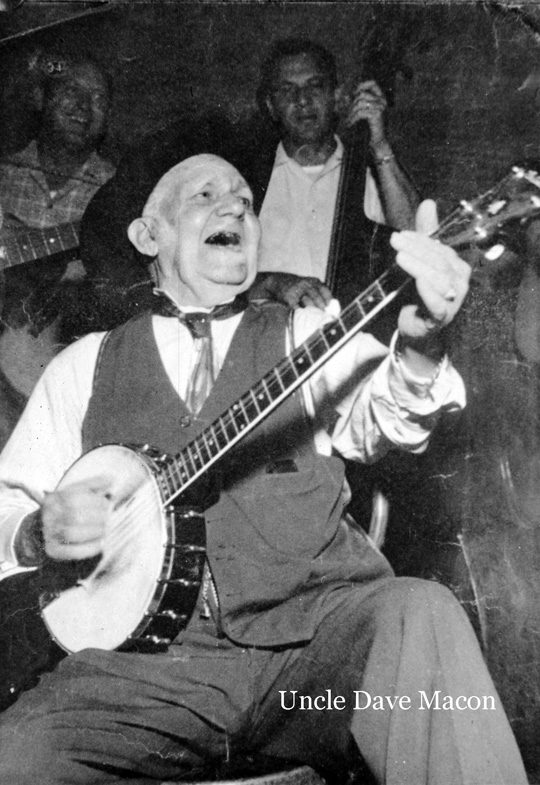
Uncle Dave Macon & "Keep My Skillet Good 'N' Greasy"


To start with, I had always thought that this song was just plain weird, and at two minutes, really just album filler on New Frontier. Allan Shaw and others had suggested that Dogies' Lament on the same Kingston Trio album was just a space-filler, though as you can see from the link, I disagree - the KT performance may be a bit perfunctory but the song is a good one and the arrangement was interesting.

But "Honey"? It seemed to me for decades just a bit of misfired strangeness, not unlike "Coo Coo U." I figured that despite the copyright to Trio members Shane, Stewart, and Reynolds it was probably based on some older, public domain song - but I could never find a source for it.

Then about four years ago I was reading a review of The Essential Kingston Trio CD by Billy Faier, a seminal force in the folk revival, acknowledged master banjo player, and an active performer still at age 80. Faier was trying to be even-handed in explaining his dislike for most of what the Kingston Trio did, and I've quoted parts of his review extensively both in these posts and in my Wikipedia article about the Trio. Faier suggested that the KT had at many points subverted the original meanings of traditional songs, and "Honey" was his most specific and developed example. He wrote:

“Keep My Skillet Good And Greasy” is a fine old folk song that paints a marvelous portrait of a lovable country ne’er-do-well. Here it is renamed “Honey Are You Mad At Your Man”, with an interesting but totally inappropriate instrumental arrangement, and the addition of a chorus from which the new title derives.

What Faier did not mention was that the "old folk song" was quite possibly composed solely by the legendary Uncle Dave Macon (1870-1952), the banjo-playing granddad of country and roots music in the U.S. - and a character whose approach to music had a lot more in common with that of the KT and other pop folk groups than it did with that of the dour-faced denizens of basement clubs in Greenwich Village. And what Faier also couldn't have known was how much this song provides us with an example of the connective tissue that links 19th century mountain music with 21st century pop.

You can read a solid if simple bio of Macon on Wikipedia HERE; note the emphasis on his connection to vaudeville and his emphasis on humor and banter as part of his shows. Macon understood that his later-in-life (age 51) career switch made him an entertainer, not the high priest of (at that time) a non-existent but soon to become sacrosanct tradition. The music was part of the show, as was the humor. (Macon may be the great unknown source of Trio song selection: in addition to "Skillet" becoming "Honey," he also popularized or wrote "Saro Jane" as noted in my Lou Gottlieb piece and "Buddy Won't You Roll Down The Line" - and possibly more.) Here is Uncle Dave's premier recording of "Keep My Skillet Good And Greasy" - Uncle Dave follows Stringbean and precedes Woody Guthrie in this extended video:


Most subsequent versions of the song include Macon's seventh-chord based accompaniment and that little hammer-on and wrinkle he is doing on "time, time, time" and elsewhere. Here for example is a clearer recording of the song by Woody Guthrie:


It appears that the legendary Sonny Terry and Cisco Houston are with Woody here, Terry on harmonica and Houston on (for him, a baritone) an unusual tenor harmony and fine guitar work. Guthrie is on mandolin.

Faier must have known of the Osborne Borthers' 1956 version, called "Ruby, Are You Mad?" that was the immediate antecedent of the KT "Honey Are You Mad At Your Man?":


Why this bluegrass adaptation did not strike Faier as "inappropriate" is a bit of a mystery, since the elements that he objects to in the KT version are present in prototype here.

The Kingston Trio, as Faier notes, added a chorus but preserve much of the original feeling of the song - with a unique banjo part by Stewart and that punchy, syncopated guitar strum by Shane:


What makes this recording significant and part of what I term above the connective tissue of popular music is this. While I may not have liked the song all that much - Lindsey Buckingham of Fleetwood Mac sure did. Buckingham was listed as producer for John Stewart's most financially successful solo album, 1979's Bombs Away Dream Babies with its Top Ten hit "Gold." But as Stewart relates in The Kingston Trio On Record, Buckingham was actually preoccupied with a FM project at the time, Tusk, I believe. So he told Stewart simply to crank the knobs on the mixing board until he liked what he heard - which Buckingham averred should be like "Seasons In The Sun" and "Honey" - simple, repetitive, and hypnotic, as Stewart said. Anyone who has listened to any significant amount of Fleetwood Mac recordings from the 70s and early 80s will recognize that formula for instrumentation immediately - take songs like "Rhiannon" or "Tusk". And like them or not, Fleetwood Mac gave much of 80s, 90s, and even 2000s rock a kind of template for instrumental accompaniment - derived from something Lindsey Buckingham heard in the Kingston Trio recordings, including "Honey."

The original "Skillet" version of the song has some fine performances available on YouTube. Three of the best, I think, are -

1) Lew Dite, a solo roots singer who has over 2 million views of his many roots recordings, most done like this one with great fidelity to the original:


2) The Mars Hillbillies, from Flagstaff AZ, just up the pike from Scottsdale - a really fun version of the song:


3) The Roe Family Singers from Minnesota, who have a clean traditional sound that sounds amazingly like Macon and Guthrie:


And a wonderful late addition in March 2012 - the fabulous Carolina Chocolate Drops:


I have the feeling that Uncle Dave would have liked all of these versions - they all make the song just weirdly fun - and repetitive and hypnotic to boot.

Friday, May 14, 2010

1964, Billy Edd Wheeler, And "Coal Tattoo"


1964 seldom gets credit for being as pivotal a year in American folk and pop music history as it was - seems as though '65 gets all the props. The latter year, of course was the flowering of Beatlemania with the second album and A Hard Day's Night and the explosion of folk-rock with the Byrds, the Mamas and Papas, and finally Dylan plugging in at Newport. American rock was also enjoying a renascence with the continued singles success of the Everly Brothers, the rise of the Beach Boys as likely the U.S. all-time greatest rock band, the growth of Motown, Phil Spector's "wall of sound," solo artists like Roy Orbison and Elvis, and more.

But the roots of much of this are in 1964 - the Beatles coming to the U.S., the break-up of the original Journeymen that sent John Phillips and Scott McKenzie to LA to work their folk-rock vocal magic while the Big Three with Doherty and Elliott was floundering - and the re-direction of popular folk music represented by the emergence of Bob Dylan and the continued and thoroughgoing dominance of the more politically-oriented Peter, Paul and Mary, whose self-titled debut album was still in the process of spending a astounding 84 weeks in Billboard's Top Ten, with their next two albums joining that elite level during the year.

What this meant, of course, was that the more good-timey pop folk groups like the Kingston Trio and their immediate competitors from the late 1950s, the Limeliters and the Brothers Four, went into a decline that proved irreversible, as none of those three or their lesser imitators every approached the levels of their early album sales again.

A sure sign of the decline was the KT album Time To Think. In terms simply of sales, the album made a bit of money for all concerned, as it sold 100,000 copies, which would have been respectable for anyone other than the former leader of the pack. The peak Billboard ranking of 18 was the lowest of any album released to date by the group, including the poorly selling Stereo Concert and holiday album. More seriously, though, it was the first time that the Kingston Trio was following a trend rather than initiating one, and trying to cash in on a style that was alien to their own "mission statement" and that was being pursued with huge success by their competitors. That is a simple but melancholy fact.

What that obscures, though, is just how good many of the performances on the album are - a decent if derivative "Patriot Game", perhaps the best recorded versions of "Seasons in the Sun" and "Deportee", and more.

One of the best cuts on the album is the rendition of another outstanding songwriting effort by Billy Edd Wheeler, Nashville Songwriters Hall of Fame inductee, successful playwright and artist, and composer of two previous KT hits, "The Rev. Mr. Black" and "Desert Pete." That song, of course, is "Coal Tattoo," said to be Wheeler's favorite among his compositions because of his own deep connections to West Virginia and its coal mines.

"Coal Tattoo" is a pointed observation on the hardships of the lives of American miners, but "The Times They Are A-Changin'" it's not. It has a lot more in common with Fred Hellerman's "Poverty Hill" and similar songs in its implied compassion. It reflects rather than prescribes, as do many of the other songs on this themed album - but that fact explains largely why the record never caught on. PP&M were doing Dylan and Ochs songs with a far more overtly political message and call to action - and that was what was selling. It is noteworthy that the Trio never tried another theme album again, or one with even distant and remote political messages. The Kingstons do, however, present "Coal Tattoo" with their trademark energy:


Lead singer John Stewart delivers a powerful and impassioned vocal here, but Voyle Gilmore's legendary production skills seem to fail him a bit in the mix , which has too much reverb and in which the instrumental blend is muddy rather than crystal clear, as 90% of the group's earlier cuts were.

Sadly perhaps, few of the song's many fans know it as a KT song. The best-known version is by West Virginia's alt-country star Kathy Mattea:


Mattea's version has the ring of authenticity to it, though with a fairly conventional country instrumental accompaniment.

Shawn Phillips has had a John Stewart-type of career, with a singular success with the title role on Broadway in Jesus Christ, Superstar and more than twenty folk albums that have a devoted but small following. He's a powerful performer, still with us at age 67:


The most recent version I found is by a younger ensemble that I featured in the "Darlin' Corey" post, Red Molly:


This is from a few days ago at Merlefest, one of the biggest remaining folk festivals in the US. I love the ladies' vocal and instrumental blends here.

The song is thought to be referring to a kind of atherosclerosis resulting in miners from black lung disease. But the "tattoo" was often just that - marks of coal dust embedded under exposed or cut skin, sometimes large, sometimes small. Look at the hands, arms, and necks of any log-time coal miners and you'll see the tattoos to which Wheeler makes reference.

Finally, our Xroads and FC friend Steve Cottrell has an excellent version on YouTube as well:


Steve's slower tempo brings out the melancholy of the lyric, and his distinctive three finger picking on the 12 string is an innovative and unique sound for the song.

"Coal Tattoo" is one of several genuinely enduring songs that Wheeler penned, and American pop music would be in better shape today if there were more younger generation writers of his ability.


Plus - Billy Edd Himself and Denver, Boise and Johnson - 11/18/12
A note from my fellow folkie Ron Wilburne prompted me to look on YouTube again, and I was delighted to find Billy Edd Wheeler singing his own song - a fine version in a sweet country tenor:


Also popping up was a recording by Denver, Boise, and Johnson - the last troupe of what had started out as the Chad Mitchell Trio. The Denver, of course, was John; the Johnson was Michael, later of "Bluer Than Blue" fame and a number of other hits in the '70s and '80s. This version, though, is a solo by David Boise, whom I got to know some months after this 1968 recording. The killer banjo part is by stringed instrument legend Paul Prestopino:


And a rousing version from bluegrass legend and "Union Maid" Hazel Dickens:


And Finally At Long Last - 10/16/17....

.....Judy Collins, whose rendition is the favorite of many folk revival music aficionados. I've always loved it, but it wasn't available on YT when I wrote this article seven years ago. Oversight rectified:


Friday, May 7, 2010

Stan Hugill And "Away, Rio"

Stan Hugill (1906-1992) was a Briton who styled himself "The Last of the Shanteymen" (he preferred that spelling), and he likely was, working as he did on the last British commercial sailing ship, the Garthpool that finally went down in 1929. Hugill made an enormous contribution to folk music by collecting, categorizing, and publishing songs that he actually sang at work for the twelve years or so that he worked "before the mast." Hugill's blue collar background and almost continuous decade at sea gave his understanding of the work songs of the sailors an authenticity that other admirable collectors like Cecil Sharp and Carl Sandburg just couldn't quite match.

Hugill pointed out that a shanty-man was usually just another working stiff who had a good strong voice and an extensive knowledge of songs that he could lead the crew in. But music was such a critical part of life at sea in the Age of Sail - the only entertainment, really, along with drinking the daily allotment of grog and dancing - that before Hugill's time in the great eighteenth and nineteenth century days of the British navy and merchant fleets, shanty-men were sometimes hired for that skill primarily even if they were of little other use. There were cases in the Napoleonic era of partially blind or crippled men hired to do a bit of galley work to justify their real reason for being on board - they could sing and play a tin whistle or recorder or (most prized) a fiddle. There are interesting fictional portrayals of this in films in recent decades - the near blind fiddler and singer in the 1984 The Bounty and the lead singer in the crew in 2003's Master and Commander (and note there how often even the officers break out in song).

As I've noted here before (and as Hugill confirms), there were different kinds of chanteys for different functions, fo'c'sle chanteys for relaxation for example, or dancing chanteys for hornpipes and so on, a sort of seagoing square dance group of songs. By far the largest group was the collection of capstan or windlass chanteys, the slower and more rhythmic songs that accompanied hard group tasks like weighing anchor. It is into this group that Hugill categorized what he called the "Santy Anno" group, which included "Lowlands" and "Bay of Mexico" and "Away, Rio" - all of which have a punctuating refrain like "Way up, Susianna!" and "Heave away, Santy Anno" and "Away, Rio!"

A word of clarification first on "Rio" before we get to the performances. I was confused when I first heard the song in 1962 because I couldn't figure out what British or Yankee sailors were doing sailing in the mid 1800s to the mouth of the Rio Grande in the Gulf of Mexico. Turns out they weren't. I found some book or other that pointed out that the "Rio Grande" of the song is actually Rio Grande do Sul - the great River of the South - the southernmost state in Brazil.

Note the port city on the Atlantic Rio Grande, where the Lago dos Patos leads to the capital city of Porto Allegre. That's the Rio Grande they're bound for. Also note the location of the state - where the pampas of Argentina, Uruguay, Paraguay, and southern Brazil come together. In the nineteenth century, this was an important trading port for all the exports of the region - grain, dried beef, leather goods, and so on. That's why in the lyric "We'll head for Cape Horn and then pull her about."


Our first version is from the Kingston Trio - the original recording before arranger Jimmie Haskell's orchestrations were added for the group's Something Special album:


I actually thought that this was the only number on the album that didn't suffer unduly from the secondary music - the french horns evoking the sea swells was a nice little trick that Haskell stole from Debussy and that John Denver used effectively on "Calypso." Also, John Stewart here is using those extra frets on the long neck banjo - the key is E so JS is playing without a capo, all the way down the neck of the instrument.

Next up is the Revel Players doing a Robert Shaw Chorale-type harmonized version - and pronouncing "Rio" as "Rye-O" as American sailors apparently always did:


Artist Lord Drako Araxis is really talented, though I don't much like anime, especially in this context. But he's assembled the best collection of choral arrangements of chanteys on the web - plus we get a bit of the Poxy Bogards doing "Up And Away" at the end.

Next - since about 1958 with the opening of the St. Lawrence Seaway, my hometown Chicago has in fact been a seaport - which is why they can have a Maritime Festival - here from 2009:


The Rambling Sailors with appropriate gusto from the Bristol Renaissance Faire last year:


The Metropolitan Opera's Leonard Warren did a full orchestra and chorus version:


David Peel, who performed for a time with Bob Shane of the KT after the 1967 break-up of the original group, here in a recent recording from Denver's Swallow Hill -


Finally, "Catmelodeon" gives us an authentic-sounding version on a melodeon, which is close enough to a concertina or an original keyless accordion to be maybe as sailors in the fo'c'sle might have heard it:


What a fine song it is, in nearly any version. The days of sail may be gone, but there are clearly a lot of musicians out there who are keeping its songs alive.

Friday, April 30, 2010

"Good News, Chariot's A-Comin' "

Last week's post about Bob Gibson reminded me of another fascinating but largely forgotten character from the folk revival era, Dr. Lou Gottlieb (left, on bass) - musicologist, comedian, scholar, hippie, bon vivant, eclectic genius, and the the heart of the pop folk group The Limeliters, of whom Time Magazine wrote, "“If the Kingston Trio are the undergraduates of big-time folk singing, the Limeliters are the faculty.”

Gottlieb was clearly a unique figure in a whole variety of ways. He was the only person I know of in the entire folk movement who had a doctorate in musicology. He was a founding member of the Gateway Singers, a group that he and his friend (and ours) the late Travis Edmonson proudly proclaimed was the first integrated vocal group in the U.S. He was a comedian turned folksinger a decade before Noel Paul Stookey did the same as a member of Peter, Paul and Mary. And Dr. Lou was the first external vocal arranger employed by a young and unknown at the time Bay Area act that would become the Kingston Trio.

Gottlieb worked the North Beach night clubs in San Francisco in the early and mid 1950s already a grown man - he was born in 1923 - and combined his own cutting edge comedy (he was said to be an influence on Mort Sahl, who is happily still with us) with outstanding musicianship on piano, clarinet, and upright bass, all of which he used to comedic effect. He was paying his way through grad school at UC Berkeley and in fact left the Gateway Singers to finish the doctoral degree in 1958. What happened next that year Gottlieb described to Ronald Cohen for his wonderful folk history, Rainbow Quest:

I had a wife and children and no money so I started working as a stand up comic and got a job at the Purple Onion. There were three guys there who used to hang around the Hungry i all the time. In fact, they'd be in the dressing room half the time. But they were cute....They were the opening act at the Purple Onion...Well, sir, these kids really had something different. There was a magic about that act that was hard to explain. When they made their first record...they needed a tune. I had a couple of old charts from the Gateway Singers that I quickly re-scored for three voices. They sang a song I stole from Uncle Dave Macon called "Rock About My Saro Jane" and put it on their first album. And they let me publish it. The royalties ultimately came out to thirty grand.

[Note: that comes out to about $200 Gs in today's dollars and meant at songwriter's rates that the album sold about half a million copies]

Lou also did some uncredited arrangements for the Kingston group but earned full copyright for two spirituals, "Round About The Mountain" and "Good News" from the Trio's third real album, At Large. You can hear the touch of a real pro in that latter arrangement, where Gottlieb creates simple but tasteful harmonies, rhythms, and a slight key change that are well within the limited musicianship of the still-young Trio:


Note that once again, producer Voyle Gilmore is working his studio magic with the able assistance of engineer Pete Abbott and remixing engineer Rex Uptegraft (thanks to PC Fields for pointing that out). David Wheat's bass is given a prominence in the mix that reflects the "swing" that Gilmore liked so much and that emphasized the professionalism of the most accomplished musician in the quartet that's playing here.

Lou Gottlieb's good friend Bob Gibson was, like Lou, a pop folk artist who had a successful if modest career before the Kingston wave raised all the folk boats. Gibson's role model early on was clearly Pete Seeger, from Gibson's use of the extra long neck banjo to the fact that on early albums that was Bob's only accompaniment (see his Carnegie Concert - no guitar or bass) to Gibson's success at lining out songs and getting audiences to sing along - just like Seeger. Here Bob does "Good News" on TV's Hootenanny with the exact sing-along arrangement he used on the 1957 Carnegie album:

Good News (Live) - Bob Gibson

That's legendary banjo player Eric Weissberg behind Bob with the mandolin, with the Gateway's second generation Elmerlee Thomas on the other side.

The next two versions of today's song are from gospel groups. The King's Heralds are a kind of corporate endeavor, having been founded in 1927 and continuing today. A total of thirty singers have graced the group using the same original arrangements over the eighty plus years of the group's history:


The Heralds have Gibson's verve and just a bit of that Gottlieb key shift (which I'm betting Lou got from these guys).

More in the tradition of the African-American roots of the song, The Raymond Raspberry Singers rock out a classic gospel version - from the early '50s,I believe:


A choral version next from the Jubilate! Chamber Choir from the University of British Columbia - nice creative rhythm shifts here:


And who better to close with this week than arguably the greatest spiritual singer of them all, Mahalia Jackson:


As with many good and real folk songs, "Good News" lends itself to a wide variety of very effective interpretations.

Thursday, April 22, 2010

Bob Gibson And "To Morrow"

Over the years of these posts, I've tried at times to present song profiles by artists who have been even more neglected than has the Kingston Trio - artists like Ed McCurdy and Ewan MacColl and John Stewart. Tonight is especially melancholy for me in that regard, because I have a few words to say about the granddaddy of all the forgotten heroes of my childhood and youth - a figure little known among even the younger generation of Trio fans who read here (meaning those under 70) - the late and great and genuinely gifted Bob Gibson.

[Parenthesis: Imagine being a celebrated folk singer who hit the skids in the 60s carrying that name while a Hall of Fame pitcher with the same name is making his mark in America - not unlike the recognition problem that John Stewart had when comedian Jon came along, or CMT baritone Joe Frazier did after the boxer of the same name gained fame.]

Gibson was the bridge between the solo pop folk artists of the 1940s and early 1950s (really, just Burl Ives and Terry Gilkyson, though Glenn Yarborough had the beginnings of a nice career going as well) and the Dylans and Paxtons and Ochs and Patrick Skyes and others who followed in the 60s. He may well have been the most influential soloist of his generation, after only Pete Seeger. A passel of 12-string guitar players, including Leo Kottke and Gordon Lightfoot, acknowledged an admiration for and influence from the way Bob handled that instrument.

It was Gibson who gave the 18-year-old Joan Baez national exposure, and he was instrumental in helping the young Judy Collins along as well - for both of which lovers of folk music owe him an enormous debt. Though he flamed brightly across the pop folk sky for only about seven years, between about 1957 and 1964 before being undone by his own mad addictive personality, Gibson left behind some of the best polished and commercial folk music of the era in four albums especially - his 1957 Carnegie Concert, the 1961 Yes I See, the 1964 Where I'm Bound - and most especially, the album on which what little remains of his memory rests, Gibson and Camp at the Gate of Horn (1961). (pictured above) Gibson was also the first to record "Day-O/Banana Boat Song," which Alan Arkin and Erik Darling heard him play with his banjo in Washington Square one summer - they formed the Tarriers with Bob Carey, recorded Gibson's arrangement, and had a minor hit with it - a hit heard and recorded by Harry Belafonte, who had a blockbuster hit with it.

The Camp is Bob, who later resumed his birth name of Hamilton and made a career as a comedian and actor. Gibson had introduced Camp at the 1960 Newport Folk Festival, and they co-wrote a number of what became standard folk group numbers (including "You Can Tell The World" and "Well, Well, Well") before the legendary gig at Chicago's first and arguably greatest folk club, owned by Albert Grossman, who later assembled and managed PP&M as well as co-founding the Newport Folk Festival and guiding the careers of Odetta and Ian and Sylvia and Gordon Lightfoot. The Gate of Horn album is regarded by many as the musical high point of the pop folk era.

Though Gibson had been born in Brooklyn, he will forever be associated with the Chicago folk scene that also produced Steve Goodman and John Prine and Frank Hamilton and Bernie Krause (Seeger's last replacements in The Weavers) and all Gibson admirers - and of course Jim McGuinn, who came to folk music because Gibson played a solo banjo gig at McG's high school. The eventual founder of the Byrds and folk rock came to this kind of music because of Bob Gibson - who I hope I've shown was about the most important figure in folk music that nearly no one remembers. He was big and doing Carnegie Hall while Dave Guard was still in grad school.

Oddly, for a performer who wrote and arranged some splendid folk music ("Foghorn," "Yes I See," the spirituals mentioned above,"Blues Around My Head"), the one song that the Kingstons chose to do by Gibson was one that he copyrighted but freely admitted he didn't write (shades of "Scotch and Soda"). Gibson learned "To Morrow" from a Bob Black of Indiana University, but the basic tune and words were copyrighted in 1898 by humorist Lew Sully with music by Geoffery O'Hara. According to a Dayton, Ohio newspaper, not far from the very real Morrow, OH:

The railroad also provided humorist Lew Sully with the material he needed to compose the famous poem "I Want To Go To Morrow." According to legend, Mr. Sully overheard a conversation between a Kentucky farmer and a Cincinnati railroad ticket agent. The agent decided to have some fun at the farmer's expense, and thus the basis for the poem was born.

The earliest known recording of the song - and one of the oldest surviving recordings in the world - is by Dan W. Quinn, recorded July 11, 1902:


This recording is from the Library of Congress National Jukebox.

Gibson re-worked the words and came up with this in 1991: (unfortunately removed for copyright and will be added again if it becomes available)


The Kingston Trio put Capitol Studio B and Dave Guard's still-new Vega Pete Seeger long neck banjo (the legend is that Gibson had bought the first production model of that instrument) to excellent use in their delightful version, with Bob Shane doing his jaunty bit and Guard almost visible in the imagination as a bespectacled railroad agent:


The number is clearly better suited to two voices in counter point, but the influence of Gibson on this, especially Dave's instrumental, is clear.

And now, some more fun versions of a fun song. First, one good re-write deserves another, and Scots folksinger Iain Mackintosh rewrote both the words and the melody in this early 1950s radio broadcast:


Just a few weeks back in February, the Slomski Brothers of Virginia go for the full-on comedy version. Their self-evident youth is somehow encouraging:


Let's close, however, with some real folk music pros - the Muppets, with these puppets created as images of the real (l-r) Jim Henson, Frank Oz, and Jerry Nelson, who reportedly are actually playing the instruments:


Bob Gibson died in 1996 at the age of 64 of supranuclear palsy, a week after a farewell concert performed for him in Chicago by many of those artists listed above and many more as well, including Tom Paxton. I hope he's out there some place smiling at even this little memorial to one of my all-time favorite performers.

Thursday, April 15, 2010

"What Do We Do With A Drunken Sailor?"/"Early In The Morning"

"The folk process" is a term that has been bandied about a lot over the years and was the root of a great deal of now-forgotten controversy back a few decades ago. I say "forgotten" because nowadays nearly anyone who strums a guitar (it need no longer even be acoustic) and writes a few soul-searching/suffering/political lyrics gets plopped into the category of "folk" by the recording companies without any regard whatsoever for whether or not the performer/writer has any roots in or even knowledge of what had been called "folk" for centuries before the 1970s - traditional music peculiar to a particular regional or ethnic group, often but not always of uncertain authorship, and passed down through generations orally. The "process" of that original definition of folk was the diversifying of a single root song into a family of related ones, with melodies and lyrics morphing into often very different variants. "Greensleeves" may have started as a Renaissance lament for lost love, but it was easily adapted into the Christmas carol "What Child Is This?" and the American frontier song "I'll Build You A Home In The Meadow." Thus it was with hundreds if not thousands of English-language folk songs, the families of which were traced and categorized by folklore giants like Francis James Child, Cecil Sharp, and John A. Lomax.

Those original musical archeologists seldom questioned the legitimacy or "authenticity" of those transformations, largely because they seemed to have evolved in a mythical ether of "purity" - meaning an apparently natural process of adaptation that was unsullied by the "commercialism" of the desire for filthy lucre. Yet someone made those changes and adaptations, sometimes for money and at other times for equally ulterior motives. Someone transformed the Irish drinking song "Rosin The Bow" into "Lincoln and Liberty" for the 1860 campaign; a religious revival song from 1800 became "John Brown's Body" until Julia Ward Howe re-wrote it as "The Battle Hymn Of The Republic." No one was on record as protesting these uses of melody as inauthentic; the music was just there and handy to use to one's own purposes.

Then came the so-called folk revival of the 1930s through the 1960s, and the process became a bone of contention (brilliantly and comprehensively discussed in Richard Weissman's [of The Journeymen fame] 2005 book Which Side Are You On?). Who had the "right" to adapt a traditional melody? When, and to what purpose? Dominic Behan took an old and little-known Appalachian air and used it for "The Patriot Game" - and then reportedly was put out when Bob Dylan took the same public domain tune for his "With God On Our Side" (and even some of the lyric as well) - which Dylan also did with "The Parting Glass" (becoming his "Restless Farewell"), "The Leaving of Liverpool" (becoming "Fare Thee Well"), and even one of the most venerable of all British ballads "Lord Randall" (becoming "A Hard Rain's Gonna Fall"). While there were many of the folk purists who disapproved of what they regarded as Dylan's kind of high-handedness with sacred "folk music," most of the Greenwich Village stripe of folkies seemed to accept it and celebrate it because Dylan's politics were of the right shading. The same was true of the Weavers, who played very fast and very loose (and often very lucratively) with the folk material that they freely adapted.

But let those commercial exploiters like the Kingston Trio do the same, and what you get is, in the words of a 2006 review of a Trio reissue by traditional banjo master and major force in the revival Billy Faier, ""a mishmash of twisted arrangements that not only obscure the true beauty of the folk songs from which they derive, but give them a meaning they never had." Forget the fact that as fine a song as it may be, "A Hard Rain" has absolutely nothing to do with the tale of love and murder that "Lord Randall" is; it's Dylan and he's authentic, even when he plugs in and rocks. The Kingston Trio? Profit-driven "tinselly showmen" (thank you, Mark Morris in 1959 for that description).

Which brings us to this week's song, the chantey "What Do We Do With A Drunken Sailor?" that Randy Starr and Dick Wolf - Tin Pan Alley types whose commercial songs were recorded by Elvis Presley and Chet Atkins among many others - turned into a kind of faux-folk traveling/pop love song with a syncopated jazzy beat called "Early In The Morning":


This is a piece of pleasant fluff with just enough folk overtones to fit thematically on a Trio album, especially one like At Large whose song selection with "The Seine" and "All My Sorrows" has more of a pop bent to it than the first two albums anyway. David Wheat's bass provides a nice beat, and the final chorus features two tenor harmonies by Dave Guard and Nick Reynolds above the melody by Bob Shane.

Now for a good version of an Irish sailor tune, who better to listen to than the Clancy Brothers and Tommy Makem:


Makem, of course, is the lead voice here. Tommy M. was the pennywhistle player in the group, so someone else is playing the banjo here, possibly Pete Seeger.

The first version I ever heard, and probably still my favorite, is from that great album of sea chanteys by the Robert Shaw Chorale from about 1959:


This is no more "authentic" than "Early In The Morning" - the song is after all a capstan chantey sung rhythmically and fairly slowly to mark time while raising anchor or hoisting sail. But damned if it isn't a great version of the song - a fine use to put a folk tune to.

I always thought of the Irish Rovers (of "Unicorn" fame) as a kind of poor man's Clancy Brothers. The Rovers do justice to this song, though, and the concertina gives it a genuine Irish sailor's feeling:


You get a clear sense here of the unpleasant things that the crew wants to do to a sailor derelict in his duty - and I'm sure that most know by now that "the captain's daughter" was a mordantly humorous seafaring reference to the cat-o'-nine-tails, a few lashes from which would certainly put a sailor in his hammock for a few days.

And finally - optional - what passes as Celtic and folk today - if you know the Dropkick Murphys ("Skinhead on the MBTA") and their ilk, you'll recognize the approach of the popular Blaggards:


I don't know exactly what this is - but I'll tell you what it's not. Folk. Or authentic anything other than loud and raunchy. Thanks anyway, guys - I'll take Robert Shaw and the Kingston Trio any day. Are the latter two traditional? - no, certainly. But musical and talented? Most definitely.