Thursday, August 27, 2009

Moonshiners and Revenuers: "Darling Corey"


My little Comparative Videos enterprise is constantly full of surprises, like my last posting's excellent version of "Maria" by actor Pernell Roberts, or Johnny Cash doing "Remember The Alamo," or a mountain ocarina version of "The First Time Ever I Saw Your Face."

That notwithstanding, I was in no way prepared for this week's revelation. Of the fifty three songs I've profiled thus far, the one with the largest number of video interpretations on YouTube is this week's entry, "Darlin' Corey," or as the Kingston Trio named it (never forget those lucrative publishing profits), "Corey, Corey." And it isn't even close - there are more than 80 different video versions on YouTube, many with a good claim to be heard for their creativity of interpretation or their uniqueness. I'd guess that the elasticity of the simple song lends itself to multiple interpretations, and the song has been a multi-generational delight for banjo pickers and frailers alike.

I was never a big fan of the song originally on the KT At Large album, and I often skipped the cut. I thought it was just too mono-tonal, and Nick Reynolds' "ohhs" I found especially annoying. I still don't think they add much to the song at all, but I've developed an affection for the other vocal harmonies and have always been stunned by the quantum leap in Dave Guard's banjo work that the song represents.

Like a substantial number of now-familiar Appalachian folk songs, "Darlin' Corey" was first recorded in the 1920s by a number of artists, the best-known of whom I think was Clarence Gill (though Wikipedia says that the song was never released). Despite a number of versions copyrighted under different titles, the piece is clearly a traditional folk song, and musicians and banjo players especially have undoubtedly noticed the similarity of chord structure between it and that other great moonshining girl song, "Little Maggie." I am surprised, though, that A.P Carter apparently never got his hands (and copyright) on it.

We start with a mid-1950s version is the skiffle performance from the UK's Lonnie Donegan:


The immediate antecedent of the Kingston version was the Weavers' recording in 1954. The arrangement for the latter was by Pete Seeger, whose solo version from 1993 is here:


The influence on the KT is clear, including Dave's respectable (for a two-year banjo player) attempt to replicate the far more complex Seeger frail:


Now, what the current Trio often does is use the original recording as a template and then enhances both instrumentation and harmonies, and I think that's perfectly on display here:


And since we're doing KT versions, here is one of the best camper trios ever from FC10 - Tom Sanders, Tony Lay, and Bert Williams. Note the dead-on frailing that Bert is doing (we played this one together in Mike and Mikey's suite)and Tony's authentic Shane bare-handed strum:


There are so many other great versions, and so little space here. Some of the best - one of my favorite singers from the 80s, Bruce Hornsby with pop-country turned traditionalist Ricky Skaggs:


The legendary Seldom Scene doing what I think Ives was trying to do:


Two hot, popular younger groups I've seen in person - first, Crooked Still:


and Red Molly - I love the ladies doing this:


The variety of styles demonstrated here is what got me going in this project in the first place, and it feels great to be at it again. More to come....

___________________________________________________

Addendum, August 2014

A few weeks ago an extremely rare live performance video was posted to YouTube of the Kingston Trio on The Perry Como Show in January of 1960 doing this song. It is extraordinary how much better Dave Guard had gotten at frailing in the year following the studio recording above.

Friday, August 14, 2009

"They Call The Wind Maria"

Every time I think I'm coming to the end of this series and can envision only four or five more songs to profile, something comes up and I find myself seeing ten or fifteen beyond that number - and delaying one week's selection for something more immediate.

When I did the KT Wikipedia a month ago, I came upon and used a quotation from Bob Shane from the 1997 book Martin Guitars in which Bob descried the folksinger label attached to the group, saying that they did "folk-oriented material amid all kinds of other stuff." The first song that popped into my head for "other stuff" was "They Call The Wind Maria," a Broadway Lerner&Loewe chestnut that stood out from the folkier selections on the ...from the Hungry i album but remained a highlight of that record because of the sheer power and excellence of the performance. And as with songs previously profiled here like "Scarlet Ribbons" and "Try To Remember", it has been folkies and country singers who have contributed at least as much to the song's popularity as the musical comedy community.

The Trio has long introduced the song as one swiped from a failed Broadway musical, but that's not quite so, unless you prefer to think relatively. Paint Your Wagon played on Broadway for 289 performances between late 1951 and mid 1952 - at seven shows a week, that's about 40 weeks - not enough to retire on but what should have been well past the break-even point for shows of that era. Production problems created cost overruns that ate up the modest profits. Now that's not a flop - unless of course you remember that Lerner and Loewe were almost co-equal with Rodgers and Hammerstein as the dominant composers on postwar Broadway and unless you compare Wagon with genuine L&L hits that ran for years like My Fair Lady and Camelot.

Still, Wagon would likely be dismissed to the dustbin of history were it not for this song and another great tune, "I Was Born Under A Wanderin' Star." "Maria" was sung in the original cast by Rufus Smith, the least-known but fully equal member of that group of stunningly talented Broadway baritones of the era that included Gordon MacRae, John Raitt, Richard Kiley, Robert Goulet and more - and the recently-deceased Harve Presnell (d. 6/30/09), whose version here is from the 1969 movie and is as Lerner and Loewe conceived it:


The Kingston Trio gives us the next three versions - first, the one that many of us fell in love with from Hungry i, a fabulous version in a nightclub without orchestra or chorus (forgive the fanzine images of Mariah Carey, whose parents did in fact name her after this version of the song but got the spelling wrong):


Now, I never fully embraced John Stewart doing Dave Guard-era Trio songs - until the Flashback album. That version here is a superior performance - five years down the line Shane is in even better voice, Stewart's lead guitar and background vocals are haunting, and Stewart and then Shane just blow away the rhythm guitar part at the end - and John Triofan Lee's mastering brings Nick Reynolds' bongos up to a proper level - just magnificent:


And an excellent piece of evidence showing why Bill Zorn is the only singer in folkdom with the vocal power to take Shane's place in the group - here's the current KT in an equally wonderful rendition:


And another Big Voice from the days of yore - I hope some here remember Vaughn Monroe:


Frankie Laine, from 1998, late in his career:


It would have been a treat to hear Laine do this in his prime.

Carlie Slaven presents a delightfully unique and original bluegrass version:


Finally, our surprise selection of the week - actor Pernell Roberts of Bonanza and Trapper John MD set against videos of the former show in its glory days:


Contrary to some people's suppositions, I do not actually live at the computer, and next week's Weekend Videos may well go the way of last week's - into the dark cavern of lost good intentions. I'll be in Manitou Springs CO rehearsing like crazy for our show there - hope to have a WV anyway but no promises. Then again - no one seemed to miss one last week....:)

Thursday, July 30, 2009

Woody Guthrie's "Hard Travelin'"

" I am out to sing the songs that make you take pride in yourself and in your work."
- Woody Guthrie


And just such a song is this week's selection, "Hard Travelin'," which I think must rank in the top five of Guthrie's best-known songs. It's prototypical political and myth-making Woody Guthrie at his best, celebrating the virtues of the common working man while at the same time infusing it with a hint of discontent and protest - and continuing to paint the portrait of himself that he wanted painted in the public's imagination.

Now, Woody Guthrie was the real deal as far as intinerancy and joblessness went, but some of that was of his own creation. The family that he was born into in Okemah, Oklahoma was until he was 14 far more prosperous than nearly any other family in town, and despite a series of setbacks and disasters including the death of his mother, WG's eventual nomadic lifestyle came about as much from his own dislike of school, discipline, and authority in general (and from his dislike of the uncle he lived with after his family dissolved in his late teens) as it did from economic circumstance. [Some speculate that it was WG's hatred of top-down authority that kept him from actually joining the Communist Party.] So Oklahoma-born and bred Woody Guthrie was never an Okie - never one of John Steinbeck's hardscrabble dirt farmers made homeless by foreclosed mortgages in the Depression.

And Guthrie seemed to have more of a taste for work in radio stations and music (at least as far as union organizing went) than he had for work in "hard rock tunnels" and "Pittsburgh steel." That's not to say that Woody didn't do that kind of work, because he did, most notably in FDR's WPA projects around the west, including the Grand Coulee and other dams on the Columbia River. But Woody turned that into good coin - he wrote a group of labor-oriented songs while being paid well by the federal government to do so because somebody in Washington recognized that WG had a voice that resonated with the common people. Traditional folksinger Raymond Crooke of Hong Kong and YouTube fame wrote, "It is ironic that some of Woody Guthrie's best songs were written as pro-government propaganda. In May 1941, he was hired to promote the federal dams on the Columbia River, especially the enormous Grand Coulee Dam..."

None of this mitigates the quality of WG's legacy as an artist or citizen - it's just that it is at at least slight odds with the public persona he created in his autobiography Bound For Glory - and in songs like "Hard Travelin'."

Our first performance is of course from Guthrie himself, from the Folkways recordings of the late 40s. I find his voice here quite pleasing - and the lyrics are different from some of the ones we've heard:


Now the Kingston Trio did this song in two distinctly different ways. The KT with Dave Guard gave the song a slightly bluesy quality, moderate speed, with a touch of country. The Trio with John Stewart used this is an opener when I saw them, and that version is faster, louder, less nuanced - because as here from the album Once Upon A Time, it's an opener:


I've always preferred the version by the original Trio with Dave Guard, however - fabulous bass opening by David Wheat:


Thanks to my KT message board friend Dave Long for uploading this.

About the same time that the Kingston's were getting started in the U.S., Lonnie Donnegan was beginning the skiffle craze in the UK. Sort of anticipating what Jim McGuinn described as "putting a Beatle beat to folk music" to create folk-rock, Donnegan put a simple 4/4 r&r beat to folk numbers like "The Rock Island Line" and this one, creating hits in Britain that influenced the young and impressionable John Lennon and Paul McCartney:


And now for three rather different contemporary versions. First, Flatt and Scruggs put their distinctive bluegrass spin on the song:


Recently uploaded here, some classic videos from the most dedicated KT tribute band, and I'll bet the longest-lived, the CountyLine Trio. The show is from 1982, and I'm hoping Chuck C. can fill us in a little bit on this - a fine upbeat performance of generally the Stewart arrangement:


Friday, July 24, 2009

"John Hardy/Getaway John"

In the past 12 months, I've profiled The Kingston Trio singing sea chanteys, cowboy songs, love songs, spirituals, patriotic songs, protest songs, and more - but it was only this week that I discovered in preparing this week's selection what a bunch of subversive, anti-American, disreputable scofflaws these musicians have been. For 52 years they've been pulling the wool over our eyes. They've propounded a crisp, clean, All-American image while in reality they have been undercutting our most basic societal values. They glorify crime and criminals and just keep singing about them. The FBI must have a file on these guys several inches thick.

What were we thinking? The clues have been there from the first. They start their career with a song that sells 3.5 million singles and maybe as many as 3 million more on albums - about a guy who gets his neck stretched for murdering a girl. I mean, really - that song borders on the sympathetic! "Poor boy, you're bound to die"? Poor boy indeed! Where's the commitment to law and order? (see Appendix)

So it is with a great deal of indignation that I present this week's song selection cited above, "John Hardy." There are object lessons galore in this story, one that I have to say seriously that I knew nothing about (unlike most of the other CompVid selections) until I looked into it this week.

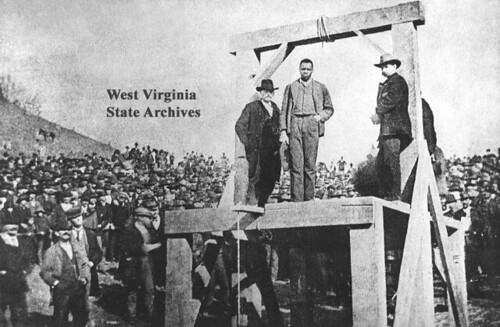
John Hardy was a real man, hanged for murder in Welch, WV in January of 1894. Hardy was a black railroad worker (the same as another real character of folk song, John Henry) who shot a man named Thomas Drews after either a poker game or a game of craps, though Hardy brought a pistol with him to the game and the underlying cause seems to have been a "pretty little girl." Oddly, like Tom Dula, Hardy had a first-rate defense team headed by a retired judge, and again like Dula, Hardy's case generated widespread attention including articles in New York newspapers. The passage of time has obscured the reasons for this attention to a couple of run-of-the-mill murder cases.

Hardy was hanged at Welch a year after the murder and four months after his conviction, and above is an actual picture of Hardy immediately before. As the song suggests, Hardy experienced a religious conversion while awaiting execution and was let out under guard from jail on the morning of his hanging to be taken to a river for baptism. Three thousand people attended the hanging, and it took him 17 1/2 minutes to die (more here). Ugh.

The song sprang up immediately, rather in the fashion of a broadside ballad, and like so many other mountain songs came to national attention through the Carter family recording, here with a great example of the Carter lick on the guitar played by Maybelle - I think the vocal is by Sara:


The Kingston Trio took the basic song and gave it the sort of arrangement that I call "hushed urgency" characteristic of many NBD cuts but not so much from NBJ - think "Tom Dooley" and "Sloop John B" and "Fast Freight" among others, songs that are not slow but quiet and intense:


The pictures in this video that I uploaded are largely purloined from the KT FaceBook, which includes some rare and little-seen pictures of the group's early days.

Another early recording with fabulous guitar work by the great Roscoe Holcolmb:


Today, you're likely to hear the song done most often in bluegrass style, so here are a few in that style - first The Bluegrass All Stars with Allison Krause and Tony Rice and friends:


Also, a blazing instrumental from Dan Paisley and Southern Grass from two years ago:


Speaking of bluegrass...the acknowledged masters Doc Watson and Earl Scruggs from a couple of decades back:


A blessing indeed that these two giants are still with us...and still performing.

A different proto-folk-rock version from 1962 by British invasion group Manfred Mann:


Just because other artists have also done this song, the basic fact remains: The Kingston Trio is a subversive act that glorifies crime and criminals. I'm gonna go and get my copy of the Patriot Act out to see if there's something that can be done about this.

Appendix

For those of you other soft-on-crime types who play guitar and want to do the KT arrangement - here's one of those wonderful instructional videos put out last year by Xroad friends Bert Williams, the pride of Tucson and a mean guitar player himself, speaking, and Gentleman Tom Sanders playing - this is the slightly different version from the one above - this one as the KT performed it with John Stewart:


And for those who question the basic thesis - Well, look at this little list I've compiled by album - song first and then the crime that's being glorified in parenthesis:

The Kingston Trio: "Banua" (drunk and disorderly) "Tom Dooley" (murder) "Sloop John B" (assault,drunk and disorderly) "Little Maggie" (violation of federal excise laws)

Hungry i: "Tic,Tic,Tic" (pickpocketing/petty larceny) "New York Girls" (solicitation, larceny)

At Large: "Corey, Corey" (violation of federal excise laws), "I Bawled" (assault) "Getaway John" and "Long Black Rifle" (murder)

Here We Go Again: "E Inu Tatou E" (public intoxication)

Sold Out: "Bimini" (drunk and disorderly)

String Along: "Badman Blunder" (murder) "John Webb" (jail breaking) "This Morning, This Evening, So Soon" (sexual harassment, murder)

Goin' Places: "You're Gonna Miss Me" (murder) "Razors In The Air" (assault, drunk and disorderly)

Closeup: "The Gypsy Rover" (kidnapping) "Jesse James" (armed robbery, murder)

College Concert: "Roddy McCorley" (treason)

New Frontier: "Honey, Are You Mad" (public intoxication) "Poor Ellen Smith"/"Adios, Farewell"/"Long Black Veil" - murder

#16: "Run The Ridges" (murder)

I think I've made my point without going any further into classics like "Hanna Lee" and "Parchment Farm" and so on. Any group that even includes this many acts of criminal behavior in their repertoire needs to be on some law enforcement watchlist somewhere!

Friday, July 17, 2009

Ian Tyson's "Four Strong Winds"

Back in November
, I posted a more extended discussion of Ian Tyson's contributions to the last fifty years of folk music in an article about "Someday Soon". Tyson is one of those artists (and I have frequently mentioned Emmylou Harris in the same fashion in these posts) that makes you glad that you live in the same century that he does. He created a kind of sub-genre almost singlehandedly - Canadian pop folk, decidedly different from the French voyageur songs and Celtic, Breton, and Acadian music that is the traditional musical heritage of Canada - that spread its roots and branches out as far as the Kingston Trio did in this country. Gordon Lightfoot, Joni Mitchell, k.d. laing, Neil Young, Bruce Cockburn, Stan Rogers, even Anne Murray and maybe even Leonard Cohen owe a great deal to Tyson.

Tyson is also a talented guitarist who works extremely tastefully and well within his skills set, a wonderful singer with a round high baritone - and one of the best songwriters of his generation. The simple fact that he wrote "Someday Soon" and "Four Strong Winds" would be enough by itself - but "Summer Wages," "Navajo Rug" (co-written with Tom Russell), "Four Rode By" and many more cement his place in the folk songwriter firmament.

How might it feel, I wonder at times, to be Pete Seeger ("Flowers") or Bob Dylan ("Blowin' In The Wind") or Tom Paxton ("Last Thing On My Mind") or Ian Tyson with "Four Strong Winds" and know that you have created something that will outlive you by decades for sure, quite possibly for centuries? There is such an aching and beautiful melancholy to Tyson's composition that in my book only the John Stewart/John Phillips "Chilly Winds" can compare to it in expressing what most of us have felt - a love that no matter how strong or true just can't work out.

Apparently most of Canada feels the same way - in 2005, the Canadian Broadcasting Company conducted a poll that placed FSW at the top of the list of the greatest and most essential songs in Canadian pop history:

The 50 Essential Songs Of Canada

Interestingly, though Tyson apparently wrote it in 1961, it was first released on a U.S. album in 1963 by none other than the monarchs of mellow folk, the Brothers Four. It's perfectly suited to their relaxed and quiet style and is our first selection this week:


It looks to me like this is Hootenanny. I'd actually love to hear the number done by their current configuration with the beautiful clear tenor of Mark Pearson on lead.

You can't go too deep into a discussion of the song without seeing how the master himself does it. From the mid-1980s Reunion concert, here are Ian and Sylvia (with some surprise guests at the end) doing what might be their best version:


We also can't go far on this site without seeing what the Kingston Trio did with the number. This is a most respectable version that never made it to an album - from the Decca years, I believe. My video here with a montage of CopyVio images of NBJ - that's Nick, Bob, and John - Reynolds, Shane, and Stewart:


I can only guess that this wasn't included on an album because the guys felt that there were so many other great versions out there already. If so - then this is certainly one of them - the Chad Mitchell Trio originally recorded it on Singin' Our Mind, maybe my favorite single album from the era. For me, this is the definitive version of the tune, with Mike Kobluk on lead and Chad Mitchell's soaring tenor on high harmony:

We also have a video of the CMT doing the song at their 21 year reunion concert with John Denver - this version is every bit as good as the 1963 original. It runs on this video from 2:18 to 5:12.


The less educated among the North American population thinks of FSW as a Neil Young song. Now I really love a lot of Young's stuff, and he's got countless versions of the song out there. I just never warmed to his performance - until, at least, I saw this duet with Willie Nelson:


A few more - a man whose lonely voice makes a train whistle in the night sound cheerful, Johnny Cash:


A man whose scratchy voice makes a train whistle in the night sound operatic, Bob Dylan:


A man whose voice sounds impossibly country authentic - Waylon Jennings:


And finally, our good friends Jere Haskew and the Cumberland Trio give us a sublime version. The group is planning a show in Tennessee next spring - and we might all consider going:


I believe that in my entire adult life there are a few songs I have loved as much as "Four Strong Winds" - but none more.

Thursday, July 9, 2009

Beginning With Belafonte: "Scarlet Ribbons"

Unlike Athena of Greek mythology, none of us springs full-grown from the brow (or any other sector) of our forbears - and none of our musical or artistic heroes did, either. Except for the very rare creative geniuses who through talent or idiosyncrasy or madness see the world and human experience through completely unique eyes - Aeschylus, Leonardo, Mozart, Van Gogh, Picasso, a few more - the most successful artists are those who traverse familiar ground again, but with a flair or insight or intuitive quirk that enables us to see it again as if new - or as one of those originals, T.S. Eliot said, "...the end of all our exploring/Will be to arrive where we started/And know the place for the first time."

The great folk revival of the late 1950s as a popular and not a niche market phenomenon did indeed start with the Kingston Trio's mega-hit "Tom Dooley" in 1958 and with that group's unprecedented (and unmatched) album sales - but the guys were building on a phenomenon no less successful than they became and equally astounding in its numbers.

That phenomenon was named Harry Belafonte.

Now, we all know that the Weavers and Gateway Singers and Stan Wilson and others had a great impact on the early repertoire of the Trio and in fact most of the pop folk groups. But it was calypso music that Dave and Bob played around Menlo Park initially, and Nick joined the group as first a percussionist - which you don't need if you're main gig is going to be doing the Weavers. The earliest name we have for the Kingston group is "Dave Guard and the Calypsonians" - and the only reason that most people in the U.S knew the word "calypso" as anything other than a goddess in the Odyssey was Harry Belafonte.

Consider. Though both Sinatra and Crosby had had 78s that sold over a million copies, the first 12" 33 1/3rpm LP that was certified as doing so was Harry B's third album, Calypso! That's the rose colored album - it spent 32 weeks as the #1 album on the Billboard charts, and I'm not sure that any other record has ever come close. It dragged its predecessor from its release year of 1955, the green album Belafonte, to the same level and propelled the next studio ("blue") album Belafonte Sings Of The Caribbean to #1 million selling status in 1957. I identify these by color because that's how I knew them as a child who could play them on a stereo but couldn't read or understand enough of the liner notes.

How I loved those records and the songs on them - "Matilda," "Jamaica Farewell," "Sylvie," "Water Boy," "Take My Mother Home," "Coconut Woman" - and "Scarlet Ribbons." Harry B. was not the first to record the song (Jo Stafford apparently was) - but he was the first to have a charting single with it, and it became a staple of his live shows for at least a couple of decades.

The song was written by Evelyn Danzig and Jack Segal (who also wrote "When Sunny Gets Blue") in 1949 - and that pair has Tin Pan Alley written all over them - that group of buildings on one block in NYC that housed hundreds of mostly Jewish songsmiths for decades, as early as the Gershwins and Jerome Kern and as late as Neil Diamond and Neil Sedaka, churning out pop songs by the thousands that became the framework of the entire American Songbook.

Belafonte recorded it as a single in August of 1952 and again as part of the green Belafonte album (where I first heard it) in August of 1955. So it is fitting that our first video is of Harry B. doing the whole song - I would definitely say late 50s:


The guitar accompaniment here is by Millard Thomas, Belafonte's collaborator from his first singing engagement in 1950 through most of his performing career. I can find virtually nothing on Thomas - not even if he is still alive. And yet I am sure that I owe my love of the instrument as much to him as I do to Burl Ives, Uncle Win Stracke, and the Kingston Trio.

What a thrill it was to find the song on the KT's At Large - though missing the second verse that I swear I have heard them do somewhere - the "all the stores" verse:


This version, of course, is the single recording with added celeste that was actually the KT's first commercial release on Capitol in April of 1958, two months before the first album and timed for the KT's performance of it on the Playhouse 90 program.

Another treasure is a recording made by Joan Baez while she was still in high school. Though Baez was (in her own words) a "pure folk" singer, she stressed in her autobio that she loved the Kingston Trio - and she demonstrates a true artists's authority with this pop-folk song that is not within the normal repertoire that she drew from:


Now we have two interestingly different approaches to the song, one from a very old performer and one from a much younger one. For us oldsters, Britain's Cliff Richard, billed as their answer to Elvis but really so much more, a gifted singer who moved easily from rock to blues to folk, more like Bobby Darin, I'd say. Richard puts an entirely different spin on the song in 1991:


And for the newer - Ireland's Róisín Murphy has written her own song of the same title, here integrated into the Danzig/Segal song with powerful effect, sung with England's Tony Christie:


I love this performance - Murphy has recorded her song as a separate entity, but I love the shifting rhythms and moods of this version, not unlike the way the Trio handled "They Call The Wind Maria."

I think I'll give the last word here to the Irish and Finbar Furey, whose gravel voice I included with his rendition of "New York Girls" a few weeks ago but who here does a surprisingly affecting version:


It's interesting to me that like "Maria" and "Try To Remember," "Scarlet Ribbons" is not a folk song at all, but it is folk artists from Belafonte on who have promulgated it and kept it alive - and turned it into a standard.

Appendix

One of the greatest TV shows I've ever seen was PBS' "Belafonte and Friends" fundraiser on Harry's 70th birthday in 1997. If you missed that - or never got to see him live - take a look - he's doing my (and a million others) favorite HB number, "Matilda":